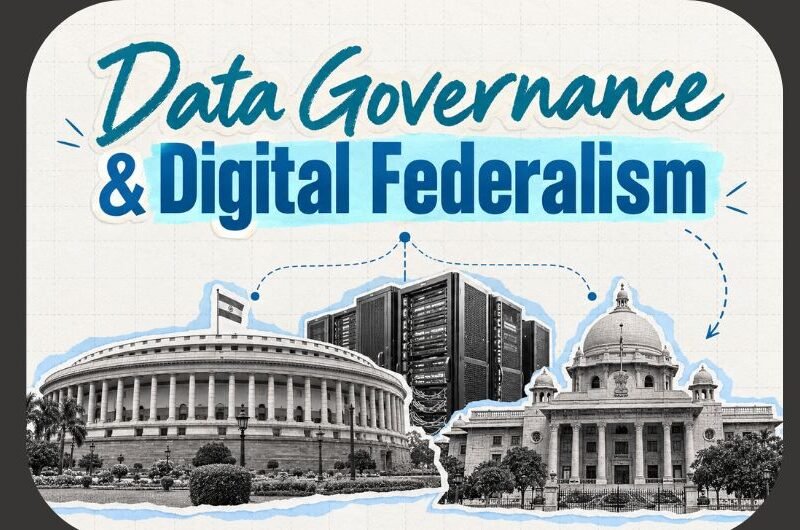
Data Governance & Digital Federalism
Data Governance and Digital Federalism represent a critical intersection in India’s constitutional and administrative framework, directly influencing
Centre-State relations, legislative competence, and the distribution of authority in the digital age.
The growing integration of digital infrastructure into public administration has introduced new dimensions to federal governance, particularly concerning data ownership, institutional autonomy, regulatory jurisdiction, and technological centralization.
1. The Intersection: Data Governance and Traditional Federalism
The following table outlines the core tension between centralized technological structures and decentralized constitutional powers.
| Dimension | Traditional Constitutional Federalism | Emerging Digital Federalism / “Surveillance Federalism” |
|---|---|---|
| Jurisdiction & Limits | Territorially defined boundaries; strict division of power via the Seventh Schedule through the Union, State and Concurrent Lists. | Borderless architectures operating on networked and centralized databases that transcend State boundaries. |
| Locus of Authority | Exercised through formal legislative law passed by Parliament or State Assemblies. | Exercised through infrastructural control, digital platforms, algorithms, and technical engineering. |
| Execution Mode | Decentralized implementation across distinct State administrative machineries. | Centralized stacks such as India Stack, Aadhaar and unified portals can create a parallel channel of administrative authority. |
2. Key Dimensions of Digital Federalism in India
2.1 Centralization vs. State Autonomy
Platform Imperialism:
Centralized national platforms like Aadhaar, UPI, and PM-Kisan dictate the architectural frameworks within which States must deliver public services. This reduces the flexibility of individual States to customize welfare delivery according to local demographies.
Asymmetric Data Control:
While States are primary collectors of ground-level data relating to health, agriculture and land records, processing infrastructure, analytical tools and regulatory frameworks are increasingly concentrated at the Central level, including through the proposed India Data Management Office (IDMO).
2.2 Cooperative Fiscal & Data Federalism
Evidence-Based Policy:
Platforms like the NITI-NCAER States Economic Forum Portal bridge regional disparities by integrating State macroeconomic, human development and financial data.
Interoperability:
Initiatives such as the National Data and Analytics Platform (NDAP) by NITI Aayog standardise data across governance tiers to streamline fiscal planning, policy coordination and devolution-related analysis.
2.3 Legislative Friction over Data Protection
Overlapping Jurisdictions:
Cyber security and personal data regulation under the Digital Personal Data Protection Act, 2023 are heavily directed by Central regulatory mechanisms such as the Data Protection Board. State administrative departments may be subject to uniform compliance requirements, creating friction regarding local administrative and legislative autonomy.
3. Major Challenges in India’s Digital Federal Landscape
As of late 2024, TRAI highlighted a severe urban-rural teledensity gap of
132.94% in urban areas versus 59.05% in rural areas.
Centralized mandatory digital portals risk marginalizing rural populations in States with lower digital literacy.
Centralized identities allow the federal government to monitor State welfare distribution directly. This can shift power dynamics by enabling the Centre to use mechanisms such as Direct Benefit Transfers to bypass traditional State-level political and administrative channels.
Architectures such as the National Data Governance Framework Policy primarily focus on Central line ministries, leaving State-level departments with limited institutional participation in decisions concerning sharing, governance or monetisation of Non-Personal Data.
4. Way Forward: Strengthening Digital Constitutionalism
To foster a balanced and democratic digital ecosystem, India must transition towards
Digital Constitutionalism.
Formalize clear parameters ensuring data sovereignty for State Governments, mirroring the spirit of the Puttaswamy judgment on privacy.
Include State representation within governance bodies of the India Data Management Office to allow regional input on national data standards.
Expand rural connectivity through BharatNet Phase-II and PMGDISHA to equalize State capacities to participate effectively in the digital economy.
Establish multi-tier grievance-redressal systems where automated decisions such as welfare exclusion can be challenged at local Panchayat or State levels, protecting citizens from rigid centralized algorithms.
Must Know Terms
1. Digital Federalism
The distribution of digital governance responsibilities, data control, and technological authority between the Union and State Governments.
2. Data Sovereignty
The authority to regulate, manage, protect, and determine the use of data within an established legal and institutional framework.
3. Platform Centralization
The concentration of digital infrastructure, administrative control, and technological decision-making within centralized national platforms such as Aadhaar and India Stack.
4. Data Interoperability
The ability of different government databases, digital platforms, and administrative systems to securely exchange and utilise information through common standards.
5. Surveillance Federalism
A concept describing how centralized digital identity systems, databases, and monitoring mechanisms may alter the balance of power between the Centre and States.
6. Digital Constitutionalism
The application of constitutional principles, fundamental rights, accountability, privacy, and federal balance to digital technologies and governance systems.
Multiple-Choice Questions
1. With reference to Digital Federalism in India, consider the following statements:
Which of the statements given above are correct?
2. Consider the following pairs:
How many of the above pairs are correctly matched?
3. With reference to centralized digital governance platforms, consider the following statements:
Which of the statements given above are correct?
4. With reference to Asymmetric Data Control in Indian federalism, consider the following statements:
Which of the statements given above are correct?
5. Consider the following pairs:
How many of the above pairs are correctly matched?
6. With reference to the Digital Personal Data Protection (DPDP) Act, 2023, consider the following statements:
Which of the statements given above are correct?
7. Consider the following statements regarding Data Interoperability:
Which of the statements given above are correct?
8. With reference to the digital infrastructure divide, consider the following statements:
Which of the statements given above are correct?
9. With reference to Surveillance Federalism, consider the following statements:
Which of the statements given above are correct?
10. Consider the following statements:
Statement-I:
Centralized digital infrastructure may influence Centre-State relations even when the formal constitutional division of legislative powers remains unchanged.
Statement-II:
Administrative authority in digital governance may be exercised through technological architecture, data standards and control over digital platforms.
Which one of the following is correct?
11. With reference to Digital Constitutionalism, consider the following statements:
Which of the statements given above are correct?
12. Consider the following pairs:
How many of the above pairs are correctly matched?
13. With reference to Cooperative Data Federalism, consider the following statements:
Which of the statements given above are correct?
14. Consider the following statements regarding Algorithmic Accountability:
Which of the statements given above are correct?
15. With reference to strengthening Digital Federalism in India, consider the following measures:
Which of the above measures are consistent with cooperative and constitutionally accountable digital governance?




0 comment