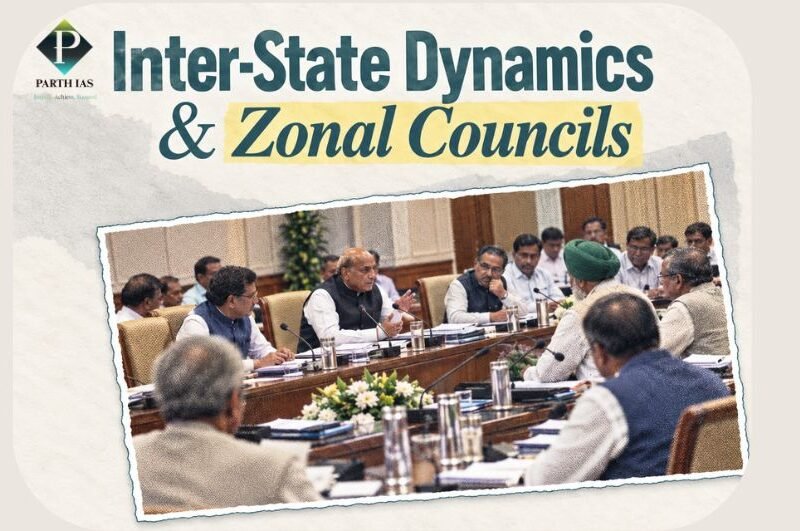
Inter-State Dynamics & Zonal Councils
Inter-State relations and Zonal Councils are important mechanisms of
cooperative federalism in India.
They facilitate coordination between the Centre and States, encourage cooperation among neighbouring States, and provide institutional platforms for addressing disputes and promoting balanced regional development.
The Constitution and parliamentary legislation establish different mechanisms for resolving inter-State issues, coordinating administrative policies and strengthening national integration. Among these, the
Inter-State Council and Zonal Councils
play an important role in maintaining cooperation within India’s federal structure.
1. Constitutional and Institutional Framework
The Constitution and parliamentary statutes provide mechanisms for cooperation, coordination and dispute resolution between the Centre and States and among States.
| Mechanism | Constitutional Provision / Legislation | Purpose and Nature |
|---|---|---|
| Inter-State Council (ISC) | Article 263 of the Constitution | A constitutionally envisaged advisory institution for discussing matters of common interest, examining inter-State issues and coordinating government policies. |
| Zonal Councils | Part III of the States Reorganisation Act, 1956 | Statutory bodies established to promote regional cooperation, reduce regionalism and linguistic tensions, and strengthen national integration. |
| North-Eastern Council (NEC) | North-Eastern Council Act, 1971 | A separate statutory institution addressing developmental, economic and security-related requirements of the North-Eastern States. |
| Inter-State Water Disputes | Article 262 and the Inter-State River Water Disputes Act, 1956 | Provides a mechanism for adjudicating disputes concerning waters of inter-State rivers and river valleys through specially constituted tribunals. The law provides for binding decisions and exclusion of court jurisdiction in specified matters. |
| Full Faith and Credit | Article 261 of the Constitution | Requires recognition throughout India of the public acts, records and judicial proceedings of the Union and every State. |
2. Inter-State Council and Zonal Councils
The Inter-State Council and Zonal Councils differ in their legal basis, composition, territorial scope and functions.
| Feature | Inter-State Council (ISC) | Zonal Councils |
|---|---|---|
| Origin and Legal Status | Established by a Presidential Order in 1990 under Article 263, following recommendations of the Sarkaria Commission. | Established under the States Reorganisation Act, 1956 as statutory institutions. |
| Chairperson | Prime Minister of India. | Union Home Minister, who serves as the ex-officio Chairperson of all five Zonal Councils. |
| Vice-Chairperson | No permanent rotational Vice-Chairperson. Its Standing Committee is chaired by the Union Home Minister. | Chief Ministers of member States serve as Vice-Chairperson by rotation for one year. |
| Composition | Prime Minister, Chief Ministers of all States and Union Territories having Legislative Assemblies, Administrators of Union Territories without Legislative Assemblies, and six Union Cabinet Ministers nominated by the Prime Minister. | Union Home Minister, Chief Ministers of member States, two other Ministers from each member State, and Administrators of member Union Territories. |
| Advisory Support | Supported by the Inter-State Council Secretariat, established in 1991, and its Standing Committee. | Assisted by advisers including a nominee from NITI Aayog, Chief Secretaries and Development Commissioners of member States. These advisers do not have voting rights. |
| Major Functions | Coordination of national policies, examination of Centre-State and inter-State issues, and discussion of matters of common interest. | Regional development, economic planning, border disputes, linguistic minorities, internal security and cooperation among neighbouring States. |
| Nature of Recommendations | Advisory and non-binding. | Recommendatory and non-binding. |
3. Five Zonal Councils of India
India has five Zonal Councils constituted under the States Reorganisation Act, 1956. These councils function under the administrative oversight of the Ministry of Home Affairs.
The Union Home Minister serves as the ex-officio Chairperson of all five councils.
| Zonal Council | Member States and Union Territories |
|---|---|
| Northern Zonal Council | Haryana, Himachal Pradesh, Punjab, Rajasthan, Jammu and Kashmir, Ladakh, Delhi and Chandigarh. |
| Central Zonal Council | Chhattisgarh, Uttarakhand, Uttar Pradesh and Madhya Pradesh. |
| Eastern Zonal Council | Bihar, Jharkhand, Odisha and West Bengal. |
| Western Zonal Council | Goa, Gujarat, Maharashtra, and Dadra and Nagar Haveli and Daman and Diu. |
| Southern Zonal Council | Andhra Pradesh, Telangana, Karnataka, Kerala, Tamil Nadu and Puducherry. |
North-Eastern Council
The eight North-Eastern States are covered by the
North-Eastern Council Act, 1971,
rather than the ordinary five-Zonal-Council framework.
2. Arunachal Pradesh
3. Manipur
4. Meghalaya
5. Mizoram
6. Nagaland
7. Tripura
8. Sikkim
The North-Eastern Council addresses the region’s development requirements and facilitates cooperation in infrastructure, economic development, connectivity and security.
4. Challenges in Inter-State Coordination
Despite their institutional importance, the Inter-State Council and Zonal Councils face several challenges that limit their effectiveness.
5. Institutional Reforms and Commission Recommendations
Strengthening inter-State institutions requires regular consultations, administrative independence and effective implementation of recommendations.
1. Sarkaria Commission (1988)
The Sarkaria Commission emphasised strengthening the Inter-State Council as an active institution for Centre-State cooperation.
2. Punchhi Commission (2010)
The Punchhi Commission recommended strengthening the institutional functioning of the Inter-State Council.
3. Digital Monitoring and Administrative Coordination
Technology-based monitoring can improve efficiency and effectiveness of inter-State institutions.
Must Know Terms
1. Cooperative Federalism
A system of governance in which the Union and State Governments cooperate in policy formulation, administration and development. It promotes consultation, coordination and collective decision-making while respecting the constitutional distribution of powers.
2. Inter-State Council (ISC)
A constitutional mechanism established under Article 263 through a Presidential Order in 1990, following recommendations of the Sarkaria Commission. Chaired by the Prime Minister, it facilitates Centre-State and inter-State coordination, examines matters of common interest and makes advisory, non-binding recommendations.
3. Zonal Councils
Five statutory bodies established under the States Reorganisation Act, 1956, to promote regional cooperation, national integration and balanced development. Chaired by the Union Home Minister, they address issues such as inter-State border disputes, linguistic minorities, regional planning and internal security.
4. North-Eastern Council (NEC)
A statutory body established under the North-Eastern Council Act, 1971, covering eight North-Eastern States. It facilitates regional cooperation and coordinated development in infrastructure, connectivity, economic growth and security-related matters.
5. Inter-State Water Disputes
Disputes concerning the use, distribution or control of waters of inter-State rivers and river valleys. Article 262 and the Inter-State River Water Disputes Act, 1956, provide a mechanism for adjudication through specially constituted tribunals, with binding decisions and statutory restrictions on court jurisdiction in specified matters.
6. Full Faith and Credit — Article 261
A constitutional principle requiring public acts, records and judicial proceedings of the Union and every State to be recognised throughout India. It promotes legal uniformity, mutual recognition and administrative cooperation within India’s federal system.
Multiple-Choice Questions
1. With reference to the constitutional and statutory framework of inter-State relations in India, consider the following statements:
Which of the statements given above are correct?
2. Match List I with List II:
Select the correct answer using the code given below:
3. With reference to the Inter-State Council (ISC), consider the following statements:
Which of the statements given above are correct?
4. Consider the following Assertion (A) and Reason (R):
Assertion (A):
Zonal Councils cannot directly enforce their recommendations upon member States as legally binding decisions.
Reason (R):
Zonal Councils are statutory consultative bodies established under the States Reorganisation Act, 1956, primarily to promote regional cooperation and coordination.
Select the correct answer:
5. Consider the following pairs:
Which of the pairs given above are correctly matched?
6. Match List I with List II:
Select the correct answer using the code given below:
7. With reference to the composition and functioning of Zonal Councils, consider the following statements:
Which of the statements given above are correct?
8. With reference to the North-Eastern Council (NEC), consider the following statements:
Which of the statements given above are correct?
9. Consider the following Assertion (A) and Reason (R):
Assertion (A):
Complex inter-State disagreements may remain unresolved despite repeated consultations within institutions such as Zonal Councils.
Reason (R):
Recommendations of Zonal Councils are non-binding, and their implementation depends substantially on cooperation between the Union Government and the concerned State Governments.
Select the correct answer:
10. Consider the following statements regarding the Inter-State Council and Zonal Councils:
How many of the above statements are correct?
11. With reference to inter-State water disputes and the principle of Full Faith and Credit, consider the following statements:
Which of the statements given above are correct?
12. With reference to the recommendations of the Sarkaria Commission and Punchhi Commission, consider the following statements:
Which of the statements given above are correct?
13. Match List I with List II:
Select the correct answer using the code given below:
14. Consider the following statements regarding the territorial composition of regional councils:
Which of the statements given above are correct?
15. Consider the following measures for strengthening the functioning of inter-State institutions:
Which of the above measures are consistent with the proposed institutional reforms?




0 comment