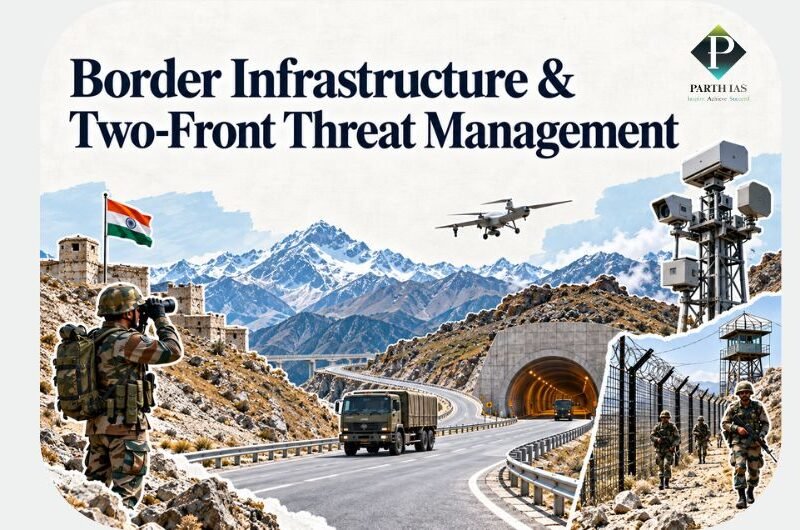
Border Infrastructure & Two-Front Threat Management
India’s border management and two-front threat strategy involves upgrading physical and technological infrastructure along the
Line of Control (LoC) with Pakistan and the
Line of Actual Control (LAC) with China,
supported by a ₹13,020 crore Central Sector Umbrella Scheme for 2021–26 under the Ministry of Home Affairs.
1. Key Dimensions of Border Infrastructure
Physical Connectivity and Hardening:
The Border Roads Organisation (BRO) has accelerated the development of strategic roads, tunnels, bridges and all-weather connectivity in border areas.
The LAC road network has expanded significantly, while projects such as the Zoji La Tunnel are intended to improve year-round military mobility and logistics.
Technological Surveillance:
The Comprehensive Integrated Border Management System (CIBMS) and BOLD-QIT use technologies such as thermal imagers,
laser walls, seismic sensors and radar systems for continuous surveillance of difficult border stretches, including riverine and high-altitude areas.
Border Development Programmes:
Focuses on the development of border villages in the northern sector, improving infrastructure, livelihoods and basic services while reducing out-migration.
Supports balanced development and infrastructure creation in remote border regions.
Facilitate trade, immigration, customs clearance and movement across designated international border points such as Attari.
2. Two-Front Threat Management
Conventional and Grey-Zone Threats:
India faces military pressure along the LAC with China and infiltration, terrorism, drone-based smuggling and cross-border threats along the LoC and International Border with Pakistan.
These challenges increasingly include cyber intrusions, disinformation and other grey-zone methods.
One-Border-One-Force Principle:
| Force | Primary Border Responsibility |
|---|---|
| BSF | India-Pakistan and India-Bangladesh borders |
| ITBP | India-China border |
| SSB | India-Nepal and India-Bhutan borders |
| Assam Rifles | India-Myanmar border |
Theaterisation and Jointness:
Greater integration among the Army, Navy and Air Force is being pursued to improve joint planning, resource utilisation and operational coordination across different theatres.
3. Major Challenges
Long stretches of the LAC remain undemarcated, while open and socially connected borders with countries such as Nepal create additional monitoring challenges.
Extreme Himalayan, desert and riverine conditions affect surveillance equipment and increase maintenance requirements.
Effective border management requires real-time coordination among intelligence agencies, Central Armed Police Forces, the Armed Forces and State Police.
Remote border areas continue to face limitations in roads, communication networks, logistics facilities and last-mile connectivity.
Drones, cyber operations, information warfare, cross-border smuggling and hybrid tactics are adding new dimensions to traditional border security.
Must Know Terms
1. CIBMS
Comprehensive Integrated Border Management System.
It integrates thermal imagers, radar, laser walls, seismic sensors and other surveillance technologies for 24×7 border monitoring.
2. Vibrant Villages Programme (VVP)
A programme focused on infrastructure, connectivity, livelihoods and basic services in northern border villages. It also aims to reduce out-migration from border areas.
3. One-Border-One-Force
An approach in which specific border guarding forces are assigned responsibility for particular international borders:
4. Two-Front Threat
The strategic challenge of simultaneously dealing with military pressure along the LAC with China and infiltration, terrorism and drone-based threats along the LoC and International Border with Pakistan.
5. Grey-Zone Warfare
Hostile activities carried out below the threshold of conventional war, including cyber attacks, disinformation, drone infiltration, economic coercion and proxy activities.
6. Theaterisation
The integration of Army, Navy and Air Force capabilities under unified commands to improve joint planning, operational coordination and utilisation of resources.
Multiple-Choice Questions
1. With reference to India’s border infrastructure, consider the following statements:
Which of the statements given above is/are correct?
2. Consider the following pairs:
How many of the above pairs are correctly matched?
3. Which of the following technologies are mentioned as components of technological border surveillance?
Select the correct answer using the code given below:
4. With reference to the Vibrant Villages Programme (VVP), consider the following statements:
Which of the statements given above are correct?
5. Which one of the following correctly describes the Border Area Development Programme (BADP)?
6. Consider the following matching:
Which of the above are correctly matched?
7. The term “Two-Front Threat” in the given context refers to:
8. Which of the following are examples of Grey-Zone Warfare mentioned in the context?
Select the correct answer using the code given below:
9. Consider the following statements regarding the One-Border-One-Force principle:
Which of the statements given above are correct?
10. What is the primary objective of Theaterisation as described in the passage?
11. Consider the following statements:
Which of the statements given above is/are correct?
12. Consider the following:
Assertion (A):
Harsh Himalayan, desert and riverine conditions create technological and maintenance challenges for border surveillance.
Reason (R):
Such conditions can affect surveillance equipment and increase maintenance requirements.
Select the correct answer using the code given below:
13. Which of the following best explains the role of Integrated Check Posts (ICPs)?
14. Consider the following statements regarding India’s border management challenges:
Which of the statements given above are correct?
15. Which of the following best captures the overall approach described in India’s border management strategy?




0 comment