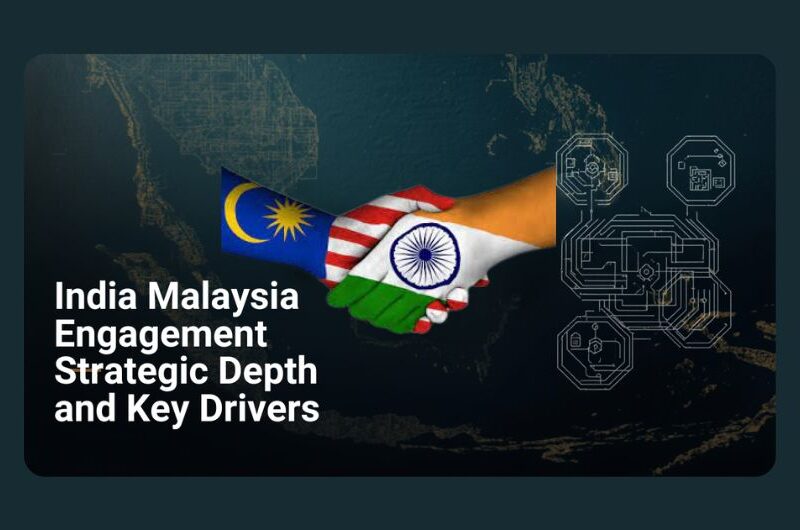
India Malaysia Engagement Strategic Depth and Key Drivers
1. On 8 February 2026, Prime Minister Narendra Modi completed a two-day official Malaysia visit, closely reinforcing the Comprehensive Strategic Partnership formed in 2024 with Prime Minister Anwar Ibrahim.
2. India frames Malaysia ties through Act East Policy, Indo-Pacific Vision, and MAHASAGAR Vision (Mutual and Holistic Advancement for Security and Growth Across Regions), highlighting maritime neighbour synergy overall.
3. India–Malaysia relations were upgraded to Enhanced Strategic Partnership in 2015, while diplomatic relations formally began in 1957 after Malayan independence on 31 August 1957, showing long continuity early.
4. Modi received ceremonial welcome and guard of honour at Perdana Putra, Putrajaya; Anwar Ibrahim welcomed him at Kuala Lumpur airport, clearly signalling strong personal chemistry, trust, and diplomacy.
5. Leaders reviewed cooperation on trade, investment, defence, security, and digital technology across key sectors; an Audio-Visual Co-production Agreement was officially signed to promote joint film and media production.
6. Memorandums of Understanding (MoUs) on disaster preparedness and other cultural-commercial areas were discussed; Malaysia formally pledged support for India’s bid in a reformed United Nations Security Council explicitly.
7. Both sides see scope in counter-terrorism, intelligence sharing, and maritime security, with India reaffirming commitment to regional peace, security, stability, and coordinated Indo-Pacific engagement initiatives bilaterally, mutual convergence.
8. India supports ASEAN Centrality and seeks synergy between AOIP (ASEAN Outlook on the Indo-Pacific, 2019) and IPOI (Indo-Pacific Oceans Initiative, 2019) for rules-based cooperation, capacity-building, connectivity, and stability.
9. MAHASAGAR (Mutual and Holistic Advancement for Security and Growth Across Regions) is described as an Indian Navy-led capacity initiative for Indian Ocean littorals; Malaysia partnership further strengthens it.
10. Malaysia’s position on the Strait of Malacca makes it pivotal; about 40% of global trade transits this chokepoint linking Indian Ocean-Andaman Sea to Pacific-South China Sea routes daily.
11. China’s dependence is high: around 80% of its trade and oil imports pass Malacca; vulnerability was termed the “Malacca Dilemma” in 2003, shaping major strategic competition regional planning.
12. Both reaffirmed rules-based maritime order and adherence to UNCLOS (United Nations Convention on the Law of the Sea) 1982, emphasising freedom of navigation, overflight, and international law commitments.
13. Trade architecture includes CECA (Comprehensive Economic Cooperation Agreement) signed 2011; Malaysia supports AITIGA (ASEAN-India Trade in Goods Agreement) review due to India’s widening deficit and persistent non-tariff barriers.
14. Semiconductor cooperation is key: Malaysia ranks sixth globally in semiconductor exports; a framework pact aims to link India’s chip design strengths with Malaysia’s assembly, testing, packaging ecosystem capabilities.
15. India Semiconductor Mission 2.0 launched February 2026 targets 70–75% domestic demand by 2029, advanced 2-nanometre and 3-nanometre nodes, ₹1,000 crore budget, and $100 billion projected market by 2030.
Must Know Terms :
1. Putrajaya: Putrajaya is Malaysia’s planned federal administrative capital, located south of Kuala Lumpur. Key government complexes, including Perdana Putra, the Prime Minister’s Office, are based here. During PM Modi’s February 2026 visit, the ceremonial welcome and guard of honour took place at Perdana Putra in Putrajaya, and the main bilateral meeting with PM Anwar Ibrahim was held there.
2. MAHASAGAR: MAHASAGAR stands for Mutual and Holistic Advancement for Security and Growth Across Regions. It is presented as an Indian Navy-led security initiative focused on harmonising capacity among Indian Ocean Rim littoral states. In the Malaysia context, it is aligned with AOIP and IPOI, while Malaysia’s partnership adds synergy for maritime security cooperation and regional stability.
3. AOIP: AOIP means ASEAN Outlook on the Indo-Pacific, adopted by ASEAN in 2019. It is framed as a regional cooperation guide that stresses a rules-based order and strengthens ASEAN Centrality. India seeks closer alignment between AOIP and IPOI, linking shared priorities such as peace, stability, maritime cooperation, connectivity, and practical collaboration across Indo-Pacific stakeholders.
4. IPOI: IPOI is the Indo-Pacific Oceans Initiative, launched by PM Modi in 2019 at the East Asia Summit. It supports a rules-based architecture and focuses on maritime security, trade, disaster management, and capacity-building. In India–Malaysia engagement, IPOI serves as a bridge to work with ASEAN’s AOIP, reinforcing coordinated approaches to regional stability and maritime cooperation.
5. AITIGA: AITIGA is the ASEAN-India Trade in Goods Agreement, signed in 2009 and in force since 2010. India is pushing a review because its trade deficit with ASEAN widened, and issues exist on non-tariff barriers and rules-of-origin transparency. Malaysia supports the review, aiming to update AITIGA for modern trade practices, complementing India–Malaysia CECA signed in 2011.
6. Chokepoint: A chokepoint is a narrow strategic passage where trade concentrates. The Strait of Malacca is a decisive chokepoint, with about 40% of global trade transiting it, linking the Indian Ocean via the Andaman Sea to the Pacific via the South China Sea. Around 80% of China’s trade and oil imports pass here; this vulnerability was termed the Malacca Dilemma in 2003.
MCQ
1. The official visit of Prime Minister Narendra Modi to Malaysia in February 2026 primarily reinforced which bilateral framework established in 2024?
A. Strategic Defence Alliance
B. Comprehensive Strategic Partnership
C. Economic Security Treaty
D. Indo-Pacific Military Pact
2. India frames its relations with Malaysia through which combination of policy visions?
A. Neighbourhood First Policy and SAARC Charter
B. Act East Policy, Indo-Pacific Vision and MAHASAGAR Vision
C. Look West Policy and Gulf Strategy
D. Indo-Pacific Economic Framework and Quad Charter
3. Diplomatic relations between India and Malaysia formally began in which year?
A. 1947
B. 1950
C. 1957
D. 1962
4. India–Malaysia relations were upgraded to Enhanced Strategic Partnership in:
A. 2005
B. 2010
C. 2015
D. 2020
5. Perdana Putra, the venue of the ceremonial welcome during the visit, is located in:
A. Kuala Lumpur
B. Johor Bahru
C. Putrajaya
D. Penang
6. Which agreement was signed to encourage collaboration in film and media production?
A. Cultural Exchange Protocol
B. Audio-Visual Co-production Agreement
C. Creative Media Partnership Treaty
D. ASEAN Cultural Integration Agreement
7. Which international reform initiative received Malaysia’s support during the discussions?
A. India’s bid for BRICS expansion
B. India’s candidature for WTO leadership
C. India’s bid for a reformed United Nations Security Council
D. India’s entry into CPTPP
8. AOIP adopted by ASEAN in 2019 stands for:
A. ASEAN Outlook on International Partnership
B. ASEAN Oceanic Investment Plan
C. ASEAN Outlook on the Indo-Pacific
D. ASEAN Indo-Pacific Initiative Programme
9. IPOI launched in 2019 refers to:
A. Indo-Pacific Oceans Initiative
B. International Pacific Ocean Integration
C. Indo-Pacific Investment Organisation
D. Indian Port Operations Initiative
10. The strategic maritime chokepoint linking the Indian Ocean with the Pacific Ocean is:
A. Strait of Gibraltar
B. Strait of Malacca
C. Bab-el-Mandeb Strait
D. Panama Canal
11. Approximately what share of global trade transits through the Strait of Malacca?
A. 20%
B. 30%
C. 40%
D. 60%
12. The term “Malacca Dilemma” refers to concerns associated with:
A. India’s naval blockade strategy
B. ASEAN trade disputes
C. China’s heavy dependence on Malacca route for trade and energy
D. Indonesia–Malaysia maritime dispute
13. CECA between India and Malaysia was signed in:
A. 2009
B. 2011
C. 2014
D. 2018
14. Malaysia holds which approximate global position in semiconductor exports?
A. Third
B. Fourth
C. Sixth
D. Tenth
15. India Semiconductor Mission 2.0 launched in February 2026 aims to achieve what level of domestic semiconductor demand fulfilment by 2029?
A. 30–35%
B. 50–55%
C. 70–75%
D. 90–95%



0 comment