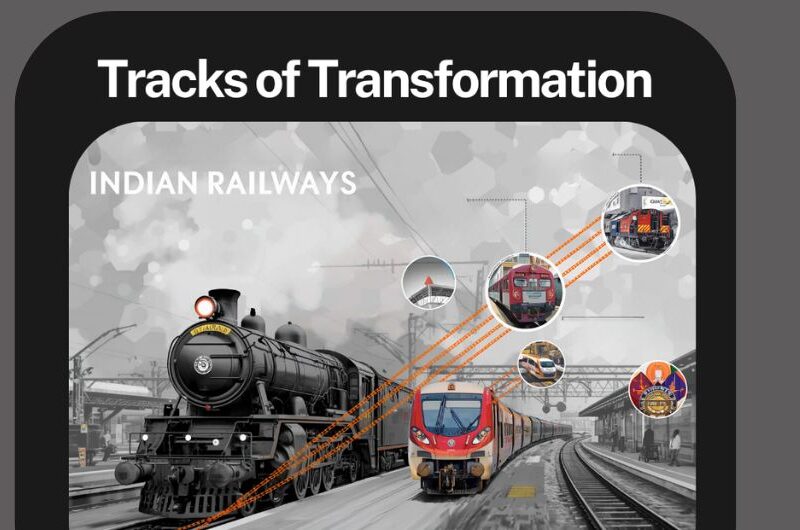
Tracks of Transformation
1. India’s first passenger train ran on 16 April 1853 between Bombay and Thane, covering about 34 to 35 kilometres, with 14 carriages, around 400 passengers, and locomotive Falkland.
2. By 1880, the railway system had expanded to about 9,000 miles, nearly 14,500 kilometres, showing rapid network growth during the steam era across much of India by then.
3. Indian Railways used four gauges: broad gauge 1.6 metre, metre gauge 1 metre, narrow gauge 0.76 and 0.6 metre, and standard gauge 1.43 metre for different operational conditions.
4. In 1871, metre gauge was adopted as India’s second standard gauge, while narrower gauges were used to develop poorer areas and bring merchandise to main lines more cheaply.
5. The Darjeeling Himalayan Railway opened in 1881, linking plains in West Bengal with Darjeeling and demonstrating innovative railway engineering for mountain transport and improved hill connectivity in India.
6. In 1895, India produced its first steam locomotive at Ajmer Workshop of the Rajputana Malwa Railway, marking an important advance in indigenous railway engineering capability and maintenance capacity.
7. India’s first electric train ran in 1925 between Bombay Victoria Terminus and Kurla Harbour, beginning the shift from steam toward faster, cleaner, and more efficient traction in operations.
8. After Independence, 42 railway systems, including princely state networks, were combined into Indian Railways, and in 1952 the network was reorganized into six administrative zones for better management.
9. Steam locomotives were gradually phased out by 1985, as Indian Railways shifted increasingly to diesel and electric traction, marking a major modernization stage in operations across the network.
10. As of March 2026, 69,873 route kilometres out of 70,142 broad gauge route kilometres were electrified, taking electrification to 99.6 percent of the network at the national level.
11. Railway electrification saved about 180 crore litres of diesel during FY 2024-25, reduced crude oil imports, and generated savings of about 6,000 crore rupees overall for Indian Railways.
12. Between 2014 and 2026, 54,600 kilometres of railway track were renewed, while track fit for speeds of 110 kmph and above exceeded 85,000 kilometres across the national network.
13. Launched in February 2019, Vande Bharat Express carried about 3.98 crore passengers in FY 2025-26, and more than 9.1 crore passengers since inception through one lakh trips.
14. In FY 2025-26, Indian Railways transported about 741 crore passengers, earned around 80,000 crore rupees, and moved a record 1,670 million tonnes of freight during the year.
15. Indian Railways commissioned Kavach over 3,100 route kilometres and began work on another 24,400 kilometres, while about 25,000 trains operated daily during 2025 and 2026 across the network.
Must Know Terms :
1. Electrification
Indian Railways achieved 99.6 percent electrification of its broad gauge network by March 2026. Out of 70,142 broad gauge route kilometres, 69,873 route kilometres were electrified. This transition reduced dependence on diesel traction, improved operational efficiency, and lowered energy costs. Electrification saved about 180 crore litres of diesel in 2024-25 and generated savings of nearly ₹6,000 crore overall nationwide.
2. Kavach
Kavach is India’s indigenous Automatic Train Protection system designed to prevent collisions and improve operational safety on railway routes. By March 2026, it had been commissioned over more than 3,100 route kilometres, while implementation was underway on an additional 24,400 kilometres. It represents a major railway safety upgrade, supporting controlled train movement, signalling protection, and safer high-density operations nationwide.
3. VandeBharat
Vande Bharat Express is India’s first indigenously designed and manufactured semi-high-speed train, launched in February 2019 under the Make in India initiative. It reflects modern rail travel with improved comfort, speed, and onboard technology. In FY 2025-26, about 3.98 crore passengers travelled on this network. Since introduction, it has carried over 9.1 crore passengers through one lakh trips.
4. Gauges
Gauge means the clear minimum distance between the running faces of two rails. Indian Railways used four gauge categories: broad gauge at 1.6 metre, metre gauge at 1 metre, narrow gauge at 0.76 metre and 0.6 metre, and standard gauge at 1.43 metre. Different gauges helped railway expansion across diverse terrains, economic conditions, and regional transport requirements in India.
5. Falkland
Falkland was the steam locomotive that hauled India’s first passenger train on 16 April 1853. The inaugural service ran between Bombay and Thane, covering about 34 to 35 kilometres. The train had 14 passenger carriages and carried around 400 passengers. Its journey marked the formal beginning of railway transport in India and opened a new phase of national connectivity.
6. MAHSR
MAHSR stands for Mumbai-Ahmedabad High-Speed Rail Corridor, India’s first concrete high-speed rail project. The corridor covers about 508 kilometres and has been designed for maximum operations at 320 kilometres per hour. It represents India’s entry into high-speed passenger rail infrastructure. The project forms part of a larger vision involving seven announced high-speed corridors spanning nearly 4,000 kilometres.
Key Takeaways
a) Railways in India began with the first passenger train running between Bombay and Thane on 16th April, 1853.
b) Evolving from early steam locomotives, railways have now achieved 99.6% electrification of the broad gauge network as of March 2026.
c) The network now operates about 25,000 trains daily, ensuring reliable connectivity across the country.
d) From carrying a few hundred passengers in its early years, Indian Railways transported around 741 crore passengers in 2025–26.
e) Kavach commissioned over 3,100 route kilometres, with implementation underway on an additional 24,400 kilometres.
MCQ :
1. With reference to the beginning of railway transport in India, consider the following statements:
1. The first passenger train in India ran in April 1853.
2. It operated between Bombay and Thane.
3. It was hauled by a locomotive named Falkland.
How many of the above statements are correct?
A. Only one
B. Only two
C. All three
D. None
2. Which of the following correctly describes the inaugural passenger train service in India?
A. It covered nearly 50 kilometres with 10 carriages
B. It carried around 400 passengers in 14 carriages
C. It ran between Bombay and Pune under GIPR
D. It was hauled by India’s first indigenous steam locomotive
3. By 1880, the railway system in India had expanded to approximately:
A. 9,000 miles
B. 6,000 miles
C. 12,000 miles
D. 15,000 miles
4. Consider the following pairs:
1. Broad Gauge — 1.6 metre
2. Metre Gauge — 1 metre
3. Standard Gauge — 1.43 metre
4. Narrow Gauge — 0.9 metre
How many pairs given above are correctly matched?
A. Only one
B. Only two
C. Only three
D. All four
5. In the historical development of Indian Railways, metre gauge was officially adopted as the second standard gauge in:
A. 1853
B. 1871
C. 1881
D. 1895
6. Why were gauges narrower than metre gauge used in many parts of India during the steam era?
A. To support only military transport in frontier regions
B. To replace broad gauge lines in major commercial centres
C. To develop poorer areas and connect merchandise to main lines
D. To ensure higher speeds than broad gauge lines
7. The Darjeeling Himalayan Railway, opened in 1881, is significant mainly because it:
A. Marked the first electrified hill railway in India
B. Linked Bombay with the Himalayan foothills
C. Demonstrated innovative railway engineering in mountain terrain
D. Became the first standard gauge railway in eastern India
8. India’s first steam locomotive built within the country was produced in:
A. Chittaranjan Workshop in 1881
B. Ajmer Workshop in 1895
C. Perambur Workshop in 1925
D. Jamalpur Workshop in 1871
9. Consider the following statements:
1. India’s first electric train ran in 1925.
2. It operated between Bombay Victoria Terminus and Kurla Harbour.
3. It marked the beginning of railway electrification in India.
Which of the statements given above are correct?
A. 1 and 2 only
B. 2 and 3 only
C. 1 and 3 only
D. 1, 2 and 3
10. After Independence, Indian Railways was formed by combining:
A. 28 railway systems
B. 42 railway systems
C. 52 railway systems
D. 62 railway systems
11. The reorganization of Indian Railways into six administrative zones took place in:
A. 1947
B. 1950
C. 1952
D. 1985
12. As of March 2026, electrification of the broad gauge railway network in India stood at:
A. 82.0 percent
B. 95.4 percent
C. 99.6 percent
D. 100 percent
13. Which one of the following is correct regarding the impact of railway electrification in India?
A. It increased diesel use but reduced track renewal costs
B. It saved about 180 crore litres of diesel in 2024-25
C. It eliminated the need for all imported energy sources
D. It reduced the broad gauge network length below 70,000 kilometres
14. With reference to Vande Bharat Express, consider the following statements:
1. It was launched in February 2019.
2. It is India’s first indigenously designed and manufactured semi-high-speed train.
3. In FY 2025-26, it carried about 3.98 crore passengers.
How many of the above statements are correct?
A. Only one
B. Only two
C. All three
D. None
15. Which of the following correctly reflects recent railway safety and operations data?
A. Kavach was commissioned on over 3,100 route kilometres and about 25,000 trains operated daily
B. Kavach covered 24,400 commissioned route kilometres and 10,000 trains operated daily
C. Kavach replaced all signalling systems and 3,100 trains operated daily
D. Kavach was limited to freight corridors and daily operations remained below 15,000 trains




0 comment