India’s Expanding Drone Ecosystem
1. As of February 2026, India’s regulated drone ecosystem included over 38,500 registered drones, 39,890 DGCA certified remote pilots, and 244 approved Remote Pilot Training Organisations across India currently.
2. Under the SVAMITVA scheme, nearly 3.44 lakh villages were targeted, and drone surveys were completed in 3.28 lakh villages by December 2025, covering about 95 percent overall target.
3. By December 2025, 2.76 crore property cards had been prepared for 1.82 lakh villages under SVAMITVA, while 31 States and Union Territories had signed Memorandums of Understanding.
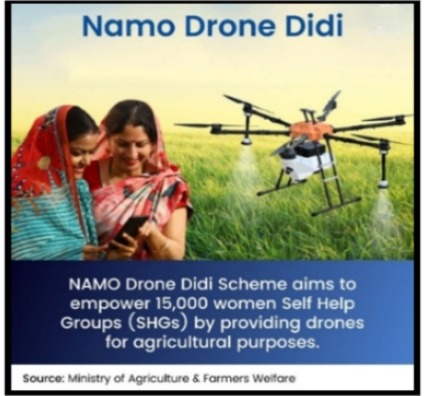
4. The Namo Drone Didi scheme, launched in November 2023, aimed to provide drones to women Self Help Groups for precision farming, higher productivity, lower input costs, and livelihoods.
5. Since the scheme began, 1,094 drones were distributed to women Self Help Groups by Lead Fertilizer Companies, including more than 500 drones supplied under Namo Drone Didi.
6. Drone Rules 2021 and later amendments reduced forms from 25 to 5, cut approval requirements from 72 to 4, and liberalised operations for drones weighing 500 kilograms.
7. Nearly 90 percent of Indian airspace was declared a Green Zone for drone operations, permitting flights up to 400 feet and supporting easier civilian use nationwide.
8. The requirement of a traditional pilot licence was replaced by a Remote Pilot Certificate issued by DGCA, while passport requirements were removed for civilian drone operations.
9. The Production Linked Incentive scheme for drones and drone components has an approved outlay of ₹120 crore, supporting domestic manufacturing, start ups, MSMEs, and scale expansion.
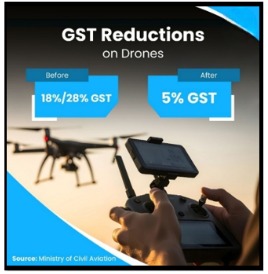
10. GST on drones was reduced to a uniform 5 percent in September 2025, replacing earlier 18 percent and 28 percent rates, and lowering costs for drone adoption.
11. Regulatory services including drone registration, remote pilot certification, type certification, and RPTO authorisation were migrated from Digital Sky to eGCA, while flight plans remained integrated.
12. As of 9 February 2026, 38,575 drones had been successfully registered and issued Unique Identification Numbers, strengthening formal compliance and digital oversight within India’s drone ecosystem.
13. By February 2026, 39,890 Remote Pilot Certificates had been issued, while DGCA had approved 244 Remote Pilot Training Organisations, expanding India’s national capacity for certified pilot training.
14. SwaYaan, focused on human resource development in unmanned aircraft systems, conducted more than 857 programme activities, benefited over 26,000 participants, and recorded 337 collaborations till reporting period.
15. NIDAR promotes autonomous drone applications in disaster management and precision agriculture, offers a prize pool of ₹40 lakh, and supports start up incubation for students.
Must Know Terms :
1.SVAMITVA
SVAMITVA is a drone-based rural mapping scheme launched in April 2020. It is implemented by the Ministry of Panchayati Raj, State Governments, and the Survey of India. The scheme targets 3.44 lakh villages. By December 2025, surveys were completed in 3.28 lakh villages, and 2.76 crore property cards were prepared for 1.82 lakh villages across 31 States and Union Territories.
2.NamoDroneDidi
Namo Drone Didi is a government initiative launched in November 2023 to provide drones to women Self Help Groups for precision agriculture. Its objectives include improving farm efficiency, raising crop productivity, reducing input costs, and creating sustainable livelihoods. Since inception, 1,094 drones were distributed through Lead Fertilizer Companies, including more than 500 supplied specifically under the initiative across India overall.
3.DGCA
DGCA is the central authority responsible for issuing Remote Pilot Certificates and approving Remote Pilot Training Organisations within India’s drone ecosystem. By February 2026, 39,890 Remote Pilot Certificates had been issued, and 244 RPTOs were approved nationwide. It also replaced the earlier requirement of a traditional pilot licence with a Remote Pilot Certificate for civilian drone operations across the country.
4.DigitalSky
Digital Sky is India’s digital single-window platform for drone regulation and operations. It enabled services such as registration, certification, flight planning, and airspace management within a unified framework. Later, regulatory services including registration, remote pilot certification, type certification, and RPTO authorisation were migrated to eGCA, while operational functions such as flight plans and airspace maps remained integrated with it there.
5.SwaYaan
SwaYaan is a capacity building programme for human resource development in unmanned aircraft systems. It supports training, talent creation, and ecosystem development in drone technologies. More than 857 programme activities have been conducted under it, benefiting over 26,000 participants. The programme has also recorded 337 collaborations, showing its role in expanding India’s skilled workforce for the drone sector nationwide overall.
6.NIDAR
NIDAR is the National Innovation Challenge for Drone Application and Research. It promotes autonomous drone solutions in areas such as disaster management and precision agriculture. The programme engages students and researchers, offers a prize pool of ₹40 lakh, and supports start-up incubation. It serves as a platform for innovation, experimentation, and early-stage development in India’s drone ecosystem for future applications.
Key Takeaways
a) As of February 2026, India has built a regulated drone ecosystem with 38,500+ registered drones (UIN), 39,890 DGCA-certified remote pilots, and 244 approved training organisations.
b) Under the SVAMITVA Scheme, 3.28 lakh villages have been surveyed using drones, and 2.76 crore property cards have been prepared for 1.82 lakh villages across 31 states.
c) 1,094 drones distributed to women SHGs including 500+ under Namo Drone Didi initiative, enhancing farm productivity and livelihoods.
MCQ:
1. As of February 2026, which of the following correctly describes India’s regulated drone ecosystem?
A) 38,575 registered drones, 26,000 certified pilots, 337 training organisations
B) 38,500+ registered drones, 39,890 certified remote pilots, 244 approved training organisations
C) 39,890 registered drones, 38,500 certified pilots, 244 training organisations
D) 244 registered drones, 38,500 certified pilots, 39,890 training organisations
2. Under the SVAMITVA scheme, by December 2025, drone surveys had been completed in:
A) 2.76 lakh villages, covering 82 percent of target
B) 1.82 lakh villages, covering 90 percent of target
C) 3.28 lakh villages, covering about 95 percent of target
D) 3.44 lakh villages, covering 100 percent of target
3. Which of the following correctly matches the property card progress under SVAMITVA by December 2025?
A) 2.76 crore property cards for 1.82 lakh villages
B) 1.82 crore property cards for 2.76 lakh villages
C) 3.28 crore property cards for 1.82 lakh villages
D) 2.76 crore property cards for 3.44 lakh villages
4. The Namo Drone Didi scheme was launched in:
A) April 2020
B) September 2025
C) February 2026
D) November 2023
5. Since inception, how many drones were distributed to women Self Help Groups by Lead Fertilizer Companies, including those under Namo Drone Didi?
A) 500
B) 1,094
C) 857
D) 244
6. Under the liberalised drone regulatory framework, the number of forms and approval requirements was reduced respectively from:
A) 72 to 4 and 25 to 5
B) 25 to 4 and 72 to 5
C) 25 to 5 and 72 to 4
D) 28 to 5 and 90 to 4
7. Nearly what share of Indian airspace was declared a Green Zone for drone operations, with flights permitted up to 400 feet?
A) Nearly 90 percent
B) Nearly 75 percent
C) Nearly 60 percent
D) Nearly 50 percent
8. Which of the following changes took place in civilian drone operations in India?
A) Passport became mandatory for all operators
B) Traditional pilot licence remained compulsory
C) Remote Pilot Certificate was abolished
D) Traditional pilot licence was replaced by a Remote Pilot Certificate
9. The approved outlay of the Production Linked Incentive scheme for drones and drone components is:
A) ₹40 crore
B) ₹120 crore
C) ₹337 crore
D) ₹500 crore
10. GST on drones was reduced to a uniform rate of:
A) 12 percent
B) 18 percent
C) 5 percent
D) 28 percent
11. Which of the following regulatory services were migrated from Digital Sky to eGCA?
A) Drone registration, remote pilot certification, type certification and RPTO authorisation
B) Flight planning, airspace mapping and satellite navigation only
C) Drone manufacturing licensing and export clearance only
D) Crop insurance claims and land records integration only
12. As of 9 February 2026, how many drones had been successfully registered and issued Unique Identification Numbers?
A) 38,500
B) 39,890
C) 37,575
D) 38,575
13. By February 2026, how many Remote Pilot Certificates had been issued, and how many RPTOs had been approved?
A) 38,575 RPCs and 244 RPTOs
B) 39,890 RPCs and 244 RPTOs
C) 39,890 RPCs and 337 RPTOs
D) 26,000 RPCs and 857 RPTOs
14. Which of the following correctly reflects the achievements of SwaYaan?
A) 244 activities, 39,890 participants, 120 collaborations
B) 857 activities, 3.28 lakh participants, 244 collaborations
C) 857+ activities, 26,000+ participants, 337 collaborations
D) 1,094 activities, 26,000 participants, 500 collaborations
15. NIDAR is associated with:
A) autonomous drone applications, a ₹40 lakh prize pool, and start-up incubation
B) railway surveillance, 244 RPTOs, and Green Zone mapping
C) drone taxation reforms and remote pilot licensing
D) drone distribution to women Self Help Groups for agriculture




0 comment