
India’s Research and Innovation Surge
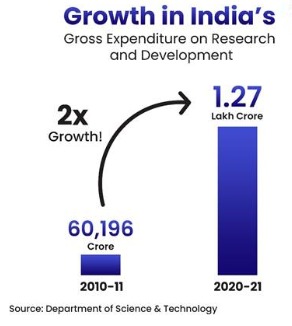
1. India’s Gross Expenditure on Research and Development rose from ₹60,196.75 crore in 2010–11 to ₹1,27,380.96 crore in 2020–21, showing a more than twofold increase.
2. Per capita research and development expenditure increased from PPP$ 29.2 in 2007–08 to PPP$ 42.0 in 2020–21, indicating a steady rise in innovation spending.
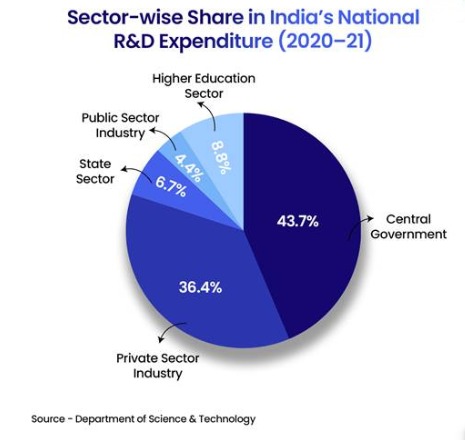
3. The government sector contributes about 64 percent of India’s Gross Expenditure on Research and Development, while the private sector accounts for nearly 36 percent.
4. India awarded 40,813 doctorates in 2018–19, of which 24,474 were in Science and Technology, placing the country third globally in Science and Engineering PhDs.
5. Patent filings in India increased from 24,326 in 2020–21 to 68,176 in 2024–25, reflecting a nearly threefold rise in innovation-related intellectual property activity.

6. The Research Development and Innovation Scheme was launched on 3 November 2025 with a ₹1 lakh crore fund to promote private sector-led research and innovation.

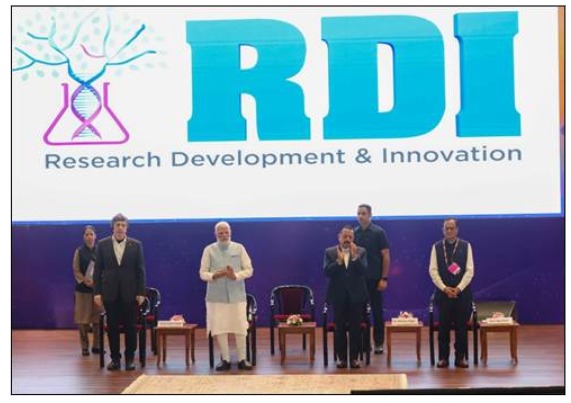
7. ESTIC 2025 was held at Bharat Mandapam, New Delhi, from 3 to 5 November 2025, bringing together over 3,000 participants from academia, industry, research, and government.

8. The Anusandhan National Research Foundation Act, 2023 came into force on 5 February 2024, and the foundation aims to mobilise ₹50,000 crore during 2023–28.

9. Out of the planned ₹50,000 crore under ANRF during 2023–28, ₹14,000 crore will come from the Central Government, while the remainder is expected from non-governmental sources.

10. The National Geospatial Policy was notified on 28 December 2022 and aims to make India a global leader in the geospatial sector by 2035.
11. The National Quantum Mission was approved on 19 April 2023, spans 2023–24 to 2030–31, and has an allocation of ₹6,003.65 crore.

12. The National Mission on Interdisciplinary Cyber-Physical Systems was approved on 6 December 2018 with a total outlay of ₹3,660 crore and supports 25 Technology Innovation Hubs.

13. The India Semiconductor Mission, established in 2021, is backed by a ₹76,000 crore incentive scheme, with ₹65,000 crore already committed and 10 projects approved across six states.
14. The IndiaAI Mission, approved in March 2024 with a budget outlay of ₹10,371.92 crore, expanded computing capacity from an initial target of 10,000 GPUs to 38,000 GPUs.
15. In August 2025, UPI handled more than 20 billion transactions worth ₹24.85 lakh crore and accounted for about 85 percent of India’s digital payments.
Must Know Terms :
1.RDIScheme
RDI (Research Development and Innovation) Scheme was launched on 3 November 2025 with a fund of ₹1 lakh crore. It is designed to promote private sector led research, innovation, and commercialisation in sunrise and strategic sectors. The scheme supports long term financing, technology acquisition, transformative projects, and a Deep Tech Fund of Funds to strengthen innovation financing and nationwide growth.
2. ANRF
ANRF (Anusandhan National Research Foundation) was established under the Anusandhan National Research Foundation Act, 2023, which came into force on 5 February 2024. It provides strategic direction for research, innovation, and entrepreneurship in science and technology. The foundation aims to mobilise ₹50,000 crore during 2023 to 2028, including ₹14,000 crore from the Central Government, while encouraging strong academia industry collaboration through multiple funding streams.
3. ESTIC
ESTIC (Emerging Science, Technology and Innovation Conclave) 2025 was held at Bharat Mandapam, New Delhi, from 3 to 5 November 2025 as a major platform for scientific collaboration and innovation. It brought together over 3,000 participants from academia, research institutions, industry, and government. The conclave featured 11 thematic technical sessions, Nobel Laureate talks, panel discussions, exhibitions, sponsor stalls, and young scientist poster presentations during the event.
4. NQM
NQM (National Quantum Mission) was approved on 19 April 2023 and runs from 2023 to 2024 through 2030 to 2031 with an allocation of ₹6,003.65 crore. The mission focuses on quantum computers, secure communication systems, advanced materials, and stronger research infrastructure. It also promotes collaboration among academia, start ups, and industry to build quantum capabilities in India for future.
5. IndiaAI
IndiaAI Mission was approved in March 2024 with a budget outlay of ₹10,371.92 crore. It advances the vision of making artificial intelligence in India and making artificial intelligence work for India. The mission expanded computing capacity from an initial target of 10,000 GPUs to 38,000 GPUs. It also focuses on innovation, governance frameworks, and skill development across sectors nationwide applications.
6. UPI
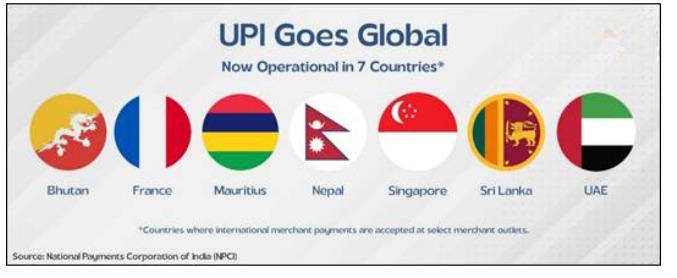
UPI (Unified Payments Interface) was launched in 2016 by the National Payments Corporation of India and transformed digital transactions through real time transfers and merchant payments. In August 2025, it handled more than 20 billion transactions worth ₹24.85 lakh crore. It accounts for about 85 percent of India’s digital payments and has become operational in seven countries, including France and Singapore and Mauritius.
Key Takeaways
- ₹1 lakh croreRDI Scheme launched, will boost private-led innovation.
- India’s expenditure on R&D rose from ₹60,196 crore in 2010–11 to ₹1.27 lakh crorein 2020–21.
- Central Government contributes 7%of total R&D expenditure.
MCQ :
1. India’s Gross Expenditure on Research and Development increased from ₹60,196.75 crore in 2010–11 to which of the following levels in 2020–21?
A) ₹1,07,380.96 crore
B) ₹1,27,380.96 crore
C) ₹1,17,380.96 crore
D) ₹97,380.96 crore
2. Per capita research and development expenditure in India rose from PPP$ 29.2 in 2007–08 to:
A) PPP$ 36.0
B) PPP$ 39.5
C) PPP$ 42.0
D) PPP$ 45.0
3. Which of the following correctly reflects the sectoral contribution to India’s Gross Expenditure on Research and Development?
A) Government about 64 percent, private sector nearly 36 percent
B) Government about 36 percent, private sector nearly 64 percent
C) Government about 50 percent, private sector about 50 percent
D) Government about 70 percent, private sector about 20 percent
4. India awarded 40,813 doctorates in 2018–19. Of these, how many were in Science and Technology?
A) 20,474
B) 22,474
C) 26,474
D) 24,474
5. Patent filings in India rose from 24,326 in 2020–21 to which of the following in 2024–25?
A) 58,176
B) 68,176
C) 78,176
D) 48,176
6. The Research Development and Innovation Scheme was launched on 3 November 2025 with a fund of:
A) ₹50,000 crore
B) ₹75,000 crore
C) ₹1 lakh crore
D) ₹1.5 lakh crore
7. ESTIC 2025 was held at Bharat Mandapam, New Delhi, during:
A) 1 to 3 November 2025
B) 5 to 7 November 2025
C) 2 to 4 November 2025
D) 3 to 5 November 2025
8. The Anusandhan National Research Foundation Act, 2023 came into force on:
A) 5 February 2024
B) 5 January 2024
C) 3 November 2025
D) 28 December 2022
9. Out of the planned ₹50,000 crore under ANRF during 2023–28, the Central Government will contribute:
A) ₹10,000 crore
B) ₹14,000 crore
C) ₹20,000 crore
D) ₹25,000 crore
10. The National Geospatial Policy was notified on:
A) 19 April 2023
B) 5 February 2024
C) 28 December 2022
D) 6 December 2018
11. Which of the following correctly describes the National Quantum Mission?
A) Approved on 19 April 2023 with an allocation of ₹6,003.65 crore
B) Approved on 6 December 2018 with an allocation of ₹3,660 crore
C) Approved in 2021 with an allocation of ₹76,000 crore
D) Approved in March 2024 with an allocation of ₹10,371.92 crore
12. The National Mission on Interdisciplinary Cyber-Physical Systems supports how many Technology Innovation Hubs?
A) 15
B) 20
C) 30
D) 25
13. The India Semiconductor Mission is backed by an incentive scheme of:
A) ₹65,000 crore
B) ₹76,000 crore
C) ₹50,000 crore
D) ₹10,371.92 crore
14. The IndiaAI Mission expanded computing capacity from an initial target of 10,000 GPUs to:
A) 20,000 GPUs
B) 28,000 GPUs
C) 38,000 GPUs
D) 48,000 GPUs
15. In August 2025, UPI handled more than 20 billion transactions worth:
A) ₹24.85 lakh crore
B) ₹14.85 lakh crore
C) ₹34.85 lakh crore
D) ₹20.85 lakh crore




0 comment