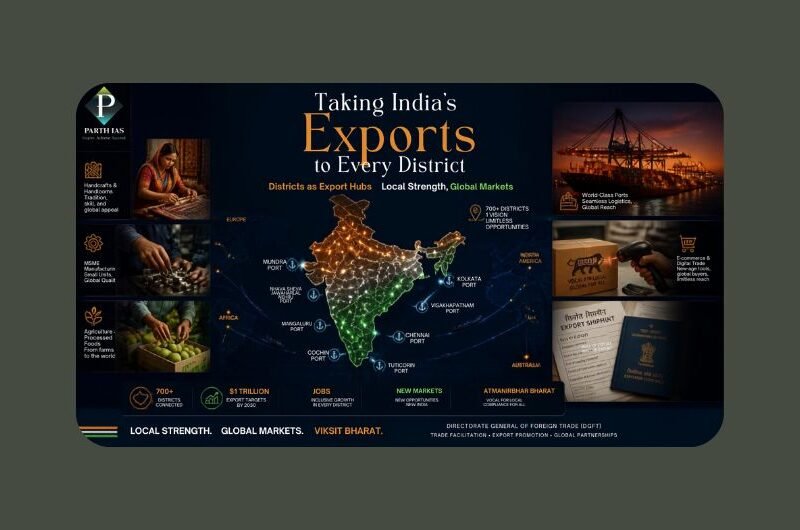
Taking India’s Exports to Every District
1. India’s total exports of goods and services reached US$825.25 billion in 2024–25 and were estimated at US$863.11 billion in 2025–26.
2. The Districts as Export Hubs (DEH) Initiative treats every district as a unit of export planning by identifying products and services with global-market potential.
3. DEH aims to connect local producers, MSMEs, artisans and agricultural clusters with international markets, employment opportunities and export-support services.
4. One District One Product (ODOP) began as a Uttar Pradesh initiative in 2018 and was later scaled up nationally.
5. ODOP focuses on selecting, branding and promoting distinctive products from individual districts, while DEH expands this approach to the wider export ecosystem.
6. The Department of Commerce implements DEH through the Directorate General of Foreign Trade (DGFT).
7. As of January 2026, DEH covered more than 770 districts across India.
8. DEH is a convergence framework, not a separate funding scheme; it uses support available under existing Central and State schemes.
9. State Export Promotion Committees (SEPCs) guide implementation and inter-departmental coordination at the State level.
10. District Export Promotion Committees (DEPCs) identify local export opportunities, resolve district-level bottlenecks and coordinate with exporters and industry stakeholders.
11. DEPCs prepare District Export Action Plans (DEAPs) to map exportable products and services, assess logistics and infrastructure, and recommend measures to improve market access.
12. By March 2026, draft DEAPs had been prepared for 590 districts, of which 249 had been formally adopted by the respective DEPCs.
13. DEH supports export readiness through awareness and capacity building on quality standards, testing, certification, packaging, branding, logistics and export procedures.
14. Partnerships with e-commerce and logistics platforms, including Amazon, Shiprocket and DHL, help MSMEs access courier-shipping options; Dak Ghar Niryat Kendras support low-cost postal exports.
15. From 1 June 2026, DEH adopted a focused and phased implementation approach covering districts in 27 States and Union Territories, supported by 24 DGFT Regional Authorities and 11 partner agencies.
Must Know Terms :
1.Districts as Export Hubs (DEH)
A Department of Commerce initiative that treats each district as a unit of export planning. It identifies products and services with export potential and connects local producers with global markets.
2. One District One Product (ODOP)
An initiative that identifies, promotes and brands one distinctive product from each district. It began in Uttar Pradesh in 2018 and was later expanded nationally.
3. Directorate General of Foreign Trade (DGFT)
An attached office of the Department of Commerce responsible for formulating and implementing foreign-trade policy. It anchors the implementation and monitoring of the DEH Initiative.
4. District Export Promotion Committee (DEPC)
A district-level committee that identifies export opportunities, resolves local bottlenecks and coordinates with exporters, industry bodies and government departments.
5. District Export Action Plan (DEAP)
A district-specific plan prepared by the DEPC. It maps exportable products and services, assesses infrastructure and logistics, and recommends interventions for better market access.
6. Dak Ghar Niryat Kendra
A postal-export facility that supports small exporters with documentation, packaging and low-cost shipment of export consignments through India Post.
MCQ :
1. With reference to the Districts as Export Hubs (DEH) Initiative, consider the following statements:
1) It treats districts as units of export planning.
2) It identifies products and services with export potential.
3) It is a separate funding scheme with an exclusive Central allocation.
Which of the statements given above are correct?
(a) 1 and 2 only
(b) 2 and 3 only
(c) 1 and 3 only
(d) 1, 2 and 3
2. The Districts as Export Hubs Initiative is implemented by the Department of Commerce through the:
(a) Reserve Bank of India
(b) Directorate General of Foreign Trade
(c) NITI Aayog
(d) Export-Import Bank of India
3. One District One Product (ODOP) began as an initiative of:
(a) Gujarat
(b) Maharashtra
(c) Uttar Pradesh
(d) Tamil Nadu
4. ODOP was initiated in Uttar Pradesh in:
(a) 2014
(b) 2016
(c) 2017
(d) 2018
5. Which one of the following best distinguishes DEH from ODOP?
(a) DEH focuses only on one product per district, while ODOP focuses on services.
(b) DEH expands product promotion into wider export-ecosystem development.
(c) DEH is limited to agricultural products, while ODOP covers all goods.
(d) DEH is a State initiative, while ODOP is a global trade agreement.
6. As of January 2026, the DEH Initiative covered:
(a) More than 500 districts
(b) More than 600 districts
(c) More than 770 districts
(d) All districts in South Asia
7. The DEH Initiative is best described as:
(a) A convergence framework using existing Central and State schemes
(b) A subsidy scheme only for large exporters
(c) A programme limited to port cities
(d) A foreign investment regulatory mechanism
8. State Export Promotion Committees (SEPCs) primarily function at the:
(a) Village level
(b) District level
(c) State level
(d) International level
9. District Export Promotion Committees (DEPCs) are responsible for:
1) Identifying district-level export opportunities
2) Resolving local export bottlenecks
3) Coordinating with exporters and industry stakeholders
Which of the statements given above are correct?
(a) 1 and 2 only
(b) 2 and 3 only
(c) 1 and 3 only
(d) 1, 2 and 3
10. District Export Action Plans (DEAPs) are prepared by:
(a) State Export Promotion Committees
(b) District Export Promotion Committees
(c) Reserve Bank of India
(d) Ministry of Finance
11. A District Export Action Plan may include:
1) Mapping of exportable products and services
2) Assessment of logistics and infrastructure
3) Recommendations to improve market access
Which of the statements given above are correct?
(a) 1 and 2 only
(b) 2 and 3 only
(c) 1, 2 and 3
(d) 1 and 3 only
12. By March 2026, draft District Export Action Plans had been prepared for:
(a) 249 districts
(b) 590 districts
(c) 770 districts
(d) 1,136 districts
13. Which one of the following is not directly supported under DEH capacity-building efforts?
(a) Quality standards and certification
(b) Packaging and branding
(c) Export logistics and procedures
(d) Monetary policy formulation
14. Dak Ghar Niryat Kendras are associated with:
(a) Postal-export support for small consignments
(b) Issuing export licences for large companies
(c) Regulation of foreign-exchange markets
(d) Insurance of export credit by commercial banks
15. From 1 June 2026, the focused and phased DEH implementation approach covered districts across:
(a) 19 States and Union Territories
(b) 24 States and Union Territories
(c) 27 States and Union Territories
(d) All 36 States and Union Territories



0 comment