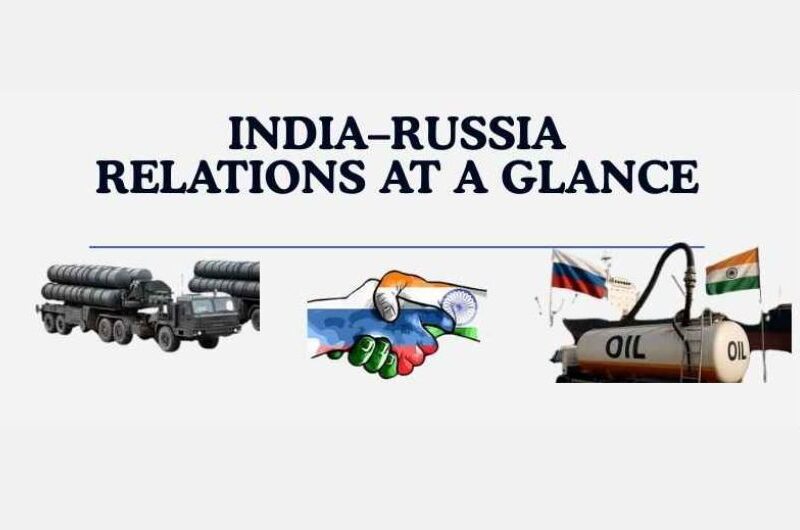
India-Russia Relations at a Glance
1. India and Russia completed 78 years of diplomatic relations in 2025, reflecting one of India’s longest-standing and most stable major-power partnerships.
2. The relationship was formalised as a Strategic Partnership in 2000 and elevated to a Special and Privileged Strategic Partnership in 2010.
3. The institutional framework is anchored through two Intergovernmental Commission tracks: IRIGC-TEC for economic, scientific and cultural cooperation, and IRIGC-M&MTC for military and technical cooperation.
4. India and Russia continued efforts in 2025 to accelerate the bilateral trade target of USD 100 billion by 2030.
5. Bilateral trade reached a record USD 68.7 billion in FY 2024–25, marking the highest level in the relationship so far.
6. India’s exports to Russia in FY 2024–25 were about USD 4.9 billion, led by pharmaceuticals, chemicals, iron and steel, and marine products.
7. India’s imports from Russia in FY 2024–25 stood at about USD 63.8 billion, dominated by crude oil, petroleum products, sunflower oil, fertilisers, coking coal, and precious stones.
8. India and Russia are also pursuing the target of USD 50 billion in mutual investments, while discussions continue on the India–EAEU Free Trade Agreement.
9. The 23rd Annual Summit held in December 2025 remained the highest political mechanism guiding bilateral relations at the leadership level.
10. Defence cooperation continues under the 10-year Defence Cooperation Programme for 2021–2031 covering joint research, production, maintenance, and technology transfer.
11. Major defence pillars include BrahMos missile cooperation, Su-30MKI licensed production, T-90S Bhishma tanks, S-400 systems, INS Vikramaditya, submarines, engines, spares, and AK-203 rifle manufacturing.
12. INDRA-2025 exercises and participation in Zapad-2025 reflected continuing operational coordination between the armed forces of both countries.
13. Kudankulam Nuclear Power Plant in Tamil Nadu remains India’s only foreign-assisted nuclear power project and the most important symbol of bilateral civil nuclear cooperation.
14. Cooperation also extends to Gaganyaan astronaut training, science and technology collaboration, and the 2021 Science, Technology and Innovation roadmap focused on joint research and commercialisation.
15. Around 20,000 Indian students study in Russia, while cultural exchanges in 2025 included Bharat Utsav in Moscow, Indian Film Festival events, Yoga Day celebrations in 60-plus Russian regions, and display of Lord Buddha relics.
Must Know Terms :
1. IRIGC
Intergovernmental Commission (IRIGC) is the main institutional mechanism guiding India–Russia cooperation. It operates through two tracks: IRIGC-TEC for trade, economic, scientific, technological, and cultural cooperation, and IRIGC-M&MTC for military and military-technical cooperation. Through these structured meetings, both countries review progress, resolve bottlenecks, and advance long-term cooperation across strategic sectors under an officially coordinated bilateral framework.
2. EAEU
Eurasian Economic Union (EAEU) is the regional economic grouping with which India is discussing a Free Trade Agreement to expand market access and reduce trade barriers. Progress on the India–EAEU FTA is linked to India–Russia efforts to raise bilateral trade to USD 100 billion by 2030. The discussions focus on tariffs, logistics, payment systems, and wider connectivity through major Eurasian transport corridors.
3. BrahMos
BrahMos is a jointly developed supersonic cruise missile and remains one of the strongest symbols of India–Russia defence cooperation. It represents collaboration in advanced weapons technology, joint research, and production capability. The project reflects a move beyond simple defence purchases toward co-development and manufacturing. BrahMos also aligns with India’s wider goal of strengthening indigenous defence production and strategic technological capability.
4. Kudankulam
Kudankulam Nuclear Power Plant in Tamil Nadu is India’s only foreign-assisted nuclear power project and the most prominent example of India–Russia civil nuclear cooperation. It occupies a central place in bilateral energy relations and demonstrates long-term collaboration in high-technology infrastructure. Kudankulam shows how the India–Russia partnership extends beyond defence into strategic energy security, nuclear power generation, and advanced engineering cooperation.
5. Gaganyaan
Gaganyaan is India’s human spaceflight programme, and Russia has contributed through astronaut training and related cooperation. This support reflects the broader scientific and technological dimension of India–Russia relations. The programme is important because it connects bilateral ties with space capability, advanced training, and strategic technology transfer. It also shows that cooperation between the two countries includes frontier sectors beyond trade and defence.
6. INSTC
International North–South Transport Corridor (INSTC) is a major connectivity initiative intended to improve cargo movement between India, Russia, and the wider Eurasian region. It is important for reducing transport time, improving trade efficiency, and supporting broader economic integration. Within India–Russia relations, INSTC is linked with efforts to expand bilateral trade, strengthen logistics networks, and build alternative connectivity routes across regional markets.
MCQ :
1. In which year was the India–Russia “Special and Privileged Strategic Partnership” established?
A) 1998
B) 2000
C) 2005
D) 2010
2. What is the bilateral trade target set by India and Russia for 2030?
A) USD 50 billion
B) USD 75 billion
C) USD 100 billion
D) USD 150 billion
3. IRIGC-TEC deals with cooperation in which area?
A) Only defence
B) Only nuclear energy
C) Trade, economic, scientific and cultural cooperation
D) Only foreign policy
4. The INDRA-2025 exercise was conducted between which two countries?
A) India–USA
B) India–Japan
C) India–France
D) India–Russia
5. India–Russia bilateral trade in FY 2024–25 reached approximately:
A) USD 18.7 billion
B) USD 28.7 billion
C) USD 48.7 billion
D) USD 68.7 billion
6. Which of the following is the major component of India’s imports from Russia?
A) Pharmaceuticals
B) Marine products
C) Crude oil and petroleum products
D) Electronic machinery
7. The BrahMos missile project represents what form of cooperation?
A) Pure procurement
B) Joint research and development
C) Only licensed production
D) Only training
8. The 2021–2031 India–Russia defence cooperation programme focuses primarily on:
A) Defence imports
B) Border management
C) Joint R&D, production and maintenance
D) Strategic communications
9. Kudankulam Nuclear Power Plant in Tamil Nadu has been established with the cooperation of:
A) Japan
B) France
C) Russia
D) USA
10. Approximately how many Indian students study in Russia?
A) 5,000
B) 10,000
C) 20,000
D) 40,000
11. The “2+2 Dialogue” between India and Russia is held at the level of:
A) Finance and Agriculture Ministers
B) Foreign and Defence Ministers
C) Culture and Education Ministers
D) Energy and Science Ministers
12. The International North–South Transport Corridor aims to improve connectivity between:
A) Europe and Africa
B) India and Russia through passenger travel
C) India–Russia–Iran freight connectivity
D) Indian Ocean maritime security
13. Russia’s stance on India’s candidature for a permanent seat in the UN Security Council is:
A) Opposed
B) Neutral
C) Limited support
D) Consistent support
14. AK-203 rifles are produced in India through which collaboration?
A) HAL
B) DRDO–Mitsubishi JV
C) Indo-Russia Rifles Private Limited
D) BHEL–Rosatom JV
15. The 2025 “Bharat Utsav” cultural festival was a major success in which city?
A) St. Petersburg
B) Vladivostok
C) Kazan
D) Moscow

0 comment