Africa’s Green Minerals Strategy
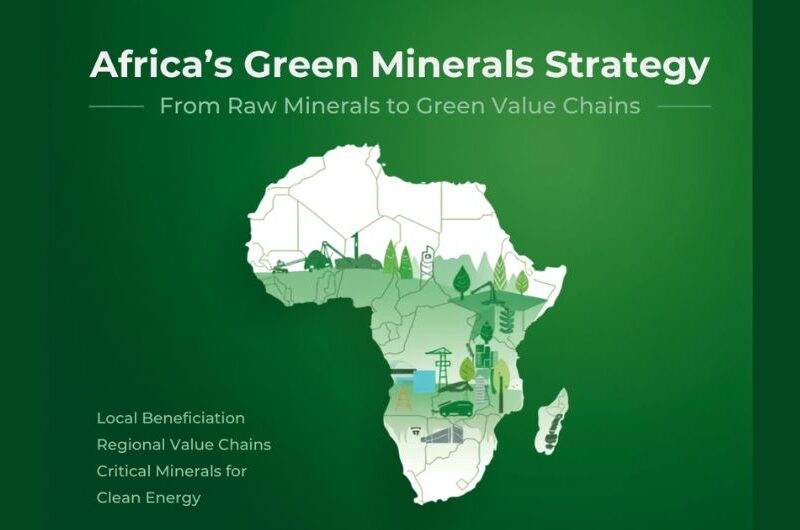
1. The Africa Green Minerals Strategy (AGMS) was adopted by African Heads of State at the 38th Ordinary Session of the African Union Assembly. It aims to transform Africa from an exporter of raw minerals into a hub for mineral beneficiation, green industrialisation and value addition.
2. The strategy focuses on green and critical minerals needed for clean-energy technologies, including lithium, cobalt, nickel, copper, graphite and rare earth elements.
3. Its central objective is to end the long-standing pattern in which African countries export unprocessed minerals while the major economic value is created through processing and manufacturing outside Africa.
4. Local beneficiation means processing minerals near or within the place of extraction. It can create employment, support domestic industries, improve technology transfer and increase Africa’s share in global mineral value chains.
5. The strategy promotes regional value chains rather than fragmented national mineral policies. Different African countries can cooperate in mining, refining, transport, battery production and other stages of the value chain.
6. The African Continental Free Trade Area (AfCFTA) is important for the strategy because it can support a larger regional market, common policies, shared infrastructure and competitive mineral-processing hubs.
7. The strategy seeks just and sustainable mining governance in line with the Africa Mining Vision. It emphasises environmental protection, transparent mineral contracts and responsible use of mineral resources.
8. Free, Prior and Informed Consent (FPIC) is an important principle under the strategy. It requires that local communities are properly informed and consulted before projects affecting their land, resources and livelihoods are undertaken.
9. AGMS supports a unified African approach towards foreign investors and major powers. This can prevent fragmented bilateral deals and strengthen Africa’s collective bargaining power on mineral prices, technology access and investment terms.
10. Africa has major reserves of minerals essential for electric vehicles, batteries, renewable-energy infrastructure and digital technologies. This has made the continent strategically important in the global race for secure and diversified mineral supply chains.
11. China has a strong presence in African mining, infrastructure and mineral processing through long-term partnerships, investments, loans and a policy of non-interference in domestic affairs.
12. The United States is seeking to diversify critical-mineral supply chains and reduce Chinese dominance through diplomatic engagement and initiatives such as the Minerals Security Partnership, including cooperation with countries such as the Democratic Republic of Congo, Tanzania and Zambia.
13. The European Union is also diversifying its Critical Raw Materials supply to build strategic autonomy. It is developing mineral partnerships with African countries, including a mining Memorandum of Understanding with Namibia.
14. For India, AGMS is important because India depends heavily on imports for critical minerals required for electric vehicles, solar panels, batteries and semiconductors. Cooperation with African countries can diversify India’s supply chains and improve mineral security.
15. India can become a development-oriented partner by investing in Africa’s exploration, geological mapping, skill development, mineral processing and refining sectors. However, implementation faces challenges such as weak energy and transport infrastructure, poor port efficiency, limited refining capacity, risks from premature export restrictions, and difficulty in balancing national interests with regional cooperation.
MCQ :
1.Mineral Beneficiation
Mineral beneficiation means processing raw minerals to increase their value. It includes activities such as crushing, refining, smelting and manufacturing of mineral-based products.
2. AfCFTA
The African Continental Free Trade Area aims to create a unified African market. It can help countries develop regional mineral value chains, reduce trade barriers and establish shared processing hubs.
3. Critical Minerals
Critical minerals are essential for modern technologies and clean-energy systems. Examples include lithium, cobalt, nickel, graphite, copper and rare earth elements.
4. Africa Mining Vision
The Africa Mining Vision promotes transparent, equitable and sustainable use of Africa’s mineral resources. It seeks to ensure that mineral wealth supports industrialisation and long-term development.
5. Free, Prior and Informed Consent
Free, Prior and Informed Consent means local communities must receive complete information and be consulted before mining projects affecting their land, resources or livelihoods are approved.
6. Minerals Security Partnership
The Minerals Security Partnership is an international partnership that aims to strengthen secure, responsible and diversified supply chains for critical minerals.
MCQ :
1. With reference to the Africa Green Minerals Strategy (AGMS), consider the following statements:
1. It was adopted at the 38th Ordinary Session of the African Union Assembly.
2. It seeks to transform Africa into a hub for mineral beneficiation and green industrialisation.
3. It promotes the export of unprocessed minerals as its main objective.
Which of the statements given above are correct?
(a) 1 and 2 only
(b) 2 and 3 only
(c) 1 and 3 only
(d) 1, 2 and 3
2. Which of the following minerals are important for clean-energy technologies?
1. Lithium
2. Cobalt
3. Graphite
4. Rare earth elements
Select the correct answer using the code below:
(a) 1 and 2 only
(b) 1, 2, 3 and 4
(c) 2, 3 and 4 only
(d) 1, 3 and 4 only
3. Mineral beneficiation refers to:
(a) Banning all mineral exports
(b) Mining minerals only for domestic use
(c) Processing raw minerals to increase their value
(d) Importing refined minerals from other countries
4. Which one of the following is NOT a likely outcome of local mineral beneficiation?
(a) Employment generation
(b) Technology transfer
(c) Development of domestic industries
(d) Increased dependence on raw mineral exports
5. The Africa Green Minerals Strategy encourages regional value chains mainly to:
(a) Replace all national governments in mineral regulation
(b) Restrict mineral trade within Africa
(c) Promote cooperation in mining, refining, transport and manufacturing
(d) End all foreign investment in the mineral sector
6. With reference to the African Continental Free Trade Area (AfCFTA), consider the following statements:
1. It seeks to create a unified African market.
2. It can support regional mineral-processing hubs.
3. It can reduce trade barriers among African countries.
Which of the statements given above are correct?
(a) 1 and 2 only
(b) 2 and 3 only
(c) 1 and 3 only
(d) 1, 2 and 3
7. The Africa Mining Vision primarily promotes:
(a) Transparent, equitable and sustainable mineral-resource use
(b) Complete privatisation of all mineral resources
(c) Export of raw minerals without domestic processing
(d) Exclusive control of minerals by foreign companies
8. Free, Prior and Informed Consent (FPIC) is associated with:
(a) Approval of mining projects by foreign investors
(b) Consultation with affected local communities before projects are undertaken
(c) Setting international prices for critical minerals
(d) Issuing licences for mineral exports
9. A unified African approach towards foreign investors can help in:
1. Improving bargaining power on mineral prices.
2. Strengthening access to technology.
3. Preventing fragmented bilateral deals.
Select the correct answer using the code below:
(a) 1 and 2 only
(b) 2 and 3 only
(c) 1, 2 and 3
(d) 1 and 3 only
10. Africa’s strategic importance in global mineral supply chains is mainly due to:
(a) Its large reserves of minerals required for clean-energy and digital technologies
(b) Its complete dominance in semiconductor manufacturing
(c) Its control over all major global sea routes
(d) Its exclusive production of petroleum
11. Which one of the following best describes China’s engagement in Africa’s mineral sector?
(a) It avoids investment in mining and mineral processing.
(b) It has a significant presence in infrastructure, mining and mineral processing.
(c) It works only through multilateral institutions.
(d) It limits cooperation only to agricultural production.
12. The Minerals Security Partnership is mainly aimed at:
(a) Creating a global military alliance for mineral protection
(b) Promoting secure, responsible and diversified critical-mineral supply chains
(c) Regulating oil production in African countries
(d) Replacing the African Union in mineral governance
13. The European Union seeks to diversify its Critical Raw Materials supply mainly to:
(a) Build strategic autonomy
(b) End all trade with African countries
(c) Promote exports of unprocessed minerals from Europe
(d) Reduce the use of renewable-energy technologies
14. For India, cooperation with African countries under the AGMS can help in:
1. Diversifying critical-mineral supply chains.
2. Supporting electric-vehicle and solar-panel manufacturing.
3. Improving mineral security for batteries and semiconductors.
Select the correct answer using the code below:
(a) 1 and 2 only
(b) 2 and 3 only
(c) 1, 2 and 3
(d) 1 and 3 only
15. Which of the following are major challenges to implementing the Africa Green Minerals Strategy?
1. Weak energy and transport infrastructure.
2. Limited mineral-refining capacity.
3. Risks arising from premature export restrictions.
4. Difficulty in coordinating national and regional interests.
Select the correct answer using the code below:
(a) 1 and 2 only
(b) 1, 2, 3 and 4
(c) 2, 3 and 4 only
(d) 1, 3 and 4 only




0 comment