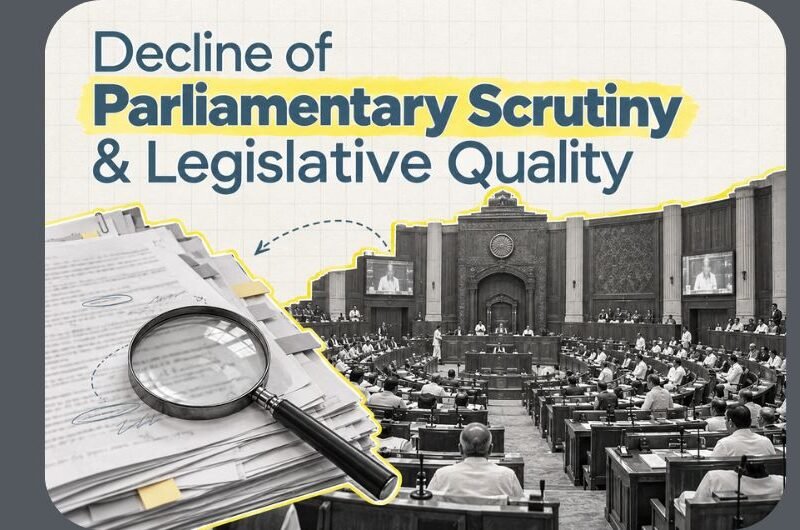
Decline of Parliamentary Scrutiny & Legislative Quality
The decline in parliamentary scrutiny and legislative quality in India raises concerns about the effectiveness of
legislative oversight, democratic accountability and parliamentary functioning.
Reduced sitting days, limited committee scrutiny and frequent disruptions have weakened Parliament’s deliberative and supervisory roles.
1. Indicators of the Decline in Parliamentary Scrutiny
Several indicators highlight structural deficiencies in parliamentary functioning:
| Dimension | Observed Status / Metric |
|---|---|
| Shrinking Sitting Days | Average annual sittings of Parliament declined from 121 days during 1952–1970 to approximately 55 days during the 17th Lok Sabha. |
| Bypassing Committees | Bills referred to Departmentally Related Standing Committees declined from 71% during the 15th Lok Sabha to 16% during the 17th Lok Sabha, with the figure reported at around 26% for the 18th Lok Sabha. |
| Guillotining the Budget | Close to 80% of Union Budget allocations have reportedly been passed without detailed discussion of individual ministries’ Demands for Grants through the Guillotine mechanism. |
| Dysfunctional Question Hour | During periods of parliamentary disruption, Question Hour utilisation reportedly fell to 23% in the Lok Sabha and 6% in the Rajya Sabha. |
| Vacant Institutional Roles | The constitutional office of the Deputy Speaker of the Lok Sabha under Article 93 remained vacant throughout the 17th Lok Sabha and during part of the 18th Lok Sabha. |
2. Core Causes for the Decline
The weakening of parliamentary oversight is associated with institutional, political and procedural factors.
The use of ordinances under Article 123 and disputes over classification of ordinary legislation as Money Bills under Article 110 have raised concerns about bypassing parliamentary scrutiny and limiting the legislative role of the Rajya Sabha.
Extensive use of party whips can restrict independent legislative judgment and discourage dissent within political parties, thereby reducing individual parliamentary autonomy.
Frequent adjournments, political polarisation and inadequate enforcement of parliamentary rules contribute to recurring legislative deadlocks and reduce opportunities for substantive debate.
Parliamentarians often face limitations in accessing specialised legislative, financial and technical research.
The absence of a dedicated Parliamentary Budget Office restricts institutional capacity for independent examination of complex budgetary and policy proposals.
3. Immediate Impacts on Legislative Quality
The introduction and passage of Bills without adequate debate, committee examination or clause-by-clause scrutiny can result in legislative deficiencies.
The enactment and subsequent repeal of the three Farm Laws highlighted concerns regarding legislative consultation and consensus-building.
Ambiguities in legislation and gaps in statutory frameworks may increase litigation and require judicial interpretation.
The Vishaka Guidelines illustrate judicial intervention in an area where a comprehensive statutory framework was absent.
India lacks a comprehensive institutional mechanism for systematically evaluating whether enacted laws have achieved their intended socio-economic objectives.
Limited post-legislative assessment can contribute to recurring amendments and difficulties in measuring policy effectiveness.
4. Roadmap to Reform
Strengthening Parliament’s deliberative, legislative and accountability functions requires institutional and procedural reforms.
Establishing a requirement for Parliament to meet for at least 100–120 days annually would provide greater opportunities for legislative debate, scrutiny and oversight.
Parliamentary Rules of Procedure could require complex, non-urgent and rights-sensitive Bills to be referred to the appropriate Departmentally Related Standing Committees for detailed examination.
Party whips could be restricted primarily to votes directly affecting government stability, particularly Confidence and No-Confidence Motions, while allowing greater legislative independence in other matters.
India could adopt a system similar to the UK House of Commons where designated parliamentary days allow the opposition to determine the agenda and initiate debate on important public issues.
Must Know Terms
1. Parliamentary Scrutiny
The process through which Parliament examines government policies, proposed legislation, expenditure and executive actions to ensure accountability, transparency and effective democratic governance.
2. Executive Dominance
A situation in which the executive exercises excessive influence over legislative processes, reducing Parliament’s independence and its ability to scrutinise government decisions effectively.
3. Guillotine
A parliamentary procedure through which outstanding Demands for Grants are put to vote together without further discussion after the allotted time for budgetary deliberations expires.
4. Departmentally Related Standing Committees (DRSCs)
Parliamentary committees responsible for examining Bills, Demands for Grants, annual reports and long-term policies of ministries and departments, enabling detailed legislative and financial scrutiny.
5. Anti-Defection Law — Tenth Schedule
A constitutional mechanism introduced by the 52nd Constitutional Amendment Act, 1985, to address political defections. Extensive use of party whips under the system may restrict independent legislative voting and internal party dissent.
6. Post-Legislative Scrutiny
The systematic evaluation of enacted laws to determine their effectiveness, implementation, unintended consequences and achievement of intended policy objectives, thereby improving legislative quality and accountability.
Multiple-Choice Questions
1. With reference to the decline in parliamentary scrutiny in India, consider the following statements:
Which of the statements given above are correct?
2. Match List I with List II:
Select the correct answer using the code given below:
3. Consider the following Assertion (A) and Reason (R):
Assertion (A):
Extensive application of party whips may reduce the independence of individual Members of Parliament in legislative decision-making.
Reason (R):
The Anti-Defection Law, combined with the extensive use of party whips, can discourage internal party dissent and restrict voting autonomy.
Select the correct answer:
4. With reference to executive dominance over parliamentary functioning, consider the following statements:
Which of the statements given above are correct?
5. Consider the following statements regarding the institutional limitations of parliamentary scrutiny:
How many of the above statements are correct?
6. Match List I with List II:
Select the correct answer using the code given below:
7. Consider the following Assertion (A) and Reason (R):
Assertion (A):
The absence of post-legislative scrutiny may prevent a systematic assessment of whether enacted laws have achieved their intended socio-economic objectives.
Reason (R):
India lacks a comprehensive institutional mechanism for regularly evaluating the implementation, effectiveness and consequences of enacted legislation.
Select the correct answer:
8. With reference to proposed reforms in parliamentary functioning, consider the following statements:
Which of the statements given above are correct?
9. Consider the following pairs:
Which of the pairs given above are correctly matched?
10. Consider the following Assertion (A) and Reason (R):
Assertion (A):
The Guillotine procedure is a mechanism of post-legislative scrutiny used to assess whether enacted laws have achieved their objectives.
Reason (R):
Under the Guillotine procedure, outstanding Demands for Grants are put to vote together without further discussion after the allotted time expires.
Select the correct answer:
11. With reference to the consequences of inadequate parliamentary scrutiny, consider the following statements:
How many of the above statements are correct?
12. Match List I with List II:
Select the correct answer using the code given below:
13. Consider the following measures:
Which of the above measures would contribute to strengthening parliamentary scrutiny?
14. Consider the following Assertion (A) and Reason (R):
Assertion (A):
Institutionalising Opposition Days may strengthen parliamentary deliberation by providing opposition parties with opportunities to initiate discussion on important public issues.
Reason (R):
The proposed reform draws upon the UK House of Commons practice of allocating designated parliamentary time for opposition-selected business.
Select the correct answer:
15. With reference to parliamentary scrutiny and democratic accountability, consider the following statements:
Which of the statements given above are correct?




0 comment