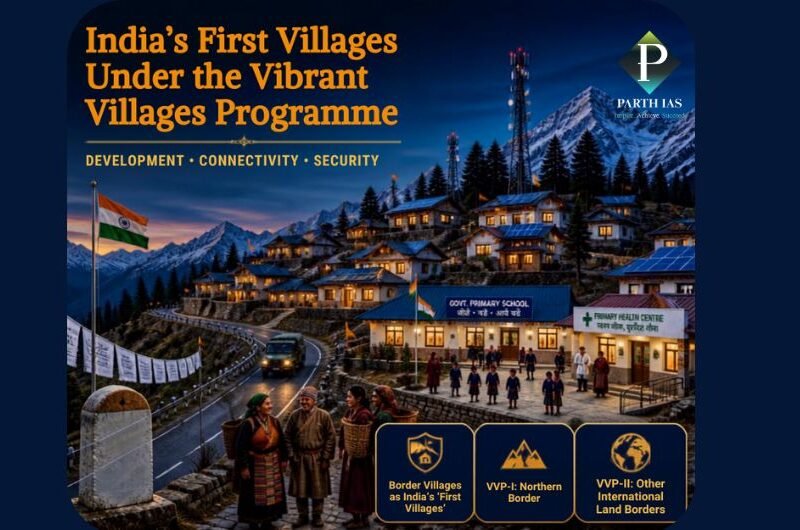
India’s First Villages Under the Vibrant Villages Programme
India’s International Land Borders
1
India shares over 15,000 km of international land borders with seven neighbouring countries.
2
Bangladesh shares India’s longest land border at 4,096.7 km, followed by China at 3,488 km and Pakistan at 3,323 km.
Vibrant Villages Programme
3
The Vibrant Villages Programme (VVP) was launched in 2023 to promote comprehensive development of selected border villages.
4
VVP treats border villages as India’s “first villages” and recognises residents as important partners in border security.
5
VVP is implemented in two phases: VVP-I for villages along the northern border and VVP-II for villages along other international land borders.
6
Together, VVP-I and VVP-II aim to cover more than 2,616 villages with a combined outlay of ₹11,639 crore.
7
VVP-I is a Centrally Sponsored Scheme, while VVP-II is a Central Sector Scheme fully funded by the Union Government.
VVP-I
8
VVP-I was launched at Kibithoo in Anjaw district of Arunachal Pradesh on 10 April 2023.
9
VVP-I covers villages in Arunachal Pradesh, Himachal Pradesh, Sikkim, Uttarakhand and Ladakh; it was approved with an outlay of ₹4,800 crore for 2022–23 to 2026–27.
10
Under VVP-I, 662 priority villages in 46 blocks across 19 districts were identified for development, covering a population of about 1.42 lakh.
11
VVP-I supports all-weather roads, drinking water, electricity, mobile and internet connectivity, healthcare, education, tourism and livelihood opportunities.
VVP-II
12
VVP-II was approved by the Union Cabinet on 2 April 2025 and launched at Nathanpur village in Cachar district of Assam on 20 February 2026.
13
VVP-II has an outlay of ₹6,839 crore up to 2028–29 and covers 1,954 villages in 334 border blocks across 15 States and two Union Territories.
Implementation and Progress
14
Village Action Plans guide VVP implementation through local needs-based interventions and convergence with existing Central and State schemes; PMGSY-IV supports all-weather road connectivity.
15
As of July 2026, the Ministry of Home Affairs had sanctioned 1,248 VVP-I projects worth ₹3,020.32 crore; 111 road projects were sanctioned to connect 134 previously unconnected villages.
Must Know Terms
1. Vibrant Villages Programme (VVP)
A border-area development programme launched in 2023 to improve infrastructure, livelihoods and essential services in selected villages along India’s international land borders.
2. VVP-I
The first phase of VVP covers northern border villages in Arunachal Pradesh, Himachal Pradesh, Sikkim, Uttarakhand and Ladakh. It is a Centrally Sponsored Scheme with an outlay of ₹4,800 crore for 2022–23 to 2026–27.
3. VVP-II
The second phase extends VVP to other international land borders. It is a fully Union-funded Central Sector Scheme with an outlay of ₹6,839 crore up to 2028–29 and covers 1,954 villages.
4. Village Action Plan (VAP)
A village-specific development plan that identifies local infrastructure, livelihood and service-delivery needs. It guides convergence of existing Central and State schemes in border villages.
5. Centrally Sponsored Scheme (CSS)
A scheme funded jointly by the Union and State Governments, with implementation generally carried out by State Governments. VVP-I operates as a Centrally Sponsored Scheme.
6. Comprehensive Integrated Border Management System (CIBMS)
A technology-based border-security framework using surveillance cameras, sensors, thermal imagers, communication networks and command-and-control centres to detect and prevent illegal border crossings.
Multiple-Choice Questions
1. With reference to India’s international land borders, consider the following statements:
1. India shares over 15,000 km of international land borders.
2. Bangladesh shares India’s longest land border.
3. China shares a longer land border with India than Bangladesh.
Which of the statements given above are correct?
(a) 1 and 2 only
(b) 2 and 3 only
(c) 1 and 3 only
(d) 1, 2 and 3
2. Which one of the following pairs is correctly matched?
(a) Bangladesh — 4,096.7 km
(b) China — 4,096.7 km
(c) Pakistan — 3,488 km
(d) Nepal — 3,323 km
3. The Vibrant Villages Programme was launched in:
(a) 2020
(b) 2021
(c) 2023
(d) 2025
4. The Vibrant Villages Programme primarily seeks to:
(a) Develop coastal ports for international trade
(b) Improve selected border villages through infrastructure, services and livelihoods
(c) Establish new urban industrial corridors
(d) Regulate migration from foreign countries
5. The expression “first villages” under the Vibrant Villages Programme refers to:
(a) Villages closest to State capitals
(b) Villages selected for Smart Cities Mission
(c) Border villages treated as strategic partners in national development and security
(d) Villages with the highest population density
6. VVP-I covers villages along the:
(a) Northern border
(b) Western coast
(c) Eastern seaboard
(d) Island territories only
7. Which one of the following correctly describes VVP-I and VVP-II?
(a) Both are Central Sector Schemes.
(b) VVP-I is a Centrally Sponsored Scheme, while VVP-II is a Central Sector Scheme.
(c) VVP-I is funded only by States, while VVP-II is funded jointly.
(d) Both are implemented only by local bodies.
8. VVP-I was launched at Kibithoo, which is located in:
(a) Tawang district of Arunachal Pradesh
(b) Anjaw district of Arunachal Pradesh
(c) Leh district of Ladakh
(d) Kinnaur district of Himachal Pradesh
9. VVP-I covers villages in all of the following except:
(a) Sikkim
(b) Uttarakhand
(c) Assam
(d) Ladakh
10. The approved outlay for VVP-I for the period 2022–23 to 2026–27 is:
(a) ₹4,800 crore
(b) ₹6,839 crore
(c) ₹11,639 crore
(d) ₹3,020.32 crore
11. Under VVP-I, 662 priority villages were identified across:
(a) 19 blocks in 46 districts
(b) 46 blocks in 19 districts
(c) 334 blocks in 19 districts
(d) 46 blocks in 15 districts
12. VVP-II was approved by the Union Cabinet on:
(a) 2 April 2023
(b) 10 April 2023
(c) 2 April 2025
(d) 20 February 2026
13. VVP-II covers:
(a) 662 villages in 46 blocks
(b) 1,248 villages in 334 blocks
(c) 1,954 villages in 334 blocks
(d) 2,616 villages in 46 blocks
14. Village Action Plans under VVP are intended to:
(a) Guide village-specific interventions and convergence of existing schemes
(b) Replace all existing Central and State schemes
(c) Regulate international trade through border villages
(d) Conduct military operations along land borders
15. With reference to VVP-I progress as of July 2026, consider the following statements:
1. The Ministry of Home Affairs sanctioned 1,248 projects worth ₹3,020.32 crore.
2. 111 road projects were sanctioned.
3. These road projects aimed to connect 134 previously unconnected villages.
Which of the statements given above are correct?
(a) 1 and 2 only
(b) 2 and 3 only
(c) 1 and 3 only
(d) 1, 2 and 3



0 comment