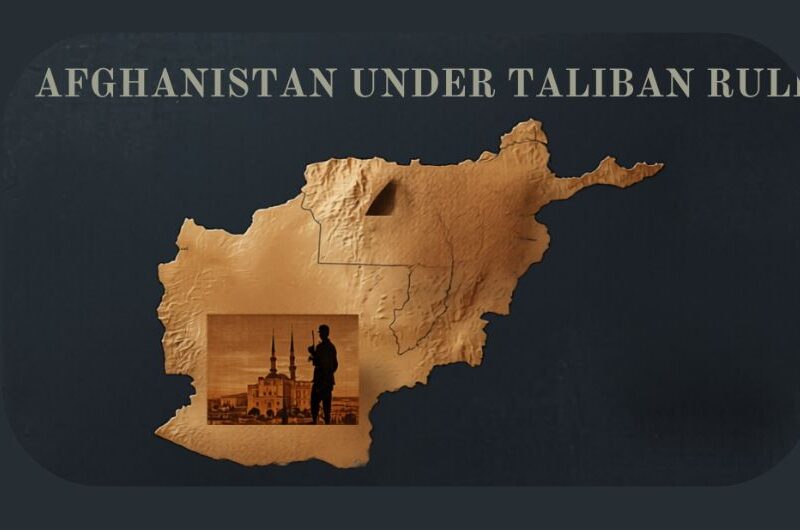
Afghanistan Under Taliban Rule
1. In 2025, Afghanistan remained under unchallenged Taliban rule, with authority concentrated in the hands of Emir Hibatullah Akhundzada and no movement toward constitutional or electoral reform.
2. Russia became the only state to formally recognise the Taliban government, doing so in July 2025, followed by commitments on deeper economic and counter-narcotics cooperation.
3. India did not formally recognise the Taliban in 2025, but increased engagement and invited Acting Foreign Minister Amir Khan Muttaqi to India in October 2025 after UN clearance.
4. During Amir Khan Muttaqi’s six-day India visit in October 2025, New Delhi reaffirmed support for Afghanistan’s sovereignty while pressing the Taliban on women’s rights, inclusive governance, and anti-India security guarantees.
5. Pakistan–Afghanistan relations in 2025 were marked by hostility, including military strikes, border closures, and mutual allegations of harbouring militants.
6. China engaged Afghanistan through a trilateral mechanism with Pakistan, focusing on security cooperation, economic support, and pressure on the Taliban to curb Uyghur militant groups such as ETIM.
7. The Organisation of Islamic Cooperation established a Contact Group on Afghanistan in 2025, while the SCO continued to exclude Afghanistan over concerns related to women’s rights and inclusivity.
8. The security environment remained unstable in 2025, with Islamic State Khorasan Province continuing assassinations, bombings, and sectarian attacks despite Taliban counter-terror operations.
9. UN monitoring recorded 72 resistance-linked attacks between February and April 2025 by anti-Taliban groups such as the National Resistance Front and Afghanistan Freedom Front.
10. Afghanistan’s economy showed modest recovery, with the World Bank estimating growth of around 2.5 percent in 2024 after the sharp downturn that followed 2021.
11. Afghanistan’s trade with Iran reached about USD 1.6 billion in the first half of 2025, surpassing trade with Pakistan and reflecting a major shift in commercial routes.
12. The 2025 UN humanitarian appeal for Afghanistan was only 31 percent funded, leaving major gaps in relief operations across the country.
13. More than half of Afghanistan’s population, around 23 to 24 million people, required emergency assistance in 2025, while about 12.4 million faced acute food insecurity.
14. Around 2.5 million Afghans returned from Pakistan and Iran during 2024–2025, many under coercive conditions, while nearly 10.3 million Afghans remained internally displaced or refugees abroad by late 2024.
15. India upgraded its technical mission in Kabul to Embassy status in 2025, while continuing humanitarian coordination, political outreach, and support for Afghan minorities such as Hindus and Sikhs.
Must Know Terms :
1.HibatullahAkhundzada
Hibatullah Akhundzada remained the supreme authority in Afghanistan during 2025, with power concentrated under his leadership. The Taliban showed no movement toward constitutional reform, elections, or a broader political transition. His centralised role reflected the continued authoritarian character of Taliban rule. Under this structure, resistance persisted only sporadically and did not seriously weaken Taliban control over major cities and security institutions.
2.ISK
ISK refers to Islamic State Khorasan Province, the main extremist threat operating inside Afghanistan during 2025. It continued to carry out assassinations, bombings, and sectarian attacks, especially against minorities, despite Taliban counter-terror efforts. Its persistence showed that Taliban control did not eliminate internal security threats. ISK remained one of the most important destabilising actors affecting Afghanistan’s security and broader regional concerns.
3.Chabahar
Chabahar emerged as a major pillar of Afghanistan’s trade reorientation in 2025 after repeated border disruptions with Pakistan. Trade with Iran reached about USD 1.6 billion in the first half of 2025, surpassing trade with Pakistan. The Taliban announced plans to prioritise Chabahar and Bandar Abbas over Karachi, while India also expanded air freight and retained strategic relevance through Chabahar-linked connectivity.
4.TAPI
TAPI refers to the Turkmenistan-Afghanistan-Pakistan-India gas pipeline project, which remained a symbol of regional connectivity and energy cooperation in 2025. Turkmenistan highlighted progress by inaugurating the Herat-Sherhetabat segment. Although the project still faced uncertainty, it continued to hold strategic importance for Afghanistan’s integration and India’s long-term energy interests. Its progress also reflected wider efforts to stabilise Afghanistan through infrastructure and transit routes.
5.MuttaqiVisit
MuttaqiVisit refers to the October 2025 official visit of Acting Foreign Minister Amir Khan Muttaqi to India after obtaining UN Sanctions Committee clearance. During the six-day visit, India reaffirmed Afghanistan’s sovereignty and territorial integrity while pressing the Taliban on women’s rights, inclusive governance, and anti-India security guarantees. The visit marked a significant step in India’s calibrated but expanding engagement with Taliban-led Afghanistan.
6.ContactGroup
ContactGroup refers to the Afghanistan Contact Group established by the Organisation of Islamic Cooperation in 2025. It was created to coordinate aid delivery and policy positions among Islamic countries regarding Afghanistan. Its formation showed growing concern over Afghanistan’s humanitarian and political situation. At the same time, other regional institutions such as the SCO continued excluding Afghanistan due to concerns over women’s rights and inclusivity.
MCQ
1. In 2025, authority in Afghanistan remained concentrated in the hands of:
A) Abdul Ghani Baradar
B) Sirajuddin Haqqani
C) Hibatullah Akhundzada
D) Amir Khan Muttaqi
2. Which country became the only state to formally recognise the Taliban government in July 2025?
A) China
B) Iran
C) Pakistan
D) Russia
3. India invited Acting Foreign Minister Amir Khan Muttaqi to India in October 2025 after obtaining clearance from:
A) UNSC Sanctions Committee
B) SCO Secretariat
C) OIC Contact Group
D) IMF Executive Board
4. During Amir Khan Muttaqi’s October 2025 visit, India pressed the Taliban on:
A) maritime cooperation and Arctic trade
B) women’s rights, inclusive governance, and anti-India security guarantees
C) immediate recognition of the Taliban regime
D) entry into the Quad framework
5. Pakistan–Afghanistan relations in 2025 were marked mainly by:
A) a full strategic alliance
B) steady economic integration
C) hostility, including military strikes and border closures
D) joint constitutional reform dialogue
6. China engaged Afghanistan through a trilateral mechanism involving:
A) India and Iran
B) Pakistan and Afghanistan
C) Russia and Iran
D) Türkiye and Qatar
7. Which organisation established a Contact Group on Afghanistan in 2025?
A) BRICS
B) SCO
C) ASEAN
D) OIC
8. Afghanistan continued to be excluded from the SCO in 2025 mainly because of concerns over:
A) trade deficits and customs barriers
B) women’s rights and inclusivity
C) narcotics routes alone
D) non-payment of membership dues
9. The principal extremist threat inside Afghanistan in 2025 was:
A) ETIM
B) TTP
C) IS-K
D) NRF
10. UN monitoring recorded how many resistance-linked attacks between February and April 2025?
A) 62
B) 72
C) 82
D) 92
11. The World Bank estimated Afghanistan’s economic growth in 2024 at around:
A) 1.5 percent
B) 2.5 percent
C) 3.5 percent
D) 4.5 percent
12. Afghanistan’s trade with Iran in the first half of 2025 reached about:
A) USD 1.6 billion
B) USD 2.6 billion
C) USD 3.6 billion
D) USD 4.6 billion
13. The 2025 UN humanitarian appeal for Afghanistan was funded only to about:
A) 21 percent
B) 31 percent
C) 41 percent
D) 51 percent
14. Approximately how many Afghans required emergency assistance in 2025?
A) 13 to 14 million
B) 18 to 19 million
C) 23 to 24 million
D) 28 to 29 million
15. In 2025, India upgraded its technical mission in Kabul to:
A) a Consulate General
B) a Special Envoy Office
C) a Development Coordination Cell
D) Embassy status

0 comment