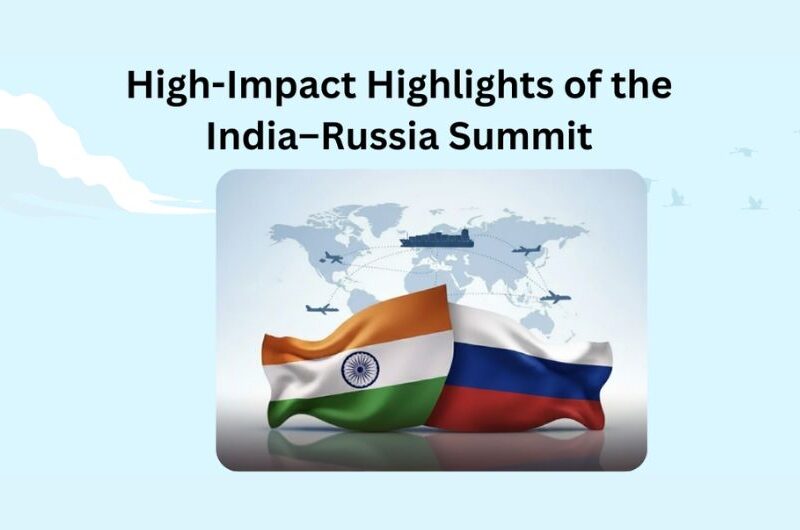
High-Impact Highlights of the India–Russia Summit
1. Summit held in New Delhi on 4–5 December 2025 reaffirmed India–Russia ties amid Ukraine talks and United States pressure on Russian crude purchases, emphasising strategic autonomy and partnerships.
2. Two-way trade in 2024–25 reached 68.69 billion United States dollars (USD): Russian exports 63.3 billion USD, Indian exports 4.8 billion USD, highlighting a persistent deficit needing diversification significantly.
3. Leaders adopted Programme 2030: Programme for Development of Strategic Areas of India–Russia Economic Cooperation till 2030, to boost investment, high technology, and raise Indian merchandise exports into Russia.
4. Free Trade Agreement (FTA) talks with the Eurasian Economic Union (EAEU) were reiterated, but only “intensified negotiations” were promised; no finalisation timeline was announced in the joint statement.
5. Agreement on Migration and Mobility signed to supply skilled Indian workers as Russia faces labour shortages; Indian work permits rose from 5,480 in 2021 to 36,208 in 2024.
6. Parallel pact to curb irregular migration aims for verified contracts, worker protection, and structured channels, reducing exploitation risks while meeting Russia’s manpower needs during war-linked demographic stress today.
7. Maritime corridors were reaffirmed: International North–South Transport Corridor (INSTC), Northern Sea Route (NSR), and Chennai–Vladivostok Maritime Corridor, intended to cut shipping time, lower costs, and improve resilience significantly.
8. Both sides agreed to train Indian seafarers for polar waters operations, supporting Arctic logistics capability and enabling India to diversify supply routes beyond traditional chokepoint-dependent maritime pathways safely.
9. Customs protocol signed for information exchange and streamlined controls; both committed to expanding national-currency settlement mechanisms. President Putin said about 96% of bilateral trade uses this payment system.
10. Defence cooperation stayed central, with push for more joint production. Energy agenda included assurance of uninterrupted crude supply and expansion of civil nuclear cooperation for cleaner diversified power.
11. Kudankulam project: accelerate work on four additional nuclear reactors and explore another similar site, strengthening India’s low-carbon electricity roadmap and long-term energy security under bilateral cooperation for decades.
12. Fertiliser security highlighted: imports from Russia surged 82% year-on-year to 10.2 billion USD during April–October 2025, supporting Indian agriculture that employs over 40% of workers nationally and productivity.
13. Memorandum of Understanding (MoU) signed with JSC UralChem and Indian partners Rashtriya Chemicals and Fertilisers (RCF), National Fertilisers Limited (NFL), and Indian Potash, for urea manufacturing in Russia.
14. Media cooperation agreements expanded content and broadcasting exchange; President Putin inaugurated RT India (Russia Today India) channel, while encouraging Indian media offices in Russia to balance presence better.
15. Key challenges flagged: trade imbalance, market access, Arctic and Far East projects, delayed corridors, and Western pressure. Cooperation in BRICS and SCO was urged to strengthen multipolar outcomes.
Must Know Terms :
1.Rouble: Rouble (RUB) is Russia’s national currency, issued by the Bank of Russia. In the summit context, India–Russia trade increasingly uses national-currency settlement; Putin said about 96% of bilateral trade is settled via such mechanisms. Settlement often pairs rupee–rouble accounts through designated banks, reducing reliance on US dollars and easing sanction-related payment frictions, while creating conversion and repatriation constraints today.
2.Seafarers: Seafarers are trained maritime crew certified under the IMO STCW system (International Maritime Organization Standards of Training, Certification and Watchkeeping). India supplies many officers and ratings globally. The summit outcome included training Indian seafarers for polar-water operations, relevant for Northern Sea Route shipping. Polar routes need ice-navigation skills, cold-weather safety, and specialized vessel procedures, increasing employability and corridor readiness today.
3.Corridor: Corridor here means a defined multimodal logistics route. Three India–Russia corridors were reaffirmed: INSTC (International North–South Transport Corridor), NSR (Northern Sea Route), and Chennai–Vladivostok Maritime Corridor. These aim to shorten distance and time versus traditional routes. Progress remains slow despite years of discussion. Seafarer training and customs information exchange are intended to make corridor operations more practical and bankable today.
4.Customs: Customs agencies control cross-border movement of goods, apply tariffs, enforce prohibitions, and manage risk-based inspections. The summit referenced a protocol to enhance customs cooperation and information exchange, intended to streamline trade flows and optimise control procedures. For India–Russia trade growth, faster clearance, standardised documentation, and data sharing can reduce dwell time and logistics costs. Coordination also supports national-currency settlement compliance.
5.UralChem: UralChem (JSC UralChem) is a major Russian fertiliser producer. Reuters reported Indian fertiliser firms signing a deal with UralChem to set up a urea manufacturing joint venture in Russia. The summit-linked MoU involved RCF (Rashtriya Chemicals and Fertilisers), NFL (National Fertilisers Limited), and Indian Potash. Fertiliser imports from Russia rose 82% year-on-year to USD 10.2 billion in Apr–Oct 2025.
6.Mobility: Mobility refers to cross-border movement of workers. India and Russia signed an Agreement on Migration and Mobility and a pact to prevent irregular migration. Russia faces labour shortages linked to war and demographic decline. Work permits for Indians in Russia rose from 5,480 (2021) to 36,208 (2024). The framework targets legal entry, contracts, worker protection, and recruitment channels.
MCQ :
1. The India–Russia summit referred to here was held in New Delhi on:
A) 4–5 December 2024
B) 4–5 December 2025
C) 14–15 January 2026
D) 22–23 February 2026
2. Two-way trade in FY 2024–25 is given as:
A) USD 58.69 billion
B) USD 63.30 billion
C) USD 68.69 billion
D) USD 73.69 billion
3. In FY 2024–25, Russian exports to India are stated at:
A) USD 4.8 billion
B) USD 36.2 billion
C) USD 63.3 billion
D) USD 96.0 billion
4. In FY 2024–25, Indian exports to Russia are stated at:
A) USD 2.8 billion
B) USD 4.8 billion
C) USD 10.2 billion
D) USD 68.69 billion
5. “Programme 2030” refers to:
A) A 2030 defence exercises calendar
B) A programme for development of strategic areas of economic cooperation till 2030
C) A roadmap to finalise EAEU FTA within 12 months
D) A plan to open 2030 new trade corridors
6. FTA talks reiterated in the summit were with:
A) European Union
B) ASEAN
C) Eurasian Economic Union (EAEU)
D) African Union
7. Indian work permits in Russia are stated to have risen from 5,480 (2021) to:
A) 16,208 (2024)
B) 26,208 (2024)
C) 36,208 (2024)
D) 46,208 (2024)
8. The maritime corridors reaffirmed include INSTC, NSR, and:
A) Mumbai–Dubai Corridor
B) Kolkata–Yangon Corridor
C) Chennai–Vladivostok Maritime Corridor
D) Kochi–Rotterdam Corridor
9. The summit included agreement to train Indian seafarers for:
A) Desert logistics operations
B) Polar waters operations
C) Inland waterways only
D) Riverine patrol operations
10. The customs-related outcome mentioned was a protocol for:
A) Abolishing all tariffs immediately
B) Information exchange and streamlined controls
C) Ending inspections at ports
D) One-time customs clearance for 10 years
11. The share of bilateral trade stated as using national-currency settlement mechanisms is about:
A) 56%
B) 76%
C) 86%
D) 96%
12. The energy agenda included assurance of uninterrupted crude supply and expansion of:
A) Coal mining cooperation
B) Civil nuclear cooperation
C) Hydropower-only projects
D) Biofuel mandates
13. Under the Kudankulam project, both sides aimed to accelerate work on:
A) Two additional reactors
B) Three additional reactors
C) Four additional reactors
D) Six additional reactors
14. Fertiliser imports from Russia are stated to have surged 82% year-on-year to:
A) USD 6.2 billion (Apr–Oct 2025)
B) USD 8.2 billion (Apr–Oct 2025)
C) USD 10.2 billion (Apr–Oct 2025)
D) USD 12.2 billion (Apr–Oct 2025)
15. The urea manufacturing MoU in Russia mentioned JSC UralChem and Indian partners including:
A) RCF, NFL, Indian Potash
B) SAIL, GAIL, IOC
C) NABARD, SIDBI, EXIM Bank
D) FCI, NAFED, CCI

0 comment