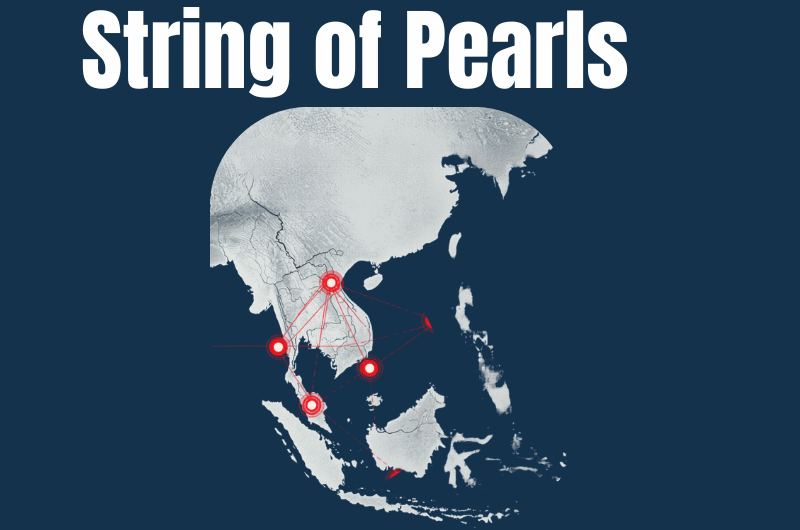
String of Pearls
1. The “String of Pearls” refers to China’s strategy of developing a network of commercial and military ports across the Indian Ocean Region.
2. The term “String of Pearls” was coined by the United States to describe China’s expanding strategic presence around India.
3. The main objective of the strategy is to secure China’s energy supply lines and maritime trade routes.
4. The strategy is closely linked with China’s attempt to overcome the “Malacca Dilemma”.
5. The Strait of Malacca is a major maritime chokepoint through which a large portion of China’s energy imports and exports pass.
6. Gwadar Port in Pakistan is one of the key “pearls” and is strategically linked with the China-Pakistan Economic Corridor.
7. Hambantota Port and Colombo Port in Sri Lanka are important Chinese-linked maritime infrastructure projects in the Indian Ocean Region.
8. Chittagong Port in Bangladesh is considered part of China’s wider maritime footprint in South Asia.
9. Kyaukpyu Port and the Coco Islands in Myanmar are strategically important for China’s access to the Bay of Bengal.
10. Djibouti hosts a major Chinese naval and military logistics base near the Horn of Africa.
11. China’s port network strengthens the blue-water capabilities and operational reach of the People’s Liberation Army Navy.
12. For India, the String of Pearls creates concerns of strategic encirclement around the Indian peninsula.
13. Chinese-controlled or Chinese-funded ports may create surveillance and national security challenges for India in the Indian Ocean Region.
14. India’s counter-strategy is often described as the “Necklace of Diamonds”, involving strategic access to ports such as Chabahar, Duqm, and Sabang.
15. India has strengthened maritime domain awareness through the Information Fusion Centre–Indian Ocean Region and infrastructure development in the Andaman and Nicobar Islands.
Must Know Terms :
1. StringOfPearls
String of Pearls refers to China’s strategy of developing a network of ports and naval facilities across the Indian Ocean Region. These ports help China secure maritime trade routes, protect energy supply lines, and expand its strategic influence around India.
2. MalaccaDilemma
Malacca Dilemma refers to China’s vulnerability due to its heavy dependence on the Strait of Malacca for energy imports and trade. Since this chokepoint can be blocked during conflict, China develops alternate maritime and land routes through ports and corridors.
3. GwadarPort
Gwadar Port in Pakistan is one of the most important pearls in China’s strategy. It is linked with the China-Pakistan Economic Corridor and provides China access to the Arabian Sea, close to the Persian Gulf and major energy routes.
4. HambantotaPort
Hambantota Port in Sri Lanka is a major Chinese-linked port in the Indian Ocean Region. It is often discussed in the context of debt-trap diplomacy and strategic vulnerability, as Chinese control over such infrastructure increases Beijing’s influence near India’s southern maritime zone.
5. NecklaceOfDiamonds
Necklace of Diamonds is India’s counter-strategy to China’s String of Pearls. It includes strategic partnerships, port access, naval cooperation, and infrastructure development at locations such as Chabahar Port, Duqm Port, Sabang Port, Andaman and Nicobar Islands, and Agalega Island.
6. IFCIOR
Information Fusion Centre–Indian Ocean Region is an Indian initiative to improve maritime domain awareness. It helps monitor shipping movement, track suspicious activities, and strengthen information-sharing with partner countries in the Indian Ocean Region.
MCQ :
1. The term “String of Pearls” refers to China’s strategy of developing:
A. Agricultural trade corridors across Asia
B. Commercial and military ports across the Indian Ocean Region
C. Inland industrial zones in Central Asia
D. Digital infrastructure networks in Europe
2. The term “String of Pearls” was coined by:
A. India
B. China
C. United States
D. Japan
3. The main objective of the String of Pearls strategy is to secure China’s:
A. Himalayan border regions
B. Energy supply lines and maritime trade routes
C. Domestic agricultural production
D. Arctic shipping routes only
4. The String of Pearls strategy is closely linked with China’s attempt to overcome:
A. Hormuz Dilemma
B. Suez Dilemma
C. Malacca Dilemma
D. Panama Dilemma
5. Strait of Malacca is important for China because:
A. It connects China directly with Europe by land
B. It is a major maritime chokepoint for China’s energy imports and exports
C. It is the headquarters of China’s naval command
D. It is China’s only domestic oil-producing region
6. Gwadar Port is located in:
A. Bangladesh
B. Pakistan
C. Sri Lanka
D. Myanmar
7. Gwadar Port is strategically linked with:
A. China-Pakistan Economic Corridor
B. International North-South Transport Corridor
C. India-Middle East-Europe Economic Corridor
D. Mekong-Ganga Cooperation
8. Hambantota Port and Colombo Port are located in:
A. Myanmar
B. Bangladesh
C. Sri Lanka
D. Maldives
9. Chittagong Port is associated with China’s maritime footprint in:
A. Bangladesh
B. Pakistan
C. Djibouti
D. Oman
10. Kyaukpyu Port and Coco Islands are strategically important for China’s access to:
A. Persian Gulf
B. Bay of Bengal
C. Mediterranean Sea
D. Black Sea
11. Djibouti is significant in the String of Pearls strategy because it hosts:
A. China’s major naval and military logistics base
B. India’s largest overseas air base
C. Japan’s largest trade corridor
D. Russia’s Arctic naval facility
12. China’s port network strengthens the operational reach of:
A. People’s Liberation Army Navy
B. Indian Coast Guard
C. Japan Maritime Self-Defense Force
D. United States Central Command
13. For India, the String of Pearls mainly creates concerns of:
A. Agricultural dependency
B. Strategic encirclement
C. Currency instability
D. Domestic migration
14. India’s counter-strategy to the String of Pearls is often called:
A. Iron Curtain
B. Necklace of Diamonds
C. Blue Dot Network
D. Golden Triangle
15. Which of the following is part of India’s maritime domain awareness efforts?
A. Information Fusion Centre–Indian Ocean Region
B. China-Myanmar Economic Corridor
C. Gwadar Port Authority
D. Hambantota Port Lease




0 comment