Russia in 2025
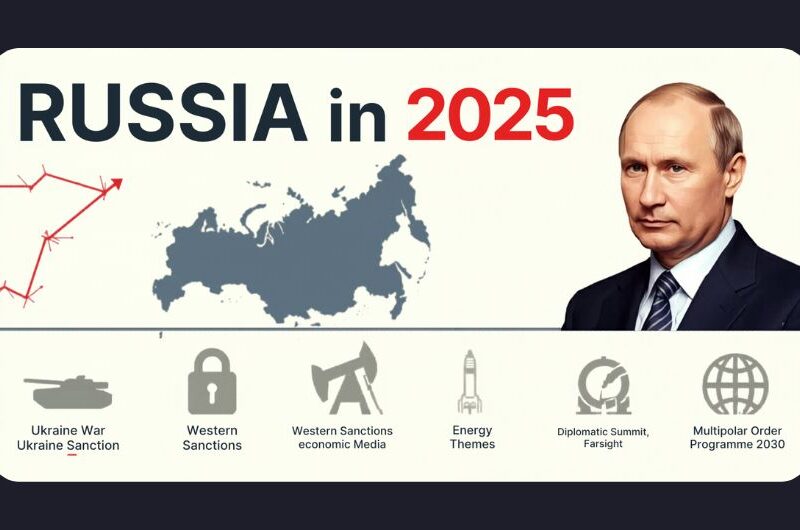
1. In 2025, Russia operated in a difficult geopolitical environment shaped by the continuing Ukraine war, Western sanctions, and a broader transition toward a multipolar international order.
2. Domestic political stability in Russia remained strong in 2025, with President Vladimir Putin recording an approval rating of 86 percent in June 2025.
3. Russia’s GDP growth slowed sharply in 2025, with the economy expanding by only 0.6 percent year-on-year in the third quarter.
4. Ukrainian drone strikes disrupted Russian oil refining capacity in 2025, contributing to a 4.5 percent decline in oil output.
5. Russia avoided economic collapse by redirecting exports toward Asia and the Middle East, while increasing domestic production in defence, energy, and high-technology sectors.
6. In 2025, Russia created a Unified Unmanned Systems Command to integrate doctrine, procurement, and deployment of drones, loitering munitions, robotic land systems, and counter-UAV capabilities.
7. Russia continued large-scale production of missiles, air defence systems, artillery modules, and electronic warfare platforms during 2025.
8. In early 2025, Russia and Iran finalised a Comprehensive Strategic Partnership Treaty covering cooperation in energy logistics, technology, defence, and financial systems.
9. Russia also expanded engagement with India, China, Gulf states, Türkiye, and Central Asian governments as part of its non-Western strategic and economic reorientation.
10. The Anchorage Summit held in August 2025 marked the first meeting between Vladimir Putin and Donald Trump since the Ukraine conflict began, reopening diplomatic channels.
11. In November 2025, an informal 28-point peace framework on Ukraine proposed territorial concessions by Ukraine, abandonment of NATO ambitions, and U.S. security guarantees.
12. India–Russia trade reached USD 68.7 billion in FY 2024–25, with Indian exports at USD 4.88 billion and imports at USD 63.84 billion.
13. Bilateral India–Russia cooperation in 2025 covered defence maintenance, energy partnerships, and emerging technologies including navigation, AI-enabled defence systems, and space platforms.
14. Russian President Vladimir Putin visited New Delhi on 4–5 December 2025 for the 23rd India–Russia Leaders’ Summit, marking 25 years of the Indo-Russia Strategic Partnership.
15. At the December 2025 summit, both sides launched Programme 2030, an ambitious roadmap aimed at achieving USD 100 billion in balanced bilateral trade by 2030.
Must Know Terms :
1.PutinApproval
PutinApproval refers to the strong domestic political support recorded for President Vladimir Putin in 2025 despite war, sanctions, and economic pressure. In June 2025, his approval rating stood at 86 percent. This reflected continued regime stability and public backing for Russian state policy. The figure also indicated that external pressure had not translated into internal political weakening or leadership erosion.
2.UnifiedUnmannedCommand
UnifiedUnmannedCommand was established by Russia in 2025 to consolidate doctrine, procurement, and deployment of unmanned systems under one structure. It covers drones, loitering munitions, robotic land systems, and counter UAV capabilities. The command reflects lessons drawn from the Ukraine war, where unmanned systems became central to battlefield outcomes. It also supports Russia’s ambition to become an exporter in this domain globally.
3.AnchorageSummit
AnchorageSummit refers to the August 2025 meeting in Anchorage, Alaska, between Vladimir Putin and Donald Trump. It was their first meeting since the Ukraine conflict began. Although no formal agreement emerged, the summit reopened frozen diplomatic channels and created space for further de escalation discussions. It signalled movement from confrontation toward exploratory diplomacy on ceasefire pathways, guarantees, and conflict management.
4.Programme2030
Programme2030 is the roadmap launched by India and Russia at the 23rd India Russia Leaders’ Summit in New Delhi on 4–5 December 2025. It aims to raise bilateral trade to USD 100 billion by 2030 in a balanced form. The plan emphasises diversification beyond hydrocarbons, joint manufacturing under Make in India, and expanded cooperation in nuclear energy, space, and sectors.
5.GLONASSNavIC
GLONASSNavIC refers to late 2025 discussions between India and Russia on ground station interoperability between Russia’s GLONASS system and India’s NavIC system. These talks signalled movement toward higher value cooperation beyond legacy defence trade. The proposed link could strengthen navigation services, technology collaboration, dual use capabilities, and space based systems. It also reflected an effort to deepen bilateral cooperation further.
6.Multipolarity
Multipolarity describes Russia’s preferred international order in which power is distributed among several major centres rather than dominated by the West. In 2025, Moscow advanced this idea through closer ties with China, Iran, India, the Gulf states, Türkiye, and Central Asia. The concept was linked to sanctions resilience, alternative financial networks, non Western connectivity corridors, and opposition to Western dominance.
MCQ
1. In 2025, Russia’s geopolitical environment was mainly shaped by:
A. the end of the Ukraine war and lifting of sanctions
B. the continuing Ukraine war, Western sanctions, and transition toward a multipolar order
C. complete integration with the European Union
D. a domestic constitutional transition
2. President Vladimir Putin’s approval rating in June 2025 stood at:
A. 76 percent
B. 96 percent
C. 86 percent
D. 66 percent
3. Russia’s GDP growth in the third quarter of 2025 was:
A. 1.6 percent year-on-year
B. 0.6 percent year-on-year
C. 2.6 percent year-on-year
D. 3.6 percent year-on-year
4. Ukrainian drone strikes in 2025 contributed to what decline in Russian oil output?
A. 2.5 percent
B. 3.5 percent
C. 4.5 percent
D. 5.5 percent
5. Russia avoided economic collapse in 2025 mainly by:
A. fully restoring trade with Western Europe
B. redirecting exports toward Asia and the Middle East and increasing domestic production in strategic sectors
C. ending wartime expenditure
D. abandoning defence-industrial expansion
6. In 2025, Russia created which command to integrate doctrine, procurement, and deployment of unmanned systems?
A. Strategic Drone Integration Authority
B. Unified Unmanned Systems Command
C. National Robotic Warfare Directorate
D. Russian Autonomous Operations Bureau
7. In early 2025, Russia finalised a Comprehensive Strategic Partnership Treaty with:
A. China
B. India
C. Iran
D. Türkiye
8. The Anchorage Summit of August 2025 was significant because it marked:
A. the signing of a formal Ukraine peace treaty
B. the first meeting between Vladimir Putin and Donald Trump since the Ukraine conflict began
C. Russia’s entry into a NATO dialogue mechanism
D. the launch of Programme 2030
9. The informal 28-point peace framework circulated in November 2025 proposed, among other things:
A. immediate NATO membership for Ukraine
B. territorial concessions by Ukraine and abandonment of NATO ambitions
C. total lifting of sanctions without conditions
D. partition of Russia into security zones
10. India–Russia trade in FY 2024–25 reached:
A. USD 58.7 billion
B. USD 68.7 billion
C. USD 78.7 billion
D. USD 88.7 billion
11. Indian exports to Russia in FY 2024–25 stood at:
A. USD 4.88 billion
B. USD 6.88 billion
C. USD 8.88 billion
D. USD 3.88 billion
12. Russian President Vladimir Putin visited New Delhi for the 23rd India–Russia Leaders’ Summit on:
A. 19–20 August 2025
B. 25–26 October 2025
C. 4–5 December 2025
D. 31 August–1 September 2025
13. Programme 2030 launched at the December 2025 summit aims to achieve what level of balanced bilateral trade by 2030?
A. USD 80 billion
B. USD 90 billion
C. USD 110 billion
D. USD 100 billion
14. GLONASS–NavIC discussions in late 2025 were related to:
A. oil settlement mechanisms
B. ground station interoperability between Russian and Indian navigation systems
C. a new fighter aircraft project
D. Arctic shipping routes
15. Multipolarity, as advanced by Russia in 2025, refers to:
A. an order dominated by Western institutions alone
B. a system in which power is distributed among several major centres rather than dominated by the West
C. complete rejection of all multilateral organisations
D. exclusive military alignment with NATO




0 comment