India U.S. Trade Breakthrough and Export Gains
1. India secured preferential access to the United States market valued at about 30 trillion dollars, marking a major trade breakthrough across goods, technology cooperation, and multiple export-oriented sectors.
2. India’s exports to the United States stood at 86.35 billion dollars in 2024, and the agreement significantly improves competitive access across major manufacturing, agriculture, services, and technology sectors.
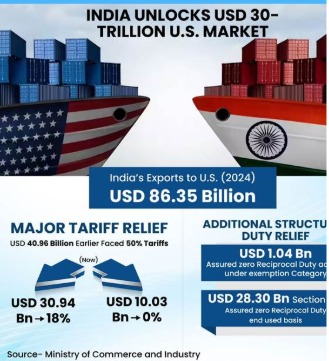
3. Reciprocal tariffs had reached 50 percent on several Indian products, but under the agreement tariffs on 30.94 billion dollars of exports were reduced sharply to 18 percent.
4. Tariffs on another 10.03 billion dollars worth of Indian exports were reduced from 50 percent to zero, greatly improving price competitiveness for Indian products in America.
5. Additional structural duty relief assures zero reciprocal duty access for 28.30 billion dollars under Section 232 end-use commitments, covering products where earlier duties could rise to 50 percent.
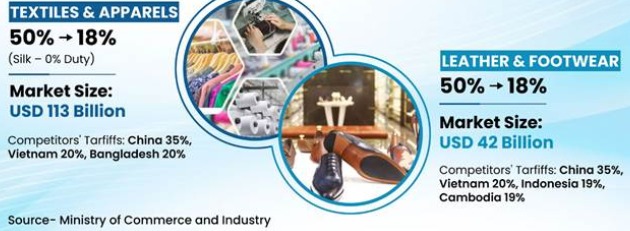
6. Textiles and apparel gained major tariff cuts from 50 percent to 18 percent, while silk secured zero-duty access, opening stronger opportunities in a United States market.
7. Leather and footwear exports from India now face tariffs of 18 percent instead of 50 percent, improving access to the 42 billion dollar United States market.
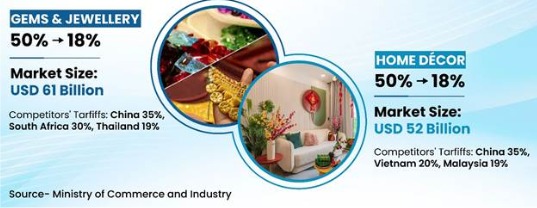
8. Gems and jewellery exports gained tariff reduction from 50 percent to 18 percent, while diamonds, platinum, and coins secured zero-duty access in a 29 billion market.
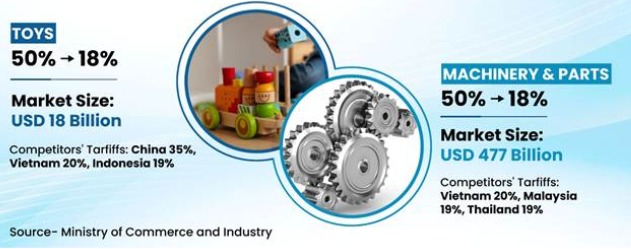
9. Home décor exports received tariff reduction from 50 percent to 18 percent, while selected products including seats, chandeliers, and illuminated signs secured zero-duty access additionally.
10. Machinery and parts exports, excluding aircraft parts, now face reduced tariffs of 18 percent instead of 50 percent, expanding opportunities in the 477 billion dollar market.
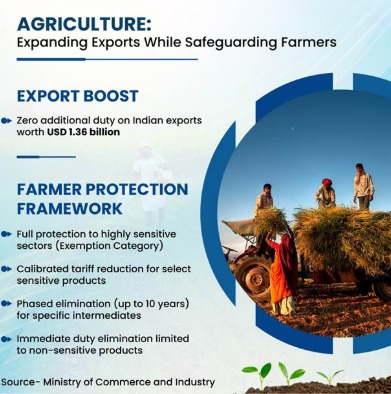
11. India maintains a 1.3 billion dollar agricultural trade surplus with the United States, with exports of 3.4 billion dollars and imports of 2.1 billion.
12. The United States will apply zero additional duty on 1.36 billion dollars of Indian agricultural exports, including spices, tea, coffee, fruits, nuts, and processed products.
13. Highly sensitive agricultural sectors remain protected, including dairy, meat, poultry, cereals, millets, pulses, oilseeds, ethanol for fuel, and various other strategically sensitive farm products.
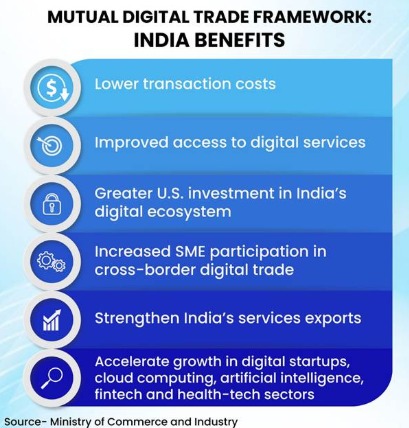
14. The agreement also secures zero additional duty access for 38 billion dollars of industrial exports, including aircraft parts, generic drugs, pharmaceutical ingredients, machinery, and auto components.
15. India ranked fifth globally in digitally delivered services exports in 2024, recording 0.28 trillion dollars, while the agreement aims to strengthen digital trade and technology cooperation.
Must Know Terms :
1.CBAM
CBAM means Carbon Border Adjustment Mechanism. It is the European Union’s border levy framework linked to carbon emissions embedded in imported goods. It is designed to reduce carbon leakage and align import costs with the EU carbon pricing system. For India, it matters because it can affect export competitiveness in carbon-intensive sectors and has been criticized as a trade-restrictive climate measure.
2.MSMEs
MSMEs means Micro, Small and Medium Enterprises. In the trade agreement context, these units are expected to benefit strongly in labour-intensive sectors such as textiles, leather, footwear, toys, home décor, and processed goods. Lower tariffs improve their price competitiveness in the U.S. market, support production scaling, increase export participation, strengthen cluster-based manufacturing, and create additional employment in smaller business ecosystems.
3.TRQs
TRQs means Tariff Rate Quotas. Under this mechanism, a fixed quantity of a product is allowed entry at a lower customs duty, while imports beyond that quota attract a higher tariff. In the agreement, products such as in-shell almonds, walnuts, pistachios, and lentils were placed under TRQs. This method allows limited market opening while preserving tariff protection for sensitive domestic sectors.
4.Copra
Copra is dried coconut kernel used mainly for extracting coconut oil and producing related coconut-based products. It is an agricultural commodity with export importance in tropical economies. In the agreement, copra and coconut oil are among the items receiving zero additional U.S. duty treatment. Its inclusion is significant because it widens farm export access alongside spices, tea, coffee, fruits, nuts, and processed products.
5.Peptones
Peptones are protein breakdown products obtained by partial hydrolysis of animal, plant, or microbial material. They are widely used in food processing, pharmaceuticals, biotechnology, microbiological culture media, and industrial formulations. In the agreement, peptones and their derivatives were placed under phased tariff elimination up to ten years. This longer phase-out period provides adjustment time to domestic users and related processing industries.
6.Abalone
Abalone is a high-value edible marine mollusc considered a premium seafood product in global trade. It is often sold fresh, frozen, canned, or processed for niche consumption markets. In the agreement, abalone appears among consumer-oriented imports given limited and structured access to widen product choice without significantly disturbing domestic supply. It is grouped with berries, premium foods, select oils, and frozen fish products.
Key Takeaways :
1.India secured preferential access to a USD 30 trillion U.S. market
2. Textiles & apparel gain tariff cuts from 50% to 18%, with silk securing 0% duty access in a USD 113 billion U.S. market
3. Machinery exports see tariffs reduced to 18%, opening opportunities in a USD 477 billion U.S. market
4. USD 1.36 billion of Indian agricultural exports receive zero additional U.S. duty access
5. Key products including spices, tea, coffee, fruits, nuts and processed foods gain zero-duty treatment
6. Highly sensitive sectors such as dairy, meat, poultry and cereals remain fully protected
- What India gets?
a. Highly competitive rate of 18% on $ 900 bn worth of global imports of the U.S.
b. Zero duty on $ 150 bn worth of global imports of the U.S.
c. No additional duty on $ 720 bn worth of global imports of the U.S.
d. Exemption continues $ 350 bn worth of global imports of the U.S.
e. Preferential treatment on 232 tariffs
MCQ :
1. India secured preferential access to the United States market valued at about:
A) 20 trillion dollars
B) 25 trillion dollars
C) 30 trillion dollars
D) 35 trillion dollars
2. India’s exports to the United States in 2024 stood at:
A) 76.35 billion dollars
B) 86.35 billion dollars
C) 96.35 billion dollars
D) 106.35 billion dollars
3. Under the agreement, tariffs on 30.94 billion dollars of Indian exports were reduced from 50 percent to:
A) 25 percent
B) 20 percent
C) 18 percent
D) 15 percent
4. Tariffs on another 10.03 billion dollars worth of Indian exports were reduced from 50 percent to:
A) 10 percent
B) 5 percent
C) 2 percent
D) zero
5. Zero reciprocal duty access under Section 232 end-use commitments was assured for:
A) 18.30 billion dollars
B) 22.30 billion dollars
C) 28.30 billion dollars
D) 32.30 billion dollars
6. In textiles and apparel, tariffs were reduced from 50 percent to:
A) 28 percent
B) 22 percent
C) 20 percent
D) 18 percent
7. Silk secured:
A) 5 percent duty access
B) 2 percent duty access
C) zero-duty access
D) preferential quota access only
8. Leather and footwear exports from India now face tariffs of:
A) 12 percent
B) 15 percent
C) 18 percent
D) 20 percent
9. In gems and jewellery, zero-duty market access was secured for major product categories including:
A) diamonds, platinum and coins
B) silver utensils, carpets and clocks
C) machinery, yarn and gloves
D) toys, lamps and paper products
10. Machinery and parts exports, excluding aircraft parts, now face reduced tariffs of:
A) 25 percent
B) 22 percent
C) 20 percent
D) 18 percent
11. India maintains an agricultural trade surplus with the United States of:
A) 0.8 billion dollars
B) 1.0 billion dollars
C) 1.3 billion dollars
D) 1.8 billion dollars
12. The United States will apply zero additional duty on Indian agricultural exports worth:
A) 1.16 billion dollars
B) 1.26 billion dollars
C) 1.36 billion dollars
D) 1.46 billion dollars
13. Which of the following remained fully protected as a highly sensitive agricultural sector?
A) silk
B) dairy
C) diamonds
D) machinery
14. The agreement secures zero additional duty access for industrial exports valued at:
A) 28 billion dollars
B) 32 billion dollars
C) 35 billion dollars
D) 38 billion dollars
15. India ranked which globally in digitally delivered services exports in 2024?
A) third
B) fourth
C) fifth
D) sixth




0 comment