
Strengthening India’s National Accounts and Core Economic Statistics
1. India is revising the base year for Gross Domestic Product estimates from 2011-12 to 2022-23 to better reflect current economic structure, digitalisation, and newly emerging sectors.
2. The year 2022-23 was selected as the new GDP base because it is considered the most recent normal year after disruptions caused during 2019-20 and 2020-21.
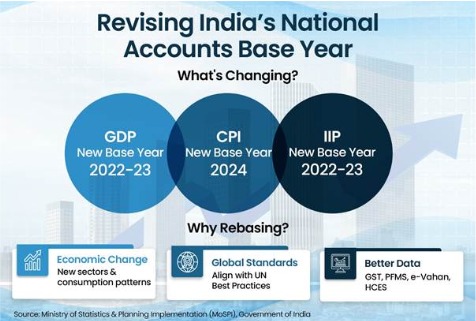
3. Real-time administrative databases such as e-Vahan, Public Financial Management System, and Goods and Services Tax system are being incorporated to improve national accounts accuracy, detail, and sectoral coverage.
4. The Consumer Price Index base year is being revised to 2024 using Household Consumption Expenditure Survey 2023-24 data for updated baskets and expenditure weights.
5. The CPI base revision began in early 2023 under an Expert Group including representatives from RBI, key ministries, academia, and senior government officials.
6. The Index of Industrial Production base year is being revised to 2022-23 to update item weights, sectoral coverage, factory representation, and consistency with national accounts.
7. The rebased GDP series with base year 2022-23 was scheduled for release on 27 February 2026 under the announced Ministry of Statistics timetable.
8. The new Consumer Price Index series with base year 2024 was scheduled for release on 12 February 2026 as part of statistical modernisation.
9. The new Index of Industrial Production series with base year 2022-23 was slated for release on 28 May 2026 under the official schedule.
10. The services sector contributes around 50 percent of India’s GDP, creating the need for improved granular statistical coverage of incorporated and unincorporated service enterprises.
11. A pilot study for the Annual Survey of Service Sector Enterprises was undertaken by the National Statistical Office to fill data gaps in incorporated services.
12. Starting 2025, Quarterly Bulletins on Unincorporated Sector Enterprises were introduced to provide quarterly estimates instead of waiting for detailed annual unincorporated sector reports.
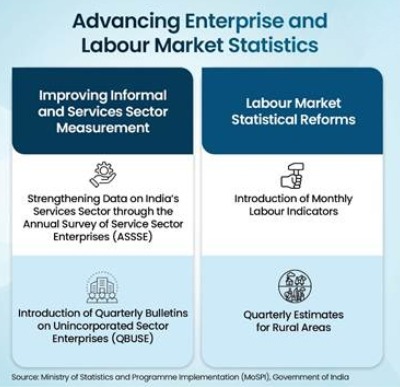
13. The Periodic Labour Force Survey methodology was revised from January 2025 to generate monthly national estimates and quarterly rural labour market indicators.
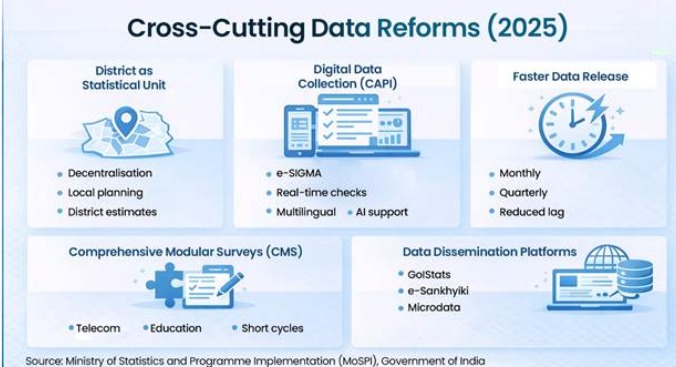
14. From January 2025, district was made the basic sampling stratum in National Sample Surveys, enabling district-level estimates across PLFS, ASUSE, and related surveys.
15. The revamped Microdata Portal launched in 2025 recorded 88 lakh hits since January 2025, reflecting expanded public access to official unit-level datasets.
Must Know Terms :
1. eVahan
eVahan is a real-time administrative database related to vehicle registrations. It is being incorporated into India’s revised national accounts framework to improve GDP estimation accuracy and sectoral detail. Its inclusion reflects the wider use of digitised administrative records in official statistics. In the current statistical reforms, eVahan is cited among the new granular data sources supporting the GDP base year revision to 2022-23.
2.PFMS
PFMS stands for Public Financial Management System. It is a real-time administrative database now being used in India’s statistical modernisation to strengthen national accounts compilation. PFMS provides granular public finance-related economic data and is listed among the new digital sources being incorporated into GDP estimation. Its role has gained importance in the revision of the GDP base year from 2011-12 to 2022-23 for better coverage.
3.QBUSE
QBUSE stands for Quarterly Bulletins on Unincorporated Sector Enterprises. Starting in 2025, it was introduced to provide quarterly estimates instead of waiting for annual reports on the unincorporated non-agricultural sector. It uses the same framework as ASUSE while focusing on scale, composition, and employment profile. Its launch reflects the National Statistical Office’s effort to provide more timely and actionable data on informal enterprises.
4.ASSSE
ASSSE stands for Annual Survey of Service Sector Enterprises. It was developed after a pilot study by the National Statistical Office to fill the gap in regular national-level data on incorporated service sector enterprises. The survey is designed to capture Gross Value Added, fixed capital, capital formation, employment, and other operational features. Its questionnaire was prepared under the guidance of the Technical Advisory Group.
5.eSIGMA
eSIGMA is the digital platform through which National Sample Survey data collection is now conducted using Computer Assisted Personal Interviewing. It includes in-built validation checks, real-time data submission, multilingual interfaces, and Artificial Intelligence enabled chatbot support. These features have improved field efficiency and data quality. eSIGMA is part of the wider statistical reform aimed at faster release cycles and stronger survey design across India.
6.eSankhyiki
eSankhyiki is a comprehensive official data platform launched in June 2024. It hosts more than 136 million records, 772 indicators, and 18 statistical products across nine thematic areas. It has onboarded datasets from DPIIT, Ministry of Labour and Employment, Ministry of Health and Family Welfare, and the Reserve Bank of India. It also supports API-based dissemination and integration with platforms like NDAP.
Key Takeaways
A. Base year for GDP estimates being revised to 2022-23to reflect new economic structures.
B. CPI base year is revised to 2024, updating the consumption basket and weights for both rural and urban households.
C. IIP is being revised to 2022-23,aligned with the new national accounts series.
D. Informal sector measurement has improvedwith quarterly QBUSE bulletins.
E. District-level estimation has become a core design featureacross PLFS, ASUSE, and NSS surveys.
F. Public access to official data has been expanded through GoIStats, e-Sankhyiki, and the revamped Microdata Portal, supporting transparency and data reuse.
MCQ :
1. India is revising the base year for Gross Domestic Product estimates from:
A) 2004-05 to 2022-23
B) 2011-12 to 2022-23
C) 2014-15 to 2022-23
D) 2016-17 to 2022-23
2. The new GDP base year was chosen as 2022-23 mainly because it was considered:
A) the first post-liberalisation year
B) the highest growth year in the decade
C) the most recent normal year after pandemic disruptions
D) the base year used by the World Bank
3. Which of the following real-time administrative databases are being incorporated into revised national accounts?
A) e-Vahan, PFMS and GST system
B) PMJDY, UPI and Aadhaar
C) GeM, ONDC and DigiLocker
D) CoWIN, e-Sanjeevani and ORS
4. The Consumer Price Index base year is being revised to:
A) 2022
B) 2023
C) 2024
D) 2025
5. The revised CPI basket and expenditure weights are based on:
A) PLFS 2023-24
B) HCES 2023-24
C) NSS 2022-23
D) ASUSE 2024-25
6. The CPI base revision process began in early:
A) 2021
B) 2022
C) 2023
D) 2024
7. The Index of Industrial Production base year is being revised to:
A) 2021-22
B) 2022-23
C) 2023-24
D) 2024-25
8. The rebased GDP series with base year 2022-23 was scheduled for release on:
A) 12 February 2026
B) 27 February 2026
C) 28 May 2026
D) 30 June 2026
9. The new CPI series with base year 2024 was scheduled for release on:
A) 12 February 2026
B) 27 February 2026
C) 28 May 2026
D) 1 July 2026
10. The new IIP series with base year 2022-23 was slated for release on:
A) 12 February 2026
B) 27 February 2026
C) 28 May 2026
D) 28 June 2026
11. The services sector contributes around what share of India’s GDP?
A) 40 percent
B) 45 percent
C) 50 percent
D) 55 percent
12. Which survey was piloted by NSO to fill data gaps in incorporated services?
A) ASUSE
B) ASSSE
C) QBUSE
D) PLFS
13. Starting 2025, which new quarterly publication was introduced for the unincorporated non-agricultural sector?
A) ASSSE
B) CMS
C) QBUSE
D) e-SIGMA Bulletin
14. From January 2025, PLFS methodology was revised to generate:
A) annual district estimates only
B) monthly national estimates and quarterly rural indicators
C) only quarterly urban estimates
D) only state-level unemployment ratios
15. The revamped Microdata Portal launched in 2025 recorded how many hits since January 2025?
A) 68 lakh
B) 78 lakh
C) 88 lakh
D) 98 lakh




0 comment