Startup India and India’s Innovation Ecosystem
1. As of December 2025, India had over 2 lakh DPIIT-recognised startups, placing it among the world’s largest startup ecosystems.
2. Around 50 percent of DPIIT-recognised startups come from Tier II and Tier III cities, showing broad regional spread of entrepreneurship.
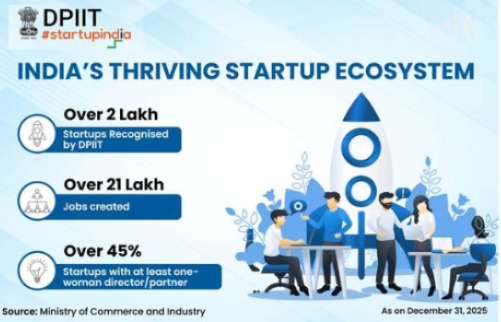
3. More than 45 percent of recognised startups had at least one woman Director or Partner as of December 2025.
4. India’s unicorn base rose from 4 firms in 2014 to over 120 by January 2026, with combined valuation above 350 billion dollars.
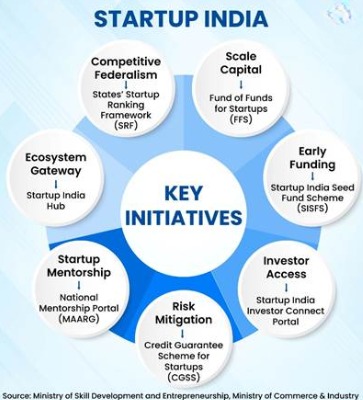
5. The Fund of Funds for Startups has a corpus of ₹10,000 crore and has committed support to over 140 AIFs.
6. Those AIFs collectively invested more than ₹25,500 crore in over 1,370 startups under the Fund of Funds framework.
7. Under the Credit Guarantee Scheme for Startups, more than 330 loans worth over ₹800 crore had been guaranteed for startup borrowers.
8. The Startup India Seed Fund Scheme has a corpus of ₹945 crore and approvals were given to more than 215 incubators.
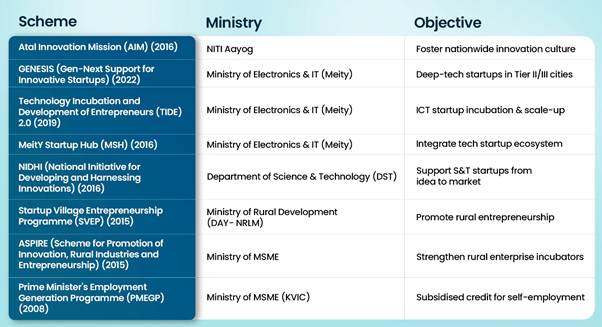
9. Atal Innovation Mission, launched in 2016, has an outlay of ₹2,750 crore up to March 2028.
10. More than 10,000 Atal Tinkering Labs were operational across 733 districts, engaging over 1.1 crore students and enabling 16 lakh plus innovation projects.
11. GENESIS, launched in July 2022 by MeitY, has a budget outlay of ₹490 crore over five years to support about 1,600 technology startups.
12. As of December 2025, MeitY Startup Hub supported over 6,148 startups, more than 517 incubators, and over 329 labs nationwide.
13. TIDE 2.0, introduced in 2019, channels support through 51 incubators located in leading academic institutions and national research organisations.
14. NIDHI has supported over 12,000 startups, generated more than 1,30,000 jobs, backed over 175 Technology Business Incubators, and produced 1,100 plus IP outputs.
15. SVEP had supported 3.74 lakh enterprises by 30 June 2025, while PMEGP supports projects up to ₹50 lakh in manufacturing and ₹20 lakh in services.
Must Know Terms :
1. MAARG
MAARG stands for Mentorship, Advisory, Assistance, Resilience, and Growth. It is the National Mentorship Portal under Startup India. It connects startups with experienced mentors across sectors. The portal was created to provide easier mentorship access nationwide, especially for young ventures needing strategic guidance. It functions as a structured support platform within India’s startup ecosystem, strengthening advisory access beyond physical incubator networks.
2.GENESIS
GENESIS means Gen Next Support for Innovative Startups. It was launched by MeitY in July 2022 as a National Deep-tech Startup Platform. It has a budget outlay of ₹490 crore over five years. The programme aims to scale about 1,600 technology startups. It focuses especially on Tier II and Tier III cities through implementing agencies, expanding deep-tech support beyond major metropolitan startup centres.
3.TIDE
TIDE 2.0 stands for Technology Incubation and Development of Entrepreneurs. It was introduced in 2019 under MeitY to support ICT startups using emerging technologies such as IoT, AI, blockchain, and robotics. The scheme covers seven thematic areas including healthcare, education, agriculture, financial inclusion, infrastructure and transportation, environment, and clean tech. Support is channelled through 51 incubators in leading institutions and research organisations.
4.NIDHI
NIDHI stands for National Initiative for Developing and Harnessing Innovations. It was launched in 2016 by the Department of Science and Technology. It supports knowledge-based and technology-driven ideas into startups. The programme has supported over 12,000 startups, generated more than 1,30,000 jobs, backed over 175 Technology Business Incubators, and produced 1,100 plus intellectual property outputs, showing its scale in innovation-led entrepreneurship support.
5.SVEP
SVEP stands for Startup Village Entrepreneurship Program. It was implemented in May 2015 under DAY-NRLM to promote rural entrepreneurship. It helps poor households establish and expand local enterprises through financial and technical support. The programme reduces poverty through self-employment and skilled wage opportunities. As of 30 June 2025, it had supported 3.74 lakh enterprises, strengthening grassroots livelihoods, local market activity, and rural income diversification.
6.ASPIRE
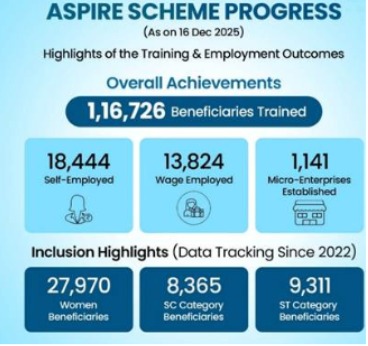
ASPIRE stands for A Scheme for Promotion of Innovation, Rural Industries and Entrepreneurship. It was launched by the Ministry of MSME in 2015. It promotes rural innovation through Livelihood Business Incubators, micro-enterprise creation, skilling, and re-skilling. For plant and machinery, it provides up to ₹1 crore to government agencies and ₹75 lakh to private agencies, besides operational expenditure support up to ₹1 crore.
Key Takeaways
• With over 2 lakh DPIIT-recognised startups as of December 2025, India stands firmly as one of the world’s largest startup ecosystems.
• A decade of Startup India has built a full-lifecycle support system spanning ideation, funding, mentorship, and scale-up.
• Around 50% of DPIIT-recognised startups originate from Tier-II and Tier-III cities, signalling the democratisation of entrepreneurship.
• AIM 2.0 centred on piloting new initiatives to address ecosystem gaps and scaling proven models in collaboration with Governments, industry, academia, and communities.
• Rural and grassroots programmes such as SVEP, ASPIRE, and PMEGP are enabling micro-enterprises, women-led ventures, and local jobs.
MCQ :
1. As of December 2025, India had more than how many DPIIT-recognised startups?
A) 1.5 lakh
B) 2.5 lakh
C) 1 lakh
D) 2 lakh
2. Around what proportion of DPIIT-recognised startups originate from Tier II and Tier III cities?
A) 60 percent
B) 30 percent
C) 50 percent
D) 40 percent
3. More than what percentage of recognised startups had at least one woman Director or Partner as of December 2025?
A) 35 percent
B) 45 percent
C) 55 percent
D) 25 percent
4. India’s unicorn count increased from 4 firms in 2014 to over how many by January 2026?
A) 100
B) 80
C) 140
D) 120
5. The Fund of Funds for Startups has a corpus of:
A) ₹7,500 crore
B) ₹5,000 crore
C) ₹10,000 crore
D) ₹12,500 crore
6. The Fund of Funds has committed support to over how many AIFs?
A) 170
B) 110
C) 90
D) 140
7. Those AIFs collectively invested more than how much in startups?
A) ₹15,500 crore
B) ₹20,500 crore
C) ₹30,500 crore
D) ₹25,500 crore
8. Under the Credit Guarantee Scheme for Startups, more than how many loans had been guaranteed?
A) 430
B) 330
C) 530
D) 230
9. The Startup India Seed Fund Scheme has a corpus of:
A) ₹1,045 crore
B) ₹845 crore
C) ₹745 crore
D) ₹945 crore
10. Approvals under the Startup India Seed Fund Scheme were given to more than how many incubators?
A) 115
B) 215
C) 265
D) 165
11. Atal Innovation Mission has an outlay of:
A) ₹3,250 crore up to March 2028
B) ₹1,750 crore up to March 2028
C) ₹2,750 crore up to March 2028
D) ₹2,250 crore up to March 2028
12. More than 10,000 Atal Tinkering Labs were operational across how many districts?
A) 783
B) 633
C) 683
D) 733
13. GENESIS, launched in July 2022 by MeitY, aims to support about how many technology startups?
A) 1,600
B) 1,200
C) 1,000
D) 1,400
14. As of December 2025, MeitY Startup Hub supported over how many startups?
A) 5,148
B) 4,148
C) 7,148
D) 6,148
15. SVEP had supported how many enterprises by 30 June 2025?
A) 4.74 lakh
B) 5.74 lakh
C) 3.74 lakh
D) 2.74 lakh


0 comment