India’s Expanding Clean and Strategic Energy Framework
1. India’s energy system is being reshaped to provide reliable, affordable, cleaner, and more secure power for households, farms, industries, transport systems, and public services.
2. Average electricity availability in rural areas increased from 12.5 hours in 2014 to 22.6 hours, while urban power supply improved from 22.1 hours to 23.4 hours.
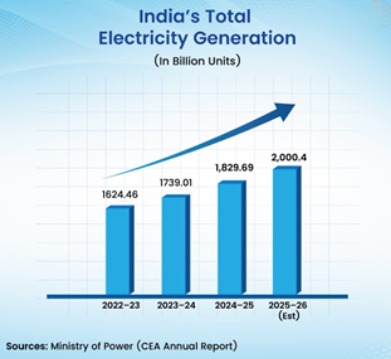
3. India is among the world’s top three energy consumers, and total electricity generation rose from 1,739.09 Billion Units in 2023-24 to 1,829.69 Billion Units in 2024-25.
4. For 2025-26, India set an electricity generation target of 2,000.4 Billion Units, reflecting rising power demand linked with economic growth and expanding energy access.
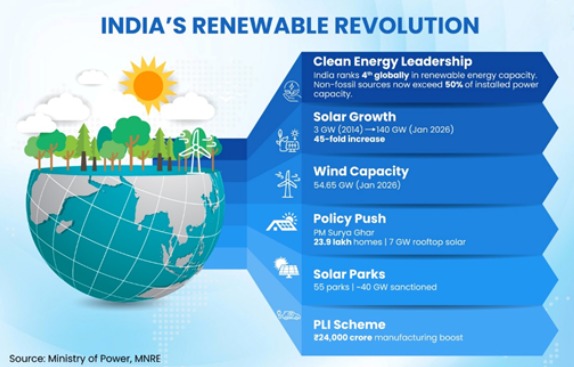
5. India ranks fourth globally in total installed renewable energy capacity, while installed solar capacity rose sharply from 3 GW in 2014 to 140 GW in January 2026.
6. Non-fossil fuel capacity has moved beyond 50 percent of total installed electricity capacity, showing the growing role of clean energy in India’s power mix.
7. India’s cumulative installed wind capacity reached about 54.65 GW by January 2026, making wind power a major contributor to grid diversification alongside solar energy.
8. PM Surya Ghar enabled 23.9 lakh households to install rooftop solar systems, adding 7 GW of distributed clean energy capacity across the country.
9. PM-KUSUM promotes solarisation in agriculture and aims to install 14 lakh standalone pumps by 31 March 2026, reducing diesel dependence and improving rural energy supply.
10. India approved 55 solar parks across 13 states with nearly 40 GW sanctioned capacity, while the solar PLI scheme with ₹24,000 crore supports domestic manufacturing.
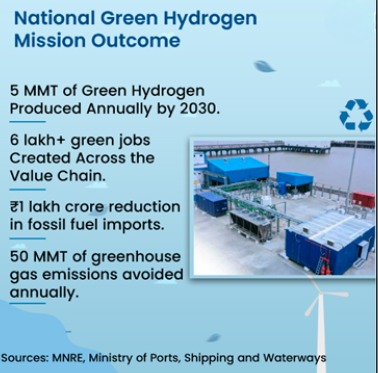
11. Under the National Green Hydrogen Mission, India targets production of 5 million metric tonnes of green hydrogen annually by 2030 with major investment and emission-reduction goals.
12. The green hydrogen mission has an approved outlay of ₹19,744 crore till FY 2029-30, including ₹17,490 crore under the SIGHT programme for electrolysers and hydrogen production.
13. India’s present nuclear power capacity stands at 8.78 GW and is projected to rise to 22.38 GW by 2031-32, with a long-term target of 100 GW by 2047.
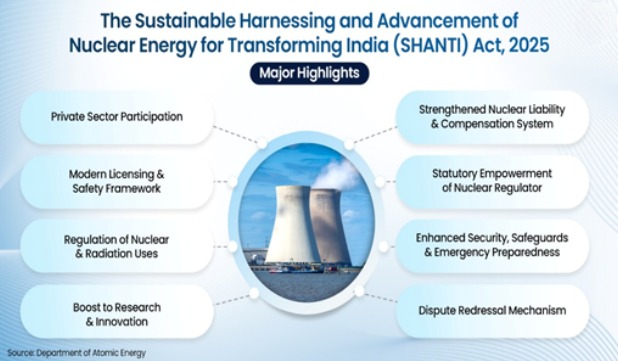
14. The SHANTI Act, 2025 modernised the nuclear legal framework by enabling limited private participation, recognising AERB statutorily, introducing graded liability, and strengthening safety safeguards.
15. Power distribution reforms expanded electricity access through village electrification, household connections, smart metering, RDSS investment, and digital systems like the India Energy Stack for efficient governance.
Must Know Terms :
1. SHANTI
SHANTI stands for Sustainable Harnessing and Advancement of Nuclear Energy for Transforming India Act, 2025. It modernised India’s nuclear legal framework. The Act enables limited private sector participation under regulatory oversight, grants statutory recognition to AERB, introduces a graded liability framework, strengthens safety, security, and safeguards, and retains sovereign control over sensitive nuclear fuel-cycle activities. It supports expansion from 8.78 GW toward future targets.
2.SIGHT
SIGHT means Strategic Interventions for Green Hydrogen Transition. It is the main incentive component of the National Green Hydrogen Mission. Out of the mission outlay of ₹19,744 crore till FY 2029-30, ₹17,490 crore is allocated under SIGHT. It supports domestic electrolyser manufacturing and green hydrogen production. This framework helps India pursue its target of producing 5 million metric tonnes annually by 2030.
3.UDIT
UDIT stands for Urja Dakshata Information Tool. It is a digital platform used to improve transparency, monitoring, and compliance in India’s energy-efficiency system. It supports data-based tracking of performance across sectors and complements market reforms such as the Carbon Credit Trading Scheme. UDIT helps strengthen governance where efficient energy use matters for savings, lower demand pressure, compliance reporting, and better implementation outcomes nationally.
4.RDSS
RDSS means Revamped Distribution Sector Scheme. It was launched in 2021 with an outlay of ₹3.03 lakh crore to improve the financial and operational condition of power distribution companies. Projects worth about ₹2.8 lakh crore have been approved under it. RDSS supports infrastructure modernisation and smart metering. It is linked with broader reforms, including installation of 5.62 crore smart electricity meters across India.
5.AERB
AERB stands for Atomic Energy Regulatory Board. It is India’s nuclear regulatory authority responsible for radiation and nuclear safety oversight. The SHANTI Act, 2025 gave it statutory recognition, strengthening its institutional status. AERB is important as India’s present nuclear capacity of 8.78 GW is projected to rise to 22.38 GW by 2031-32, while the long-term nuclear mission targets 100 GW by 2047.
6.IES
IES means India Energy Stack. It is a Digital Public Infrastructure designed for trusted digital interaction among consumers, utilities, regulators, and distributed energy assets. It is based on open standards and consent-based data sharing. IES aims to standardise data exchange, simplify onboarding across utilities, enable consumer choice, and support monetisation of rooftop solar, batteries, EV chargers, and flexible loads at scale nationwide.
MCQ:
1. India’s average electricity availability in rural areas increased from 12.5 hours in 2014 to:
A) 20.4 hours
B) 21.6 hours
C) 22.6 hours
D) 23.4 hours
2. Urban power supply improved from 22.1 hours in 2014 to:
A) 22.6 hours
B) 23.4 hours
C) 23.8 hours
D) 24.0 hours
3. Total electricity generation in India rose from 1,739.09 Billion Units in 2023-24 to:
A) 1,800.69 Billion Units
B) 1,829.69 Billion Units
C) 1,900.40 Billion Units
D) 2,000.40 Billion Units
4. India’s electricity generation target for 2025-26 was set at:
A) 1,950.4 Billion Units
B) 1,980.4 Billion Units
C) 2,000.4 Billion Units
D) 2,050.4 Billion Units
5. India ranks ______ globally in total installed renewable energy capacity.
A) second
B) third
C) fourth
D) fifth
6. Installed solar capacity in India increased from 3 GW in 2014 to:
A) 120 GW
B) 130 GW
C) 135 GW
D) 140 GW
7. India’s cumulative installed wind capacity by January 2026 was about:
A) 44.65 GW
B) 49.65 GW
C) 54.65 GW
D) 59.65 GW
8. PM Surya Ghar enabled how many households to install rooftop solar systems?
A) 21.9 lakh
B) 22.9 lakh
C) 23.9 lakh
D) 24.9 lakh
9. PM Surya Ghar added distributed clean energy capacity of:
A) 5 GW
B) 6 GW
C) 7 GW
D) 8 GW
10. PM-KUSUM aims to install how many standalone pumps by 31 March 2026?
A) 10 lakh
B) 12 lakh
C) 14 lakh
D) 16 lakh
11. India approved 55 solar parks across 13 states with nearly:
A) 30 GW sanctioned capacity
B) 35 GW sanctioned capacity
C) 40 GW sanctioned capacity
D) 45 GW sanctioned capacity
12. Under the National Green Hydrogen Mission, India aims to produce green hydrogen annually by 2030 to the extent of:
A) 3 million metric tonnes
B) 4 million metric tonnes
C) 5 million metric tonnes
D) 6 million metric tonnes
13. The approved outlay of the National Green Hydrogen Mission till FY 2029-30 is:
A) ₹17,490 crore
B) ₹18,744 crore
C) ₹19,744 crore
D) ₹20,744 crore
14. India’s present nuclear power capacity stands at:
A) 7.78 GW
B) 8.78 GW
C) 9.78 GW
D) 10.78 GW
15. RDSS was launched in 2021 with an outlay of:
A) ₹2.03 lakh crore
B) ₹2.80 lakh crore
C) ₹3.03 lakh crore
D) ₹3.30 lakh crore

0 comment