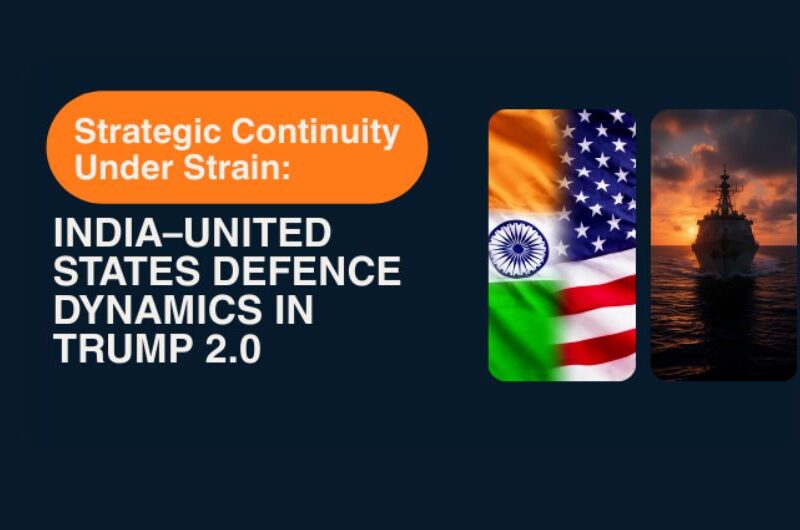
Strategic Continuity Under Strain: India–United States Defence Dynamics in Trump 2.0
1. India–United States ties during Trump 2.0’s first year remained fragile and were sustained more by institutional resilience built over three decades than by fresh political momentum after the Modi–Trump meeting on 13 February 2025.
2. A key source of friction was the imposition of United States tariffs, reportedly reaching up to 50% on several Indian exports, linked to India’s continued import of Russian oil along with wider bilateral trade disputes.
3. Repeated United States claims of mediation on India–Pakistan issues, along with sensitivities over immigration, agriculture, and reduced leader-level engagement, adversely affected Indian public sentiment and mutual trust.
4. Defence cooperation remained the most resilient pillar of the India–US Comprehensive Global Strategic Partnership and functioned as an island of continuity despite turbulence across other sectors.
5. Major defence cooperation expanded sharply during 2015–2020, continued despite CAATSA-related sanction risks, and later evolved toward advanced technology collaboration and defence-industrial cooperation.
6. The broader context included the postponed QUAD summit planned in India in 2025, growing Trump–Pakistan military proximity, 2025 United States National Security Strategy priorities, and renewal of the 10-year defence framework.
7. Major military exercises during 2025 included Tiger Triumph from 01–13 April, Yudh Abhyas from 01–14 September, and Malabar from 08–18 November, reflecting continued operational coordination.
8. Delivery of the final three Apache attack helicopters for the Indian Army was completed on 16 December 2025, in addition to the larger fleet already contracted for the Indian Air Force and Army.
9. Deliveries of GE F404 IN20 engines for the Light Combat Aircraft Tejas Mk1A resumed in 2025, and five out of the 99 contracted engines had been delivered by December 2025 after earlier delays.
10. In November 2025, Hindustan Aeronautics Limited signed an agreement with General Electric for 113 additional F404 engines, with deliveries scheduled for 2027–2032 to support 97 aircraft ordered by the Indian Air Force.
11. In mid-November 2025, the United States Defence Security Cooperation Agency notified Congress of a proposed 93 million United States dollar sale including Javelin anti-tank guided missiles and Excalibur precision artillery munitions for India.
12. Around 15 of the 24 MH-60R Seahawk helicopters contracted in 2020 had been delivered, full induction was expected by end-2026, and India signed a 946 million United States dollar five-year sustainment package in December 2025.
13. QUAD engagement continued in functional terms, with Foreign Ministers meeting in Washington DC in January and July 2025, while workshops and working groups advanced areas such as counterterrorism and critical minerals cooperation.
14. The framework for the US–India Major Defence Partnership was renewed in late October 2025 for another 10 years, with priority areas including maritime security, intelligence sharing, counterterrorism, and missile defence.
15. A major strategic risk remained the proposed Sanctioning Russia Act, under which tariffs could rise up to 500% on India, even as Russia-origin defence imports had already fallen below 50% during 2019–23.
Must Know Terms :
1) PVSM (Param Vishisht Seva Medal): This is one of India’s highest peacetime military decorations. It is awarded for “distinguished service of the most exceptional order.” It can be given to officers of the Army, Navy, Air Force, and other uniformed services. It ranks above AVSM and VSM in the peacetime distinguished service category.
2) UYSM (Uttam Yudh Seva Medal): This is a wartime distinguished service medal. It is awarded for exceptional service in an operational context during war or conflict. It ranks below Sarvottam Yudh Seva Medal (SYSM) but above Yudh Seva Medal (YSM). It recognises high-level operational leadership and planning in combat situations.
3) AVSM (Ati Vishisht Seva Medal): This is a peacetime military award for “distinguished service of an exceptional order.” It is lower in precedence than PVSM but higher than VSM. It is awarded to senior officers for outstanding service in command, staff, or leadership roles during peacetime.
4) SM (Sena Medal): Sena Medal is awarded for individual acts of exceptional devotion to duty or courage. It can be given in both peacetime and operational situations. When awarded for gallantry, it is specifically recognised as Sena Medal (Gallantry). It is primarily an Indian Army decoration.
5) VSM (Vishisht Seva Medal): This is a peacetime award for “distinguished service of a high order.” It ranks below AVSM. It is awarded to officers and personnel for meritorious service in command, administration, or technical roles contributing to military effectiveness.
6) BAR: A Bar is not a separate medal but an additional award of the same decoration. If an officer receives the same medal again, a Bar is added to the ribbon. It indicates repeat recognition for distinguished or gallant service under the same award category.
MCQ:
1. India–US defence cooperation is best described as:
A) A partnership limited to trade and tariffs
B) An “island of continuity” insulated from turbulence
C) A stalled domain due to immigration disputes
D) A QUAD-only arrangement without bilateral depth
2. The primary driver of the downturn in India–US sentiment in the first year of Trump 2.0, as described, was:
A) Cancellation of Malabar exercise
B) US tariffs linked to India’s Russian oil imports
C) India’s withdrawal from QUAD
D) India’s refusal to renew defence frameworks
3. The Modi–Trump meeting cited as the early high-optics moment occurred on:
A) 13 February 2024
B) 13 February 2025
C) 20 January 2025
D) 16 December 2025
4. Which additional irritant harmed trust and public sentiment?
A) US claim of mediation on India–Pakistan issues
B) India’s rejection of missile defence cooperation
C) India’s suspension of intelligence sharing
D) US refusal to supply naval helicopters
5. The surge phase of major India–US defence cooperation is placed mainly in:
A) 2005–2010
B) 2010–2015
C) 2015–2020
D) 2021–2025
6. CAATSA is relevant in this context primarily because it:
A) Mandates QUAD naval exercises annually
B) Enables sanctions linked to major Russian defence purchases
C) Funds US exports of agricultural produce to India
D) Regulates immigration quotas for skilled workers
7. Which set correctly matches the cited exercise windows?
A) Tiger Triumph (01–13 April); Yudh Abhyas (01–14 September); Malabar (08–18 November)
B) Tiger Triumph (08–18 November); Yudh Abhyas (01–13 April); Malabar (01–14 September)
C) Tiger Triumph (01–14 September); Yudh Abhyas (08–18 November); Malabar (01–13 April)
D) Tiger Triumph (16–31 December); Yudh Abhyas (01–13 April); Malabar (01–14 September)
8. The final three Apache attack helicopters for the Indian Army were completed on:
A) 16 December 2025
B) 20 January 2026
C) 13 February 2025
D) 08 November 2025
9. The total Apache numbers referenced were:
A) 22 for Indian Army and 6 for Indian Air Force
B) 22 for Indian Air Force and 6 for Indian Army
C) 24 for Indian Air Force and 15 for Indian Army
D) 6 for Indian Air Force and 22 for Indian Army
10. By December 2025 GE F404-IN20 deliveries restarted and:
A) 15 of 24 engines were delivered
B) 5 of 99 engines were delivered
C) 22 of 99 engines were delivered
D) 113 of 113 engines were delivered
11. The November 2025 HAL–GE agreement mentioned was for:
A) 24 MH-60R helicopters
B) 93 million USD worth of missiles and shells
C) 113 additional F404 engines with deliveries planned 2027–2032
D) A 10-year QUAD maritime surveillance lease
12. The proposed DSCA-notified package in mid-November 2025 was valued at approximately:
A) 93 million USD
B) 946 million USD
C) 9.3 billion USD
D) 500 million USD
13. That DSCA-notified package included:
A) Apache spares and Seahawk sustainment only
B) Javelin anti-tank missiles and Excalibur precision munitions
C) S-400 batteries and BrahMos missiles
D) F404 engines and AMRAAM missiles
14. Regarding MH-60R Seahawk helicopters:
A) 15 of 24 delivered; full induction expected by end-2026
B) 24 of 24 delivered; full induction completed in 2025
C) 5 of 99 delivered; full induction expected by 2032
D) 22 of 28 delivered; full induction expected by 2027
15. The December 2025 MH-60R sustainment package is described as:
A) 93 million USD, one-time purchase
B) 946 million USD, five-year sustainment support
C) 500% tariff waiver under a Russia sanctions bill
D) 113-engine support package for Tejas Mk1A


0 comment