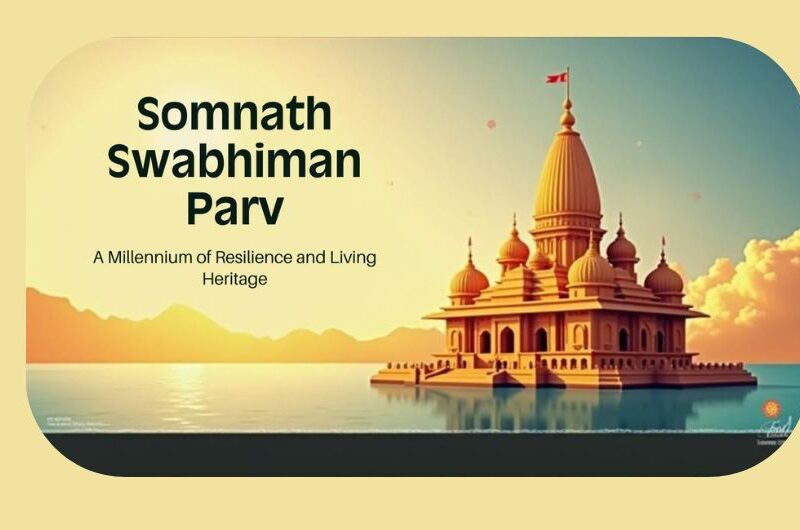
Somnath Swabhiman Parv: A Millennium of Resilience and Living Heritage
1. Somnath Swabhiman Parv (8–11 January 2026) marks 1,000 years since Mahmud of Ghazni’s first recorded assault on Somnath Temple in January 1026 at Prabhas Patan, Gujarat, Saurashtra, on western coastline.
2. Somnath is revered as the first among twelve Jyotirlingas, positioned at the start of India’s sacred spiritual geography, and remains a living symbol of civilisational continuity beside the Arabian Sea.
3. The commemoration emphasises resilience and civilisational self-respect, recalling cycles of destruction and rebuilding across centuries, and the unwavering faith of devotees who restored the shrine after each assault, repeatedly, again.
4. 2026 coincides with 75 years since the present Somnath Temple reopened on 11 May 1951 after Independence, linking medieval memory with modern reconstruction and strengthened national cultural confidence even today.
5. Across four days, Somnath became a centre of spiritual activity and cultural reflection, hosting discourses, devotional music, and programmes while pilgrims participated in rituals that reinforced shared remembrance and community.
6. A 72-hour Akhand Omkar chanting anchored the Parv; on 10 January 2026 the Prime Minister joined chanting and watched a drone show, then symbolically led Shaurya Yatra on 11 January.
7. Tradition associates Prabhas Tirtha with Chandra worshipping Shiva, relief from a curse, and enduring sanctity, situating Somnath within ancient sacred landscapes that shaped regional pilgrimage routes and memory over centuries.
8. Historical accounts describe successive temples erected with varied materials, reflecting evolving craftsmanship and resources, before the eleventh century introduced repeated raids, demolitions, and reconstructions that hardened Somnath’s lasting symbolic stature.
9. On 12 November 1947, Diwali day, Sardar Vallabhbhai Patel visited Somnath’s ruins and resolved to rebuild; reconstruction advanced through public contributions, reinforcing post-independence confidence and civic participation for national renewal.
10. The present temple, built in Kailash Mahameru Prasad architectural style, was consecrated on 11 May 1951 in the presence of President Rajendra Prasad, signifying reopening and reaffirmation of civilisational self-respect.
11. Somnath’s complex includes, in present form, Garbhagriha, Sabhamandap, and Nrityamandap, rising beside the Arabian Sea, crowned by a 150-foot shikhar and 10-tonne kalash, with a 27-foot dhwajdand flagpole marking identity.
12. Annual footfall stays around 92–97 lakh devotees; Bilva Pooja draws about 13.77 lakh, and Maha Shivratri 2025 saw about 3.56 lakh, indicating sustained ritual magnetism and capacity throughout the year.
13. Cultural outreach includes a Light and Sound Show launched in 2003, upgraded in 2017 with narration and 3D laser technology, drawing over 10 lakh visitors in three years, notably so.
14. Declared a Swachh Iconic Place in 2018, Somnath uses sustainability measures: flower vermicompost for 1,700 Bilva trees, plastic-to-paver blocks under Mission LiFE, about 4,700 produced monthly, plus sewage treatment systems.
15. Women’s employment is substantial: Somnath Temple Trust counts 262 women among 906 staff; about 363 women earn roughly ₹9 crore annually through Bilva Van management, prasad distribution, and dining services.
Key Takeaways
- Somnath Swabhiman Parv (8–11 January, 2026) commemorates 1,000 years since the first attack by Mahmud of Ghazni on the Somnath Temple in 1026.
- The Parv celebrates the enduring spirit of India’s civilisation and rich cultural and spiritual heritage.
- Prime Minister Narendra Modi to visit Somnath on 10–11 January, 2026 to participate in key commemorative events.
- Somnath temple draws 92–97 lakh devotees annually.
- Women play a central role at Somnath. The Somnath Temple Trust employs 262 women among 906 employees; in total around 363 women get employment generating about ₹9 crore annually through the temple
MCQ:
1. Somnath Swabhiman Parv (8–11 January 2026) primarily commemorates:
A. 1,000 years since the first recorded attack on Somnath in January 1026
B. 1,000 years since the construction of the present temple in 1026
C. 75 years since the first Jyotirlinga was established at Prabhas Patan
D. 500 years since the last reconstruction of Somnath in 1526
2. Which of the following pairs is correctly matched?
A. Present temple reopened to devotees — 11 May 1950
B. Consecration of present temple — 11 May 1951
C. Diwali-day Patel visit — 12 November 1951
D. Light and Sound Show launched — 2017
3. Consider the following statements:
1. Somnath is associated with Prabhas Tirtha near Veraval in Gujarat.
2. Somnath is described as the first among the twelve Jyotirlingas.
3. The Parv is conceived mainly as a remembrance of destruction.
Which of the statements given above are correct?
A. 1 and 2 only
B. 2 and 3 only
C. 1 and 3 only
D. 1, 2 and 3
4. The core symbolic practice highlighted during the Parv is:
A. 72-hour Akhand Omkar chanting
B. 72-day continuous Bilva Pooja
C. 24-hour Akhand Damru recital
D. 108-hour continuous recitation of Dwadasha Jyotirlinga Stotram
5. The Prime Minister’s participation during 10–11 January 2026 includes:
A. Leading Shaurya Yatra on 10 January and drone show on 11 January
B. Joining Omkar chanting and witnessing a drone show on 10 January
C. Addressing the gathering before offering prayers on 10 January only
D. Performing consecration rituals of the present temple on 11 January
6. Assertion (A): The Somnath narrative is presented as an unbroken cycle of revival.
Reason (R): The temple was rebuilt after repeated demolitions through collective resolve of devotees.
A. Both A and R are true, and R is the correct explanation of A
B. Both A and R are true, but R is not the correct explanation of A
C. A is true, but R is false
D. A is false, but R is true
7. The architectural style explicitly mentioned for the present Somnath Temple is:
A. Dravida Vimana
B. Vesara Nagara
C. Kailash Mahameru Prasad
D. Maru-Gurjara Solanki
8. Which of the following correctly describes the temple’s vertical elements?
A. Shikhar 150-foot; Kalash 10-tonne; Dhwajdand 27-foot
B. Shikhar 27-foot; Kalash 10-tonne; Dhwajdand 150-foot
C. Shikhar 150-foot; Kalash 27-tonne; Dhwajdand 10-foot
D. Shikhar 10-foot; Kalash 150-tonne; Dhwajdand 27-foot
9. The present temple complex is stated to comprise:
A. Garbhagriha, Sabhamandap, Nrityamandap
B. Garbhagriha, Mahamandap, Antarala
C. Sabhamandap, Pradakshinapath, Vimana
D. Nrityamandap, Gopuram, Kalyanamandap
10. Which of the following is correctly stated about reported annual footfall?
A. 9.2–9.7 lakh devotees annually
B. 92–97 lakh devotees annually
C. 3.56 lakh devotees annually
D. 13.77 lakh devotees annually
11. With reference to cultural initiatives, which statement is correct?
A. The Light and Sound Show began in 2017 and was enhanced in 2003
B. The Light and Sound Show began in 2003 and was enhanced in 2017 with narration and 3D laser
C. The Light and Sound Show began in 2001 to mark 50 years of reopening
D. The Vande Somnath Kala Mahotsav began in 2018 as a cleanliness initiative
12. Consider the following statements regarding sustainability practices:
1. Temple flowers are converted into vermicompost nourishing about 1,700 Bilva trees.
2. Plastic waste is transformed into paver blocks, with about 4,700 produced monthly.
3. Rainwater harvesting systems treat about 30 lakh litres of sewage water per month.
Which of the statements given above are correct?
A. 1 and 2 only
B. 2 and 3 only
C. 1 and 3 only
D. 1, 2 and 3
13. A Miyawaki forest initiative at Somnath is described as:
A. 7,200 trees over 72,000 sq ft absorbing about 93,000 kg CO₂ annually
B. 7,200 trees over 93,000 sq ft absorbing about 72,000 kg CO₂ annually
C. 9,300 trees over 72,000 sq ft absorbing about 7,200 kg CO₂ annually
D. 1,700 trees over 72,000 sq ft absorbing about 93,000 kg CO₂ annually
14. Somgangajal, as described, refers to:
A. A distilled seawater product used for temple cleansing
B. Purified Abhishek water bottled for beneficiary families
C. A herbal extract from Bilva leaves distributed as prasad
D. Rainwater harvested and sold for irrigation purposes
15. Consider the following statements on women’s employment:
1. The Trust employs 262 women out of 906 employees.
2. About 363 women receive employment with earnings around ₹9 crore annually.
3. Bilva Van is managed entirely by women.
Which of the statements given above are correct?
A. 1 and 2 only
B. 2 and 3 only
C. 1 and 3 only
D. 1, 2 and 3




0 comment