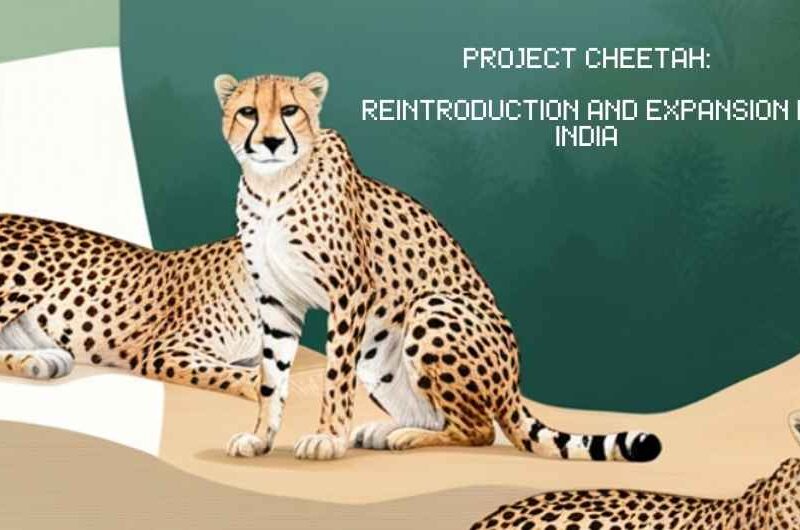
Project Cheetah: Reintroduction and Expansion in India
1.Project Cheetah began on 17 September 2022, reintroducing cheetahs to India at Kuno National Park through intercontinental wild-to-wild translocation as flagship grassland restoration programme.
2.Twenty cheetahs were brought during 2022–23: eight from Namibia and twelve from South Africa, establishing founder stock for population recovery efforts as founders.
3.As of December 2025, the Kuno population totals thirty cheetahs: twelve adults, nine sub-adults, and nine cubs, with nineteen India-born individuals within Kuno landscape.
4.The Asiatic cheetah was declared extinct in India in 1952, following severe hunting, poaching, habitat loss, prey decline, and low reproductive rates in landscapes.
5.The last confirmed wild cheetah sighting occurred in 1947, when three animals were shot in Koriya district forests in present-day Chhattisgarh in preindependence India.
6.Kuno was chosen after relocating twenty-four villages, moving 1,545 families and creating around 6,258 hectares of inviolate grassland habitat for cheetahs for future releases.
7.A phased approach uses quarantine, acclimatization bomas, and soft-release protocols, followed by monitored releases into open wilderness from 2024 onward guided by reintroduction standards.
8.The long-term target is a self-sustaining metapopulation of sixty to seventy cheetahs across about 17,000 square kilometres by 2032, linking multiple habitats nationally coordinated.
9.Gandhi Sagar Wildlife Sanctuary is planned as a second node, with 368 square kilometres sanctuary area and roughly 2,500 square kilometres potential habitat nearby.
10.Monitoring employs GPS collars, camera traps, and distance sampling on 734–816 kilometre transects to track prey, habitat conditions, movements, and survival regularly updated.
11.Early breeding indicates habitat suitability, with multiple litters recorded from 2023 onward, including second-generation births when an India-born female produced cubs with careful monitoring.
12.Mukhi, the first cub born on Indian soil, later delivered five cubs in November 2025, marking strengthened genetic continuity within the reintroduced population successfully.
13.Ranging data show large home ranges: Aasha covers 121 square kilometres, her male cubs 1,508, and the Agni–Vayu coalition 1,819 square kilometres also.
14.Community integration includes over 450 Cheetah Mitras across eighty villages, plus employment for trackers, patrol workers, and locally trained safari guides via local development.
15.The International Big Cat Alliance, launched 9 April 2023 and headquartered in India, has ₹150 crore support for five years till 2027–28 globally.
Must Know Terms :
1. Project Cheetah
Project Cheetah is India’s official cheetah reintroduction programme launched on 17 September 2022 at Kuno National Park. It began with translocation of African cheetahs from Namibia and South Africa and is the world’s first inter-continental translocation of a large carnivore in the wild. Its long-term aim is to create a self-sustaining metapopulation in multiple Indian landscapes.
2. Kuno
Kuno National Park in Madhya Pradesh is the first release site under Project Cheetah. It was selected after major habitat preparation, including relocation of 24 villages to create inviolate grassland-forest space. Kuno now serves as the primary breeding and adaptation landscape for founder cheetahs and India-born cubs and remains the core site for monitoring, management, and early population recovery.
3. Mukhi
Mukhi is the first cheetah cub born on Indian soil under Project Cheetah. In November 2025, Mukhi gave birth to five cubs, making her the first India-born female cheetah to reproduce successfully. This event was treated as a major biological milestone because it demonstrated adaptation, breeding success, and growing long-term viability of the reintroduced population within Indian conditions.
4. Metapopulation
Metapopulation refers to a larger connected population spread across multiple habitats rather than confined to one single site. Under Project Cheetah, India’s target is to build a self-sustaining metapopulation of 60 to 70 cheetahs across about 17,000 square kilometres by 2032. This approach reduces long-term extinction risk by linking several suitable landscapes instead of relying only on Kuno.
5. Cheetah Mitras
Cheetah Mitras are community members engaged around the Project Cheetah landscape to support local outreach, conservation awareness, and coexistence. By December 2025, more than 450 Cheetah Mitras across about 80 villages were associated with the programme near Kuno. Their role is important because community-based participation reduces conflict, strengthens local stewardship, and connects wildlife recovery with rural livelihood opportunities.
6. Gandhi Sagar
Gandhi Sagar Wildlife Sanctuary in Madhya Pradesh has been identified as the next major site for expanding Project Cheetah beyond Kuno. It is intended to become another important node in the future metapopulation network. Its inclusion is significant because the long-term success of cheetah restoration depends on establishing multiple landscapes that can support dispersal, breeding, and genetic continuity.
Snapshot
a) World’s first inter-continental translocation of a large carnivore successfully completed with 20 cheetahs from Namibia and South Africa (2022-23) coming to India.
b) Prime Minister Shri Narendra Modi personally released the first eight cheetahs on 17 September 2022
c) As of December 2025, India has a total of 30 cheetahs – 12 adults, 9 sub-adults, and 9 cubs – comprising 11 founder animals and 19 India-born individuals.
d) Mukhi, the first cheetah cub born on Indian soil, has herself become a mother to five healthy cubs.
e) Over 450 Cheetah Mitras, 380 direct jobs, and 5% eco-tourism revenue share created for local communities around Kuno.
MCQ:
1. With reference to Project Cheetah, consider the following statements:
1. It began on 17 September 2022 at Kuno National Park.
2. It involved intercontinental wild-to-wild translocation.
Which of the statements given above is/are correct?
A. 1 only
B. 2 only
C. Both 1 and 2
D. Neither 1 nor 2
2. Consider the following:
1. Eight cheetahs were brought from Namibia.
2. Twelve cheetahs were brought from South Africa.
The above numbers relate to cheetah translocations to India during:
A. 2020–21
B. 2021–22
C. 2022–23
D. 2023–24
3. As of December 2025, the Kuno cheetah population totals 30, consisting of:
A. 12 adults, 9 sub-adults, 9 cubs
B. 9 adults, 12 sub-adults, 9 cubs
C. 12 adults, 12 sub-adults, 6 cubs
D. 10 adults, 10 sub-adults, 10 cubs
4. The Asiatic cheetah was declared extinct in India in:
A. 1947
B. 1952
C. 1962
D. 1972
5. The last confirmed wild cheetah sighting in India (1947) is associated with:
A. Gir forests in Gujarat
B. Koriya district forests in present-day Chhattisgarh
C. Sundarbans in West Bengal
D. Corbett landscape in Uttarakhand
6. Kuno was selected after relocating:
A. 12 villages and 750 families, creating about 3,000 hectares inviolate habitat
B. 18 villages and 1,200 families, creating about 5,000 hectares inviolate habitat
C. 24 villages and 1,545 families, creating about 6,258 hectares inviolate habitat
D. 30 villages and 1,800 families, creating about 8,000 hectares inviolate habitat
7. Which of the following best describes the phased approach used in Project Cheetah?
A. Immediate hard release without acclimatization or quarantine
B. Quarantine, acclimatization bomas, soft-release, followed by monitored releases into wilderness
C. Captive breeding in zoos first, then release after five generations
D. Relocation only within India without any enclosure-based acclimatization
8. The long-term target under Project Cheetah is to establish:
A. 30–40 cheetahs across 10,000 sq km by 2030
B. 60–70 cheetahs across about 17,000 sq km by 2032
C. 80–90 cheetahs across about 25,000 sq km by 2035
D. 100 cheetahs across 30,000 sq km by 2040
9. Gandhi Sagar Wildlife Sanctuary is planned primarily as:
A. A third node with 700 sq km sanctuary and 5,000 sq km habitat
B. A second node with 368 sq km sanctuary and ~2,500 sq km potential habitat
C. A first node with 368 sq km sanctuary and 1,000 sq km habitat
D. A corridor-only site without any sanctuary area
10. Monitoring under Project Cheetah includes which of the following?
1. GPS collars
2. Camera traps
3. Distance sampling on 734–816 km transects
Select the correct answer using the code below:
A. 1 and 2 only
B. 2 and 3 only
C. 1 and 3 only
D. 1, 2 and 3
11. Evidence cited for habitat suitability at Kuno includes:
A. Absence of predators and complete prey elimination
B. Multiple litters recorded from 2023 onward, including second-generation births
C. No dispersal outside bomas after release
D. Zero mortality for all founders since introduction
12. Mukhi is known for which of the following?
A. Being the first founder male from South Africa
B. Being the first cub born on Indian soil and later delivering five cubs in November 2025
C. Being the first cheetah to be relocated from Kuno to Gandhi Sagar
D. Being the first cheetah to be declared extinct in India
13. Which of the following combinations correctly matches individuals/coalition with home range size?
A. Aasha – 1,508 sq km; male cubs – 121 sq km; Agni–Vayu – 1,819 sq km
B. Aasha – 121 sq km; male cubs – 1,508 sq km; Agni–Vayu – 1,819 sq km
C. Aasha – 1,819 sq km; male cubs – 1,508 sq km; Agni–Vayu – 121 sq km
D. Aasha – 1,508 sq km; male cubs – 1,819 sq km; Agni–Vayu – 121 sq km
14. Community integration around Kuno includes:
A. 450 Cheetah Mitras across 80 villages, plus jobs for trackers, patrol workers and trained safari guides
B. 80 Cheetah Mitras across 450 villages, plus exclusive private safari concessions
C. Only scientific staff from outside the region, with no local involvement
D. Relocation of all nearby villages without any community programme
15. The International Big Cat Alliance was launched on:
A. 17 September 2022
B. 9 April 2023
C. 12 December 2025
D. 15 August 2021



0 comment