Best UPSC and MPPSC IAS Coaching Classes in Gwalior

Digital Public Infrastructure in India

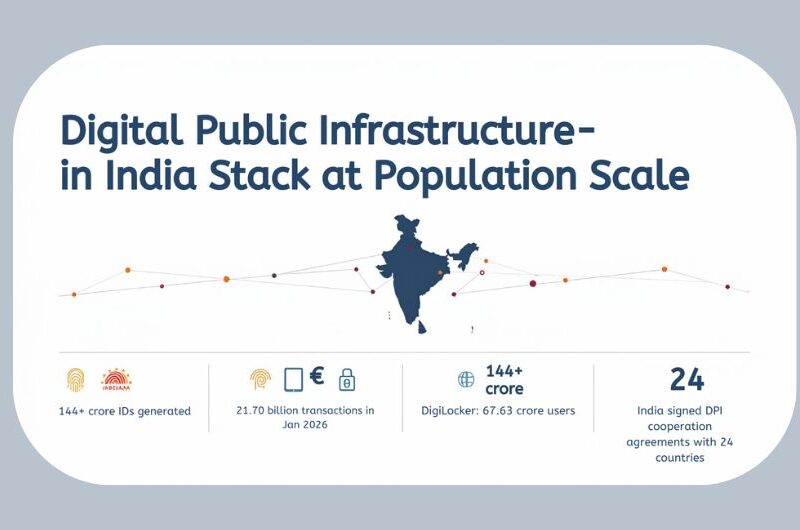
Digital Public Infrastructure in India   1. India has built population scale digital public infrastructure for over 1.4 billion people through open, interoperable systems linking identity, payments and data exchange to governance, welfare delivery and inclusion. 2. The JAM trinity combined Jan Dhan accounts, Aadhaar enrolment and mobile connectivity, creating the foundational digital rails that enabled direct benefit transfers, reduced leakages and strengthened service delivery. 3. As of March 2026, more than 144 crore Aadhaar numbers had been generated, while 2024-25 recorded over 2,707 crore authentication transactions, making identity verification portable, rapid and reliable. 4. Pradhan Mantri Jan Dhan Yojana expanded from 14.72 crore accounts in 2015 to 57.71 crore by March 2026, with deposits rising to ₹2.94 lakh crore nationally. 5. Connectivity deepened digital reach, with 85.5 percent of households owning a smartphone, 125.87 crore wireless subscribers, and 5G available in 99.9 percent districts by December 2025. 6. Unified Payments Interface processed 21.70 billion transactions worth over ₹28.33 lakh crore in January 2026, with 691 banks live, making it India’s dominant retail payments rail. 7. Public Financial Management System strengthened direct benefit transfer architecture, helping save more than ₹4.31 lakh crore between 2015 and March 2024, while cumulative DBT transfers crossed ₹49.09 lakh crore. 8. Open Network for Digital Commerce expanded digital commerce access beyond closed platforms, with over 1.16 lakh retail sellers live across more than 630 cities and towns by December 2025. 9. Government eMarketplace transformed public procurement, processing nearly 3.27 crore orders worth over ₹16.41 lakh crore by November 2025, while enabling broad participation from sellers, service providers, and enterprises. 10. DigiLocker emerged as a large scale digital document wallet, reaching 67.63 crore users by 5 March 2026 and issuing over 950 crore authenticated documents for citizen use. 11. UMANG became a major citizen service platform, recording 10.25 crore user registrations and 723.36 crore transactions by 5 March 2026, while offering more than 2,400 government services. 12. CoWIN became the digital backbone of India’s vaccination programme, managing over 220 crore doses and demonstrating transparent, real time coordination across public and private health systems. 13. eSanjeevani mainstreamed telemedicine in public healthcare, serving 45.42 crore patients and onboarding 2.3 lakh healthcare providers by 5 March 2026, especially improving specialist access in underserved regions. 14. India signed agreements with 24 countries on India Stack and digital public infrastructure by February 2026, while UPI went live in eight countries, expanding global digital cooperation. 15. During its G20 Presidency, India positioned digital public infrastructure as a development accelerator, launched the Global DPI Repository, and reinforced its role as a global reference point.   Must Know Terms : 1. Interoperability Interoperability allowed India’s digital platforms to function across shared public rails instead of isolated systems. It connected identity, payments, documents and service delivery through common standards. This made Aadhaar authentication usable in banking, welfare and governance, enabled UPI across banks, and supported document exchange through DigiLocker and service access through UMANG. It became the operational logic of India Stack. 2.PFMS PFMS stands for Public Financial Management System. It is a web based platform for tracking government fund flow, payments, accounting and reporting. It was mandated for Direct Benefit Transfer in December 2014. Between 2015 and March 2024, savings exceeded ₹4.31 lakh crore through removal of fake and duplicate beneficiaries. By January 2026, cumulative DBT transfers through this system crossed ₹49.09 lakh crore. 3.ONDC ONDC stands for Open Network for Digital Commerce. It was launched in 2022 to create an open digital commerce network instead of one closed marketplace. It links buyers and sellers through interoperable platforms. By December 2025, more than 1.16 lakh retail sellers were live on the network. Its operations had spread across more than 630 cities and towns, expanding digital market access for smaller businesses. 4.MOSIP MOSIP stands for Modular Open Source Identity Platform. It is an India developed open source framework for countries building sovereign digital identity systems. It offers configurable identity architecture instead of a locked proprietary model. It supports national registration, authentication and identity management functions. More than 25 countries are adopting or exploring MOSIP for their identity programmes, making it a major export of India’s digital governance capability. 5.APISetu API Setu is India’s Open API Platform initiated by the Ministry of Electronics and Information Technology in March 2020. It enables secure and standardised sharing of government data and services through application programming interfaces. By March 2026, the platform hosted 8,036 APIs. It had 6,592 consumers, 2,559 publishers and 10,530 organisations onboard, strengthening interoperability across public and private digital ecosystems. 6.UMANG UMANG stands for Unified Mobile Application for New age Governance. It was launched in 2017 as a single window platform for central, state and local government services through mobile and web access. It includes pension, scholarship, utility, passport, licence, Aadhaar and EPFO related services. By 5 March 2026, it recorded 10.25 crore registrations, 723.36 crore transactions and offered more than 2,400 services. Key Takeaways • India has signed DPI cooperation agreements with 24 countries. • UPI is now operational in 8 countries enabling cross border payments. • India Stack Global facilitates DPI adoption by partner nations. • India contributed highest solutions to the Global DPI Repository.  * Strategic Partnerships on Digital Infrastructure MCQ: 1. India’s digital public infrastructure is fundamentally built on linking which three core layers? A) Identity, payments and data exchange B) Roads, ports and airports C) Agriculture, trade and taxation D) Courts, police and defence 2. The JAM trinity consists of: A) Jan Suraksha, Aadhaar and Mobile banking B) Jan Dhan, Aadhaar and Mobile connectivity C) Judicial access, Aadhaar and Markets D) Jan Dhan, API Setu and Mobile wallets 3. As of March 2026, the number of Aadhaar numbers generated had crossed: A) 124 crore B) 134 crore C) 144 crore D) 154 crore 4. During 2024–25, Aadhaar authentication transactions were recorded at more than: A) 1,707 crore B) 2,107 crore C) 2,407 crore D) 2,707 crore 5. Pradhan Mantri Jan Dhan Yojana accounts increased from 14.72 crore in 2015 to:

More Details
India’s AI Governance Framework 2026: Seven Sutras, Safety Institutions and Compute Expansion

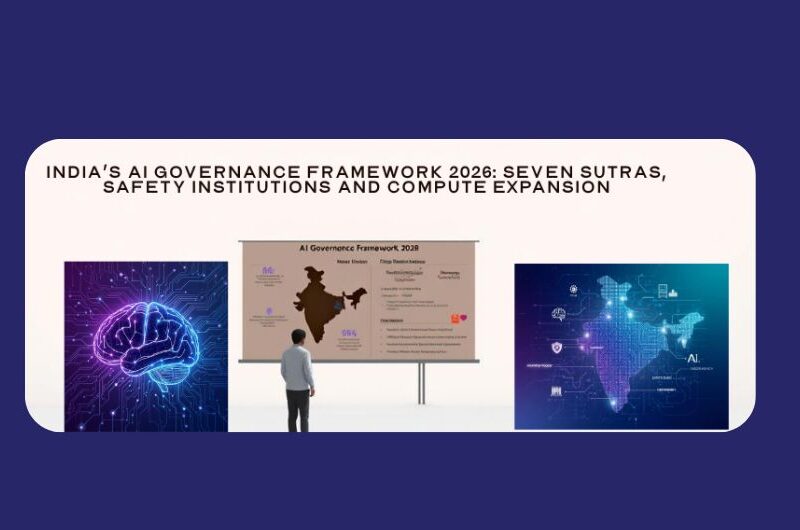
India’s AI Governance Framework 2026: Seven Sutras, Safety Institutions and Compute Expansion   1) India AI Governance Guidelines were released at AI Impact Summit 2026 and adopt a principle-based “techno-legal” framework built around seven Sutras for safe, trusted and inclusive AI innovation.   2) Ministry of Electronics and Information Technology (MeitY) formed the drafting committee in July 2025 to review laws, global developments, research, and public feedback.   3) The framework is presented in four parts: (1) seven Sutras, (2) key issues and recommendations, (3) action plan, and (4) practical guidelines for industry and regulators.   4) Guidelines recommend new national institutions: AI Governance Group (AIGG), Technology & Policy Expert Committee (TPEC), and IndiaAI Safety Institute for standards, testing, and guidance.   5) IndiaAI Mission has onboarded 38,000+ Graphics Processing Units (GPUs) via a subsidised national compute facility, with a stated target of 100,000 GPUs through the IndiaAI Compute Portal.   6) AIKosh hosts 9,500+ datasets and 273 sectoral models, supporting indigenous model development and providing ready resources for sector-specific AI deployment.   7) National Supercomputing Mission has operationalised 40+ petaflop systems, including AIRAWAT and PARAM Siddhi-AI, strengthening high-end compute capacity for AI.   8) Capacity initiatives support 500 PhDs, 5,000 postgraduates, and 8,000 undergraduates; 570 AI Data Labs and 27 IndiaAI labs across states expand grassroots innovation.   9) National Education Policy 2020 integrates AI-linked curriculum; additionally, 174 Industrial Training Institutes (ITIs) are approved across 27 States/Union Territories for skilling.   10) YUVA AI for ALL is a free foundational course launched for mass AI literacy, aiming to spread basic AI understanding beyond specialists to citizens and small businesses.   11) Seven Sutras include: Trust is the Foundation, People First, Innovation over Restraint, Fairness and Equity, Accountability, Understandable by Design, Safety–Resilience–Sustainability.   12) The guidelines position “innovation over restraint” as a core approach, prioritising AI adoption as a driver of inclusive growth, competitiveness, and Viksit Bharat 2047.   13) The risk-mitigation pillar references existing agencies: Indian Computer Emergency Response Team (CERT-In), Indian Cyber Crime Coordination Centre (I4C), and National Critical Information Infrastructure Protection Centre (NCIIPC).   14) Policy foundations referenced include Information Technology Act 2000, Information Technology Rules 2021 and Information Technology Amendment Rules 2026, Digital Personal Data Protection Act 2023, and 2026 IT rules addressing AI-generated and deepfake harms.   15) Action plan timelines: short-term sets up AIGG/TPEC, master circular, risk frameworks and incident database groundwork; medium-term publishes standards and sandboxes; long-term updates laws and expands global standards engagement.     Must Know Terms :   1) AI Governance Group: A proposed national body to steer AI governance in India. It is meant to coordinate policy direction, oversee implementation of the guidelines, and ensure agencies follow common risk and compliance expectations. It can act as a single window for government-wide alignment on AI safety, standards, accountability, and regulatory coordination across sectors. 2) IndiaAI Safety Institute: A proposed institution focused on practical AI safety work. It is meant to support standards, model testing, evaluation methods, and safety guidance for developers and users. The idea is to create a national capability for red-teaming, benchmarking, and risk assessment so that AI systems used at scale can be checked for reliability, bias, and security risks. 3) AIKosh: A national AI resource platform hosting 9,500+ datasets and 273 sectoral models. It supports Indian model development by providing ready data and model assets for domains like health, agriculture, education, and governance. It reduces duplication, speeds up prototyping, and helps teams build sector-focused AI solutions with local datasets and context. 4) IndiaAI Compute Portal: A national platform to provide subsidised compute access for AI development. The IndiaAI Mission has onboarded 38,000+ GPUs through a national compute facility, with a stated target of 100,000 GPUs via this portal. It aims to make high-performance compute affordable for startups, researchers, and public projects needing large-scale training and inference. 5) Seven Sutras Framework: A principle set used to guide safe and trusted AI. The seven sutras listed are: Trust is the Foundation, People First, Innovation over Restraint, Fairness and Equity, Accountability, Understandable by Design, and Safety–Resilience–Sustainability. These act as decision rules for design, deployment, monitoring, and governance across sectors. 6) Incident Database Framework: A proposed system to record, classify, and analyse AI-related incidents such as misuse, harmful outputs, security failures, deepfake harms, or operational breakdowns. It is planned as groundwork in the short-term action plan, so patterns can be tracked and risk controls updated. It supports faster response, learning loops, and evidence-based regulation over time.     MCQ :   1. India AI Governance Guidelines were released at: A) Digital India Week 2026 B) AI Impact Summit 2026 C) Global Tech Forum 2026 D) IndiaAI Conclave 2026 2. The drafting committee for the guidelines was formed in: A) July 2024 B) July 2025 C) January 2026 D) March 2026 3. The framework is presented in how many parts? A) 3 B) 4 C) 5 D) 6 4. Which of the following is NOT listed as a proposed new national institution? A) AI Governance Group (AIGG) B) Technology & Policy Expert Committee (TPEC) C) IndiaAI Safety Institute D) National AI Ethics Tribunal 5. IndiaAI Mission has onboarded how many GPUs through a subsidised national compute facility? A) 18,000+ B) 28,000+ C) 38,000+ D) 48,000+ 6. The stated target through the IndiaAI Compute Portal is: A) 50,000 GPUs B) 75,000 GPUs C) 90,000 GPUs D) 100,000 GPUs 7. AIKosh hosts more than: A) 5,500 datasets and 173 models B) 7,500 datasets and 200 models C) 9,500 datasets and 273 models D) 12,500 datasets and 300 models 8. National Supercomputing Mission has operationalised: A) 20+ petaflop systems B) 30+ petaflop systems C) 40+ petaflop systems D) 60+ petaflop systems 9. Which pair is specifically mentioned under National Supercomputing Mission capability for AI? A) PARAM 8000 and PARAM Yuva B) AIRAWAT and PARAM Siddhi-AI C) Pratyush and Mihir D) EKA and TeraFlop-1 10. Capacity initiatives support how many PhDs? A) 250 B) 400 C) 500 D) 700 11. The number of AI

More Details

Sarvam-Led Sovereign AI: Multilingual Models, Enterprise Stack, and Public Service Scale

Sarvam-Led Sovereign AI: Multilingual Models, Enterprise Stack, and Public Service Scale   1. India’s AI push is linked to building indigenous systems trained on Indian languages, local datasets, and governance contexts, so public services and citizen engagement remain relevant and reliable. 2. Sarvam AI (Artificial Intelligence) is positioned as an India-built, end-to-end platform where development, deployment, and governance occur domestically, aiming to reduce dependence on foreign AI infrastructure. 3. A major policy emphasis is “sovereign” foundational models—LLMs (Large Language Models) and speech models aligned with national priorities, accessibility needs, and multilingual communication across India’s linguistic diversity. 4. Sarvam AI (Artificial Intelligence) is one of 12 organisations selected under the Innovation Centre pillar of the IndiaAI Mission, receiving financial and compute support totaling ₹246.72 crore for foundational model development. 5. Its focus includes voice-based interfaces and document processing, targeting citizen-centric applications that can improve access, ease-of-use, and service delivery in multilingual settings. 6. Bulbul, a text-to-speech model, provides output in 11 Indian languages and offers 39 distinct speaker voices, expanding usable voice options for large-scale deployments. 7. Saaras, a speech-to-text model, supports all 22 scheduled languages and handles 8 kHz (kilohertz) telephony audio, improving transcription for calls and mixed-quality speech channels. 8. Saaras also processes code-mixed speech, a common Indian communication pattern, helping recognition when speakers blend languages within a single sentence during conversations. 9. Vision, the document-understanding component, is built for 22+ Indian languages, mixed scripts, and handwritten text, supporting extraction and interpretation of forms and records. 10. The conversational platform claims 100 million+ interactions handled with under 500 ms (milliseconds) latency, enabling fast responses for high-volume customer or citizen service environments. 11. The same conversational system is described as deployable within 24 hours and reporting up to 10x (ten times) ROI (Return on Investment), indicating an enterprise-focused, rapid implementation design. 12. Sarvam for Work is presented as a unified enterprise AI (Artificial Intelligence) platform supporting build–debug–optimize workflows, and designed to integrate with any model, data source, or infrastructure. 13. Content tools include multilingual video dubbing with voice cloning and audio-visual synchronisation, plus document translation that preserves layout and tone with built-in review and editing. 14. UIDAI (Unique Identification Authority of India) collaboration includes AI (Artificial Intelligence) voice interaction for Aadhaar services, real-time fraud detection, and multilingual support; a custom GenAI (Generative Artificial Intelligence) stack is planned on secure on-premise infrastructure for 10 languages. 15. Public-sector compute and research infrastructure includes Odisha’s 50 MW (megawatt) AI (Artificial Intelligence) capacity hub and Tamil Nadu–IIT (Indian Institute of Technology) Madras Digital Sangam, anchored by a 20 MW (megawatt) AI (Artificial Intelligence) data centre.   Must Know Terms :     1.Bulbul: Bulbul v3 is a text-to-speech model/API (Application Programming Interface) that supports 11 languages: Hindi, Bengali, Tamil, Telugu, Gujarati, Kannada, Malayalam, Marathi, Punjabi, Odia, and English (Indian accent). It supports output formats MP3, WAV, AAC, OPUS, FLAC, PCM (Pulse Code Modulation; LINEAR16), μ-law (Mu-law) (MULAW) and A-law (ALAW). Output sample rates supported include 8 kHz (kilohertz), 16 kHz (kilohertz), 22.05 kHz (kilohertz), and 24 kHz (kilohertz). 2.Saaras: Saaras v3 is a speech-to-text model/API (Application Programming Interface) that supports 22 Indian languages with automatic language detection. It is described as handling code-mixed audio within the same recording. It supports multiple operating modes including synchronous transcription for short inputs, batch transcription for longer files, and streaming transcription for real-time use cases. 3.Code-mixing: Code-mixing is the mixing of linguistic units such as words, phrases, or clauses from two languages within a single sentence or utterance. A commonly cited typology describes three code-mixing patterns: insertion, alternation, and congruent lexicalization. A practical distinction is that code-mixing occurs within the same syntactic unit, while switching between sentences is usually classified as inter-sentential code-switching. 4.Telephony: Narrowband telephony audio commonly uses 8 kHz (kilohertz) sampling. Classic voice systems use μ-law (Mu-law) (MULAW) and A-law (ALAW) companding encodings at 64 kbps (kilobits per second), and many IVR (Interactive Voice Response) or call-centre pipelines still accept 8 kHz PCM (Pulse Code Modulation)/μ-law (Mu-law)/A-law streams for compatibility with legacy voice infrastructure. 5.Zonation: Zonation means division into distinct zones based on a controlling factor, and it is used in ecology as well as land-use planning. In intertidal ecology, vertical zonation forms visible bands of organisms between low and high tide lines. In land-use regulation, zoning divides land into districts with legally defined permitted uses and density rules. 6.On-premise: On-premises deployment means software, hardware, and data are hosted and operated on customer-controlled servers within an organization’s own facilities rather than on a public cloud. It is typically chosen for data sovereignty, regulatory compliance, lower-latency control, and internal security policy requirements, as compared to cloud/SaaS (Software as a Service) models where the provider hosts and runs the infrastructure.     MCQ 1. The initiative described emphasizes “sovereign” AI mainly to: A) Shift all AI training overseas for scale B) Prioritize models rooted in Indian languages, data, and governance needs C) Replace multilingual systems with English-only services D) Stop using speech technologies entirely 2. The platform approach highlighted is best described as: A) Hardware-only, without deployment tools B) End-to-end development and governance within India C) Only third-party cloud dependence D) Limited to entertainment applications 3. The number of organisations selected under the Innovation Centre pillar mentioned is: A) 8 B) 10 C) 12 D) 20 4. The financial and compute support amount referenced is: A) ₹46.72 crore B) ₹146.72 crore C) ₹246.72 crore D) ₹346.72 crore 5. The text-to-speech model named Bulbul is described as supporting: A) 6 languages and 10 voices B) 11 languages and 39 speaker voices C) 22 languages and 11 voices D) 39 languages and 22 voices 6. The speech-to-text model Saaras is described as supporting: A) 11 Indian languages only B) 15 Indian languages with manual detection C) 22 scheduled languages with telephony focus D) 22 scheduled languages with code-mixed handling 7. Telephony audio sampling frequently referenced for narrowband speech is: A) 4 kHz B) 8 kHz C) 16 kHz D) 24 kHz 8. “Code-mixed speech” refers to: A) Mixing two

More Details

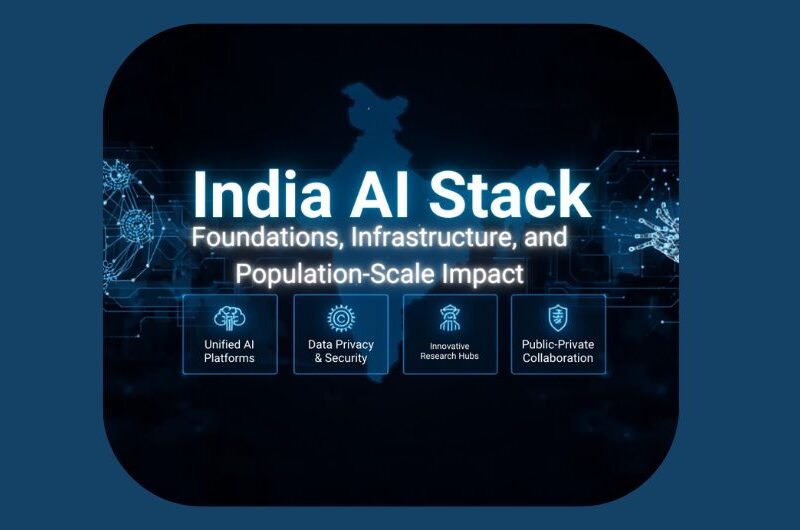
India’s AI Stack: Foundations, Infrastructure, and Population-Scale Impact

India’s AI Stack: Foundations, Infrastructure, and Population-Scale Impact     1. India’s AI vision emphasises democratisation: AI should benefit every citizen, support public welfare, and remain people centric, enabling “AI for Humanity” rather than limited elite control alone anywhere. 2. India’s AI Stack integrates tools and infrastructure to build, deploy, and operate AI reliably at population scale through five layers: applications, models, compute, data centres, networks, and energy. 3. The application layer delivers user-facing AI services such as health diagnostics, farming advisories, chatbots, and translation, embedding AI into healthcare, education, agriculture, finance, governance, transport, and climate action. 4. AI advisory deployments in agriculture, including implementations in Andhra Pradesh and Maharashtra, improve sowing decisions, raise yields, and boost input efficiency, with reported productivity gains reaching 30–50 percent. 5. In education, NEP 2020 integrates AI learning via CBSE curricula, DIKSHA, and YUVAi, building practical skills; in justice, e-Courts Phase III uses AI for translation and scheduling. 6. IMD applies AI for advanced forecasting of rainfall, cyclones, fog, lightning, and fires, and supports farmers through tools like Mausam GPT, strengthening disaster response and early warning systems nationwide. 7. Under the IndiaAI Mission, 12 indigenous AI models are being developed for India-specific use cases, while startups receive subsidised compute with up to 25 percent of costs supported directly. 8. BharatGen is building India-centric foundation and multimodal models, scaling from billions to trillions of parameters, to serve research, startups, and public-sector applications across domains securely. 9. IndiaAIKosh functions as a national repository for datasets, models, and tools; by December 2025, it hosted 5,722 datasets and 251 models from 54 entities across 20 sectors online. 10. Bhashini, under the National Language Translation Mission, hosts over 350 AI models for speech recognition, machine translation, text-to-speech, OCR, and language detection, expanding multilingual digital access. 11. The IndiaAI Compute Portal offers compute as a service, providing shared cloud access to 38,000 GPUs and 1,050 TPUs at subsidised rates under ₹100 per hour for startups nationwide. 12. A secure national GPU cluster of 3,000 next-generation GPUs is being established for sovereign strategic applications, alongside 10 approved semiconductor projects under the ₹76,000 crore mission. 13. The National Supercomputing Mission has deployed over 40 petaflops across IITs, IISERs, and research institutions; PARAM Siddhi-AI and AIRAWAT support workloads like NLP, weather prediction, and drug discovery. 14. India has about 3 percent of global data centre capacity, roughly 960 MW installed, projected to reach 9.2 GW by 2030; Mumbai–Navi Mumbai leads with over 25 percent share. 15. India met peak power demand of 242.49 GW in FY 2025–26 with shortages limited to 0.03 percent; installed capacity reached 509.7 GW, with over 51 percent from non-fossil sources.     Must Know Terms : 1. AI Stack AI Stack refers to the complete layered ecosystem enabling artificial intelligence to function at scale. It integrates applications, AI models, compute infrastructure, data centres, networks, and energy systems. This structure ensures reliable deployment, seamless integration, scalability, and real-world usability of AI across sectors such as governance, healthcare, agriculture, education, industry, and public services nationwide.   2.Application Layer The application layer represents the user-facing dimension of artificial intelligence, where advanced algorithms translate into practical services. It includes tools like health diagnostics, agricultural advisories, language translation, education platforms, and governance systems. This layer determines AI’s societal impact by embedding intelligence into everyday decision-making, service delivery, productivity enhancement, and citizen-centric digital solutions.   3.AI Model Layer The AI model layer functions as the cognitive core of artificial intelligence systems. It involves training algorithms on vast datasets to recognize patterns, generate predictions, and enable intelligent responses. Indigenous model development ensures relevance to local languages, contexts, and public needs, strengthening technological sovereignty, reducing external dependence, and aligning AI outcomes with national developmental priorities.   4.Compute Infrastructure Compute infrastructure provides the processing power required to train and operate AI models efficiently. It includes GPUs, TPUs, NPUs, supercomputers, and cloud-based resources. Affordable and shared access to compute lowers entry barriers for startups and research institutions, accelerates innovation, supports large-scale experimentation, and enables population-scale AI deployment across diverse sectors.   5.Data Centres and Networks Data centres and digital networks form the backbone enabling AI systems to store, process, and transmit data reliably. High-speed broadband, optical fibre, and 5G connectivity ensure low-latency performance, real-time analytics, and nationwide reach. Expanding domestic data centre capacity strengthens digital resilience, supports cloud services, and anchors AI infrastructure within national jurisdiction.   6.Energy Layer The energy layer sustains continuous AI operations by supplying reliable and affordable electricity to data centres and computing systems. AI workloads are energy-intensive, making power availability critical for scalability. Increasing reliance on non-fossil energy sources, storage systems, and nuclear options aligns AI expansion with sustainability, grid stability, and long-term environmental commitments.   MCQ:   1. The concept of an AI Stack primarily refers to: A) A single AI application used by governments B) A layered ecosystem enabling AI deployment at scale C) A hardware-only framework for AI computation D) A regulatory mechanism for AI governance 2. The core objective behind building a population-scale AI Stack is to: A) Promote private monopolies in technology B) Restrict AI access to research institutions C) Ensure inclusive and scalable AI deployment D) Replace conventional digital infrastructure 3. Which layer of the AI Stack directly interacts with end users? A) Compute layer B) AI model layer C) Application layer D) Energy layer 4. AI-powered health diagnostics, agricultural advisories, and chatbots belong to the: A) Model training layer B) Data infrastructure layer C) Application layer D) Energy layer 5. The AI model layer is best described as the: A) Storage unit for raw data B) Brain of AI systems C) Power supply unit of AI D) User interface of AI platforms 6. Development of indigenous AI models mainly supports: A) Higher hardware imports B) Increased data localisation costs C) Technological sovereignty and relevance D) Reduced public-sector usage 7. Compute infrastructure in AI primarily determines: A) User interface quality B) Data ownership C) Scale, speed, and efficiency of AI models D) Legal accountability of AI

More Details

Kavach and AI-Driven Safety Transformation in Indian Railways

Kavach and AI-Driven Safety Transformation in Indian Railways         1. Kavach is India’s indigenously developed Automatic Train Protection system providing collision prevention, overspeed control, and Signal Passing at Danger protection through continuous monitoring and automatic braking interventions nationwide. 2. Kavach has been implemented on more than 2,200 route kilometres, reflecting large scale deployment of indigenous ATP technology across critical corridors of the Indian Railways network nationwide infrastructure. 3. Kavach Version 4.0 operates over 1,306.3 route kilometres across five railway zones, strengthening safety on high speed, high density corridors such as Delhi–Mumbai and Delhi–Howrah trunk routes, nationally. 4. Vande Bharat 4.0 trains are envisaged to incorporate Kavach 5.0, enabling reduced headway, higher suburban frequency, and advanced automatic safety enforcement for future operations across major rail sections. 5. Kavach provides in cab signalling to loco pilots, displaying movement authority, target speed, target distance, and signal aspects for safer operations beyond 120 kilometres per hour thresholds nationally. 6. Developed by RDSO, Kavach mitigates risks arising from human error, equipment failure, and operational limitations through real time situational awareness and automated intervention mechanisms across diverse railway conditions. 7. Kavach uses secure UHF radio communication and RFID tags to determine precise train location while wayside units integrate interlocking, occupancy, and route data continuously for safe authority computation. 8. The system automatically applies brakes if a train overspeeds, approaches a danger signal, or enters a conflicting route, preventing collisions and Signal Passing at Danger incidents nationwide deployment. 9. Kavach supports Stop on Sight commands, ensuring automatic stoppage when two trains move toward each other in block sections, preventing head on and rear end collisions during operations. 10. Kavach is certified to Safety Integrity Level four, representing the highest global railway signalling safety standard and ensuring fail safe train protection under all conditions across Indian Railways. 11. Consequential train accidents declined significantly from 135 in 2014–15 to 31 in 2024–25 and further to 11 during 2025–26, reflecting technology driven safety gains across national rail corridors. 12. Indian Railways increased safety expenditure steadily from ₹39,200 crore in 2013–14 to ₹1,17,693 crore in 2025–26, underscoring long term institutional commitment towards infrastructure modernisation, accident prevention, resilience, nationally. 13. Kavach was adopted as the national Automatic Train Protection system in July 2020, enabling standardized deployment of interoperable safety architecture across Indian Railways networks, corridors, operations, zones, nationwide. 14. Kavach Version 4.0 commissioning prioritises High Density and Highly Used Network routes, including corridors cleared for 160 kilometres per hour operations with ABS and CTC signalling, control, systems. 15. AI enabled intrusion detection, predictive maintenance, video analytics, and digital communication systems complement Kavach, creating an integrated, preventive, and technology driven railway safety ecosystem across passengers, assets, operations. Must Know Terms :   1.Kavach Kavach is India’s indigenously developed Automatic Train Protection system adopted as the national ATP by Indian Railways in 2020. It prevents train accidents by monitoring speed, signal compliance, and train movement in real time. Kavach automatically applies brakes during unsafe conditions, significantly reducing human error–induced accidents and enhancing operational safety across high-density rail corridors. 2.Automatic Train Protection (ATP) Automatic Train Protection refers to systems that continuously supervise train movement, speed, and signal adherence, intervening automatically when unsafe conditions arise. ATP systems prevent Signal Passing at Danger, overspeeding, and collisions. With increasing traffic density and higher speeds, ATP has become essential to maintain safety, reliability, and capacity on modern railway networks like Indian Railways. 3.Safety Integrity Level–4 (SIL-4) SIL-4 is the highest internationally recognised safety certification for railway signalling systems. Kavach’s SIL-4 certification indicates extremely high reliability, fail-safe design, and minimal probability of dangerous failure. This level ensures that even under component failure or adverse conditions, the system defaults to safe states, making it suitable for high-speed and high-density railway operations. 4.Signal Passing at Danger (SPAD) Signal Passing at Danger occurs when a train crosses a stop signal without authorisation, often leading to collisions. SPAD has historically been a major cause of serious rail accidents. Kavach directly addresses this risk by automatically stopping trains before danger signals, reducing dependence on human vigilance and significantly improving safety, especially under fog, curves, or poor visibility conditions. 5.Stop-on-Sight (SoS) Stop-on-Sight is an automated safety command within Kavach that activates when two trains are detected moving toward each other in block sections. The system immediately applies brakes on both trains, preventing head-on or rear-end collisions. SoS is critical in non-interlocked or high-risk sections, providing a last-line defence against catastrophic accidents in real time. 6.AI-enabled Intrusion Detection System (IDS) The AI-enabled Intrusion Detection System uses Distributed Acoustic Sensing technology to detect animal movement, particularly elephants, on railway tracks. It generates real-time alerts for loco pilots and control rooms, enabling preventive action. Deployed in vulnerable corridors, IDS reduces wildlife casualties, train derailment risks, and service disruptions, integrating ecological protection with railway safety objectives.   Advantages of Kavach User-friendly cab signaling for loco pilots. Multi-vendor interoperability – avoids dependence on a single supplier. Suitable for specific Indian Railways requirements and conditions. Enhances safety in foggy weather. Effective at high speeds. Enables centralized real-time monitoring of train movements. Key Takeaways KAVACH is an indigenously developed Automatic Train Protection (ATP) system that provides Train Protection as well as Collision Prevention capabilities for trains. Kavach has now been implemented on more than 2,200 route kilometres. Kavach 4.0 now covers over 1,300 Route Kilometres across five Indian Railways Zones. Vande Bharat 4.0 is envisaged to incorporate Kavach 5.0 as part of its advanced safety and technology framework. MCQ     1. Kavach is best described as which of the following systems? A) Passenger Information System B) Automatic Train Protection system C) Train Scheduling Software D) Track Maintenance Mechanism 2. Kavach has been developed indigenously by Indian Railways through which organisation? A) DMRC B) IIT Kanpur C) RDSO D) ISRO 3. Kavach primarily helps in preventing which of the following railway incidents? A) Track corrosion B) Signal Passing at Danger C) Coach overcrowding D) Power supply failure 4. Kavach provides in-cab display information to the loco pilot related to: A) Passenger occupancy B) Ticketing status C) Movement authority and speed D) Weather forecasting 5. Kavach Version 4.0 is currently

More Details

Silicon Sovereignty: India’s Semiconductor Mission 2.0 and the Road to Chip Self-Reliance

Silicon Sovereignty: India’s Semiconductor Mission 2.0 and the Road to Chip Self-Reliance     1. ISM 2.0 in Budget 2026–27 prioritises domestic semiconductor equipment and materials, full-stack Indian semiconductor IP, and stronger supply chains, backed by ₹1,000 crore for FY 2026–27 allocation nationwide. 2. India’s semiconductor market is estimated at $38 billion in 2023, $45–$50 billion in 2024–25, and projected to reach $100–$110 billion by 2030, driven by demand across value chains. 3. ISM 1.0, approved in December 2021, created an incentive framework of ₹76,000 crore, offering fiscal support up to 50% for silicon fabs, compound semiconductors, ATMP/OSAT, and design nationwide. 4. By December 2025, ten semiconductor projects totaling ₹1.60 lakh crore were approved across six states, spanning silicon fabs, silicon carbide fabs, advanced packaging, memory packaging, and testing infrastructure. 5. By 2029, India targets capability to design and manufacture chips covering 70–75% of domestic applications, serving consumer appliances, industrial electronics, automobiles, telecommunications, aerospace, and power electronics sectors needs. 6. The advanced manufacturing roadmap defines progression toward 3-nanometre and 2-nanometre nodes, aiming for India to rank among top semiconductor nations by 2035 through sustained capability building and resilience. 7. For 2026–27, the modified semiconductor and display manufacturing ecosystem programme carries a total outlay of ₹8,000 crore, recalibrating support for manufacturing, display fabs, and the design ecosystem nationwide. 8. In 2026–27, the modified scheme for semiconductor fabs supports one fab, targeting ₹4,000 crore investment during the year and generating about 1,500 jobs in operations and engineering directly. 9. The compound semiconductors, photonics, sensors, discrete fabs and ATMP/OSAT scheme supports nine units in 2026–27, targeting ₹11,000 crore investment and about 3,000 jobs across facilities for capacity scaling. 10. The design-linked incentive scheme supports 30 design companies in 2026–27, targeting development of 10 semiconductor IP cores and employment of around 200 specialised semiconductor design professionals this year. 11. By January 2026, design incentives support 24 startups, which attracted nearly ₹430 crore venture funding, while the national EDA platform recorded about 2.25 crore high-end tool hours nationally. 12. Around 67,000 students and over 1,000 startup engineers use national design tools; academia completed 122 tape-outs and fabricated 56 chips at 180 nm in the Mohali facility annually. 13. Startups completed 16 tape-outs, producing six chips at advanced foundry nodes including 12 nm; academic institutions filed 75 patents and startups filed 10 patents, expanding indigenous IP rapidly. 14. DHRUV64 is an indigenous 64-bit microprocessor built by C-DAC under MDP, intended for 5G, automotive electronics, industrial automation, consumer devices, and IoT, reducing import dependence and security assurance. 15. Talent pipeline measures include Chips to Startup across 397 universities and startups, AICTE semiconductor programmes, SMART Lab training over 62,000 engineers toward 100,000, and Lam partnership training 60,000. Must Know Terms :   1.India Semiconductor Mission 2.0 (ISM 2.0): ISM 2.0 is the Budget 2026–27 push to move from ecosystem creation to consolidation. It prioritises domestic semiconductor equipment and materials, full-stack Indian IP, and stronger supply chains. The government earmarked ₹1,000 crore for FY 2026–27 to support industry-led R&D and training centres, aiming to deepen technology capability and workforce readiness across the entire chip value chain.   2.Modified Semiconductor & Display Programme (2026–27): This is the recalibrated support package responding to global incentive competition. For 2026–27, it carries a total financial outlay of ₹8,000 crore to accelerate capital investment across semiconductor fabs, compound semiconductors, ATMP/OSAT, and display manufacturing. It focuses on expanding fabrication, packaging, and design capacity, generating high-quality jobs, and reducing dependence on concentrated global suppliers and shocks.   3.Design Linked Incentive (DLI) Scheme: DLI strengthens India’s fabless and IP creation pipeline by supporting startups and early-stage design firms. As of January 2026, it supports 24 design startups, which attracted nearly ₹430 crore venture funding. It aims to translate academic research into deployable products, increase patents and tape-outs, and scale toward enabling at least 50 fabless companies in the next phase.   4.Advanced EDA National Chip Design Platform: Advanced Electronic Design Automation access is the backbone for domestic chip design at scale. The platform has recorded around 2.25 crore tool hours, with about 67,000 students and over 1,000 startup engineers using high-end tools. It lowers entry barriers, improves design productivity, and supports more tape-outs and prototypes by providing shared infrastructure that individual institutions may not afford independently.   5.Tape-out and Fabrication Pipeline (Mohali SCL + Advanced Nodes): Tape-out is the stage where a design is finalised for fabrication, making it a measurable output of design capability. Academia has completed 122 tape-outs, with 56 chips fabricated at 180 nm at the Semiconductor Laboratory, Mohali. Startups completed 16 tape-outs, producing six chips at advanced foundry nodes including 12 nm, signalling progress beyond legacy processes.   6.DHRUV64 and Indigenous Microprocessor Stack: DHRUV64 is an indigenous 64-bit microprocessor developed by C-DAC under the Microprocessor Development Programme. It is positioned for deployment in 5G infrastructure, automotive electronics, industrial automation, consumer devices, and IoT. It builds on SHAKTI, AJIT, VIKRAM, and THEJAS under the DIR-V programme using RISC-V architecture, improving sovereignty and security in critical computing.     Key Takeaways   Union Budget 2026–27 allocates ₹1,000 crore for India Semiconductor Mission (ISM) 2.0.   As of December 2025, 10 ISM projects worth ₹1.60 lakh crore approved across six states.   India’s semiconductor market projected to reach $100–110 billion by 2030.           MCQ :   1. India Semiconductor Mission 2.0 announced in Budget 2026–27 primarily emphasises which strategic shift? A) Import substitution through tariff protection B) Consolidation of domestic capabilities across equipment, materials, IP, and supply chains C) Exclusive focus on consumer electronics manufacturing D) Privatisation of semiconductor regulation 2. The financial provision made specifically for ISM 2.0 in FY 2026–27 is: A) ₹500 crore B) ₹750 crore C) ₹1,000 crore D) ₹1,500 crore 3. India’s semiconductor market size is projected to reach approximately what value by 2030? A) $60–70 billion B) $80–90 billion C) $100–110 billion D) $130–140 billion 4. The incentive framework approved under India Semiconductor Mission 1.0 amounted to: A) ₹45,000 crore B) ₹60,000 crore C) ₹76,000

More Details

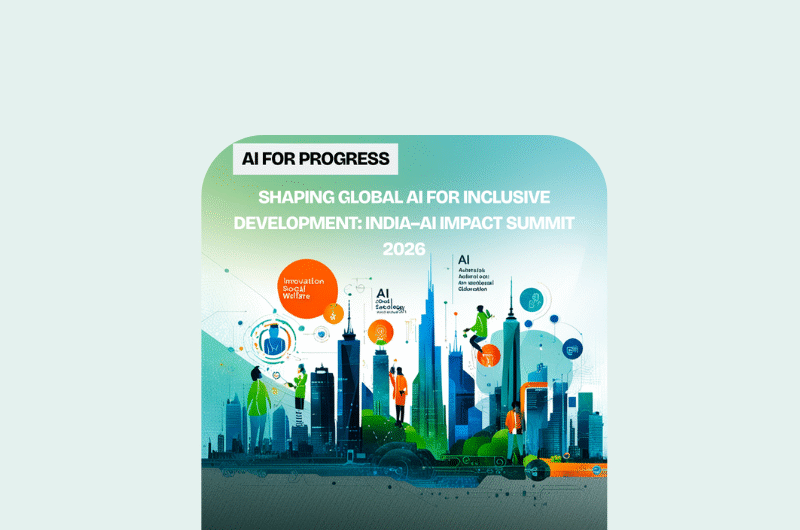
Shaping Global AI for Inclusive Development: India–AI Impact Summit 2026

Shaping Global AI for Inclusive Development: India–AI Impact Summit 2026   1. India AI Impact Summit 2026 is scheduled from 16–20 February 2026 at Bharat Mandapam, New Delhi, as a five-day programme spanning policy, research, industry, and public engagement. 2. The Summit is described as the first global AI summit to be hosted in the Global South, bringing leaders, policymakers, companies, innovators, and experts together. 3. The Summit is anchored on three foundational pillars called Sutras: People, Planet, and Progress, intended as guiding principles for impact-oriented cooperation. 4. The India AI Impact Expo 2026 is expected to feature over 300 exhibitors from 30 countries across more than 10 thematic pavilions; figures are tentative. 5. The Summit aligns with Viksit Bharat by 2047 and connects with the IndiaAI Mission and Digital India Initiative for development-focused AI outcomes. 6. The Summit outlines AI benefits for People, including telemedicine, diagnostics, adaptive education, and fraud detection, aiming to expand access and strengthen systems. 7. For the Planet, it highlights AI in agriculture through crop prediction, precision farming, drone monitoring, and advisory support using weather, pest, and irrigation data. 8. For Progress, it notes AI-assisted translation of court judgments, smart city optimisation, improved service delivery, and everyday efficiency in mobility services. 9. Pre-Summit Events are organised in India and abroad to facilitate consultations and thematic discussions involving governments, academia, industry, startups, and civil society.   10. Eight Regional AI Conferences were held between October 2025 and January 2026 across Meghalaya, Gujarat, Odisha, Madhya Pradesh, Uttar Pradesh, Rajasthan, Kerala, and Telangana. 11. The Main Summit sessions are structured around seven Chakras, and the programme reports receiving over 700 proposals, indicating strong global participation. 12. The AI Compendium will be released on 17 February 2026, presenting thematic casebooks on real-world AI applications across priority sectors. 13. The AI for ALL Global Impact Challenge is partnered with Startup India and the Digital India Bhashini Division, offering awards up to INR 2.50 crore. 14. The AI by HER Global Impact Challenge partners the NITI Aayog Women Entrepreneurship Platform, showcasing women-led AI solutions, with awards up to INR 2.50 crore. 15. The YUVAi Global Youth Challenge targets ages 13–21, partnered with MyBharat and NIELIT, offering prizes worth up to INR 85 lakh. India–AI Impact Summit 2026: Event Schedule and Key Programmes Date Event Venue 16–20 February 2026 AI Impact Expo Bharat Mandapam, New Delhi 16 February 2026 Keynotes, Panel Discussions, Roundtables Bharat Mandapam/ Sushma Swaraj Bhawan/ Ambedkar Bhawan, New Delhi 17 February 2026 Release of Knowledge Compendiums on AI in Health, Energy, Education, Agriculture, Gender Empowerment, Accessibility Bharat Mandapam, New Delhi Seminar on Applied AI AI by HER: Global Impact Challenge Sushma Swaraj Bhawan, New Delhi Keynotes, Panel Discussions, Roundtables Bharat Mandapam/ Sushma Swaraj Bhawan/ Ambedkar Bhawan, New Delhi 18 February 2026 Research Symposium Bharat Mandapam, New Delhi Industry Session AI by HER: Global Impact Challenge Sushma Swaraj Bhawan, New Delhi Keynotes, Panel Discussions, Roundtables Bharat Mandapam/ Sushma Swaraj Bhawan/ Ambedkar Bhawan, New Delhi Summit Dinner Convention Centre, New Delhi 19 February 2026 Opening Ceremony Bharat Mandapam, New Delhi   Leaders’ Plenary CEO Roundtable Keynotes / Panel Discussion/ Roundtables Bharat Mandapam / Sushma Swaraj Bhawan / Ambedkar Bhawan, New Delhi 20 February 2026 GPAI Council Meeting Bharat Mandapam, New Delhi Keynotes/ Panel Discussion/ Roundtables Bharat Mandapam / Sushma Swaraj Bhawan / Ambedkar Bhawan, New Delhi   MUST-KNOW TERMS 1. India–AI Impact Summit 2026: India–AI Impact Summit 2026 is a global artificial intelligence summit scheduled from 16–20 February 2026 at Bharat Mandapam, New Delhi. It is the first global AI summit hosted in the Global South and focuses on translating AI discussions into development outcomes aligned with national priorities, governance needs, and inclusive growth objectives under the IndiaAI Mission and Digital India. 2. IndiaAI Mission: IndiaAI Mission is a flagship national initiative aimed at building a robust, inclusive, and responsible artificial intelligence ecosystem in India. It focuses on AI compute infrastructure, indigenous AI models, datasets, skilling, startup support, and ethical deployment, ensuring AI adoption strengthens governance, economic growth, and public service delivery across sectors. 3. Three Sutras: The Three Sutras—People, Planet, and Progress—are the foundational pillars of the India–AI Impact Summit 2026. They guide AI deployment toward inclusive social outcomes, environmental sustainability, and governance efficiency. These principles emphasize people-centric AI, sustainable resource use, and technology-enabled institutional progress through multilateral cooperation. 4. Seven Chakras: Seven Chakras represent key areas of multilateral cooperation at the Summit, including Human Capital, Inclusion for Social Empowerment, Safe and Trusted AI, Resilience and Innovation, Science, Democratizing AI Resources, and AI for Economic Growth and Social Good. These Chakras structure discussions to align AI strategies with inclusive and sustainable development outcomes. 5. AI Impact Expo 2026: The India AI Impact Expo 2026 is a large-scale exhibition organised by MeitY with STPI as custodian. Spread over 70,000 square metres, it showcases AI transition from research to deployment, featuring innovators, startups, investors, and thematic pavilions demonstrating sector-specific AI solutions. 6. AI Compendium: The AI Compendium is a knowledge output of the Summit to be released on 17 February 2026. It contains thematic casebooks documenting real-world AI applications across priority sectors such as health, education, agriculture, energy, and governance, serving as a reference for practitioners and policymakers.     Key Takeaways The India–AI Impact Summit 2026will be the first global AI summit to be hosted in the Global South. It will be held from 16 to 20 February 2026 at Bharat Mandapam, New Delhi, as a five-day programme covering policy, research, industry, and public engagement. It will be anchored on 3 foundational pillars, or ‘Sutras’: People, Planet and Progress. The India AI Impact Expo is expected to feature over 300 exhibitors, from 30 Countries, across more than 10 thematic pavilions.                                                                                                                        MCQ     1. The India–AI Impact Summit 2026 will be held at which location? A. Vigyan Bhawan, New Delhi B. Bharat Mandapam, New Delhi C. Hyderabad International Convention Centre D. India Habitat Centre 2. The India–AI Impact Summit 2026 is described as: A. First AI summit hosted by

More Details

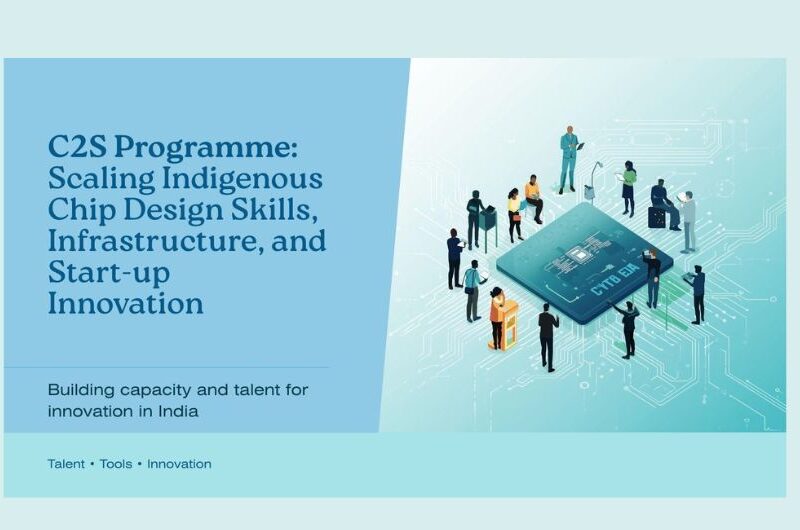
C2S Programme: Scaling Indigenous Chip Design Skills, Infrastructure, and Start-up Innovation

C2S Programme: Scaling Indigenous Chip Design Skills, Infrastructure, and Start-up Innovation       1. Chips to Start-up Programme is a national capacity-building initiative launched in 2022, with ₹250 crore over five years, expanding chip design education, fabrication exposure, and innovation across institutions. 2. It targets creation of 85,000 industry-ready professionals across UG, PG, and PhD levels nationwide, including 200 PhDs, 7,000 VLSI M.Tech, 8,800 allied M.Tech, and 69,000 B.Tech trainees overall. 3. Nearly one lakh individuals enrolled for chip design training, and about 67,000 have been trained so far, addressing global semiconductor talent shortages and strengthening domestic skill pipelines rapidly. 4. Programme ecosystem spans about 400 organisations: 305 academic institutions under C2S and 95 startups under a complementary incentive scheme, widening participation beyond elite campuses nationwide into innovation networks. 5. It aims to catalyse 25 start-ups and enable 10 technology transfers, while expanding SMART lab access, training one lakh students, generating 50 patents, and supporting 2,000 research publications. 6. Hands-on learning is delivered through industry-led training, mentorship, and access to advanced EDA software, foundry interfaces, fabrication facilities, and testing resources for designing, building, and validating chips securely. 7. Participating institutions pursue prototypes of ASICs, Systems-on-Chip, and reusable IP cores, bridging curriculum learning with full workflows from architecture and verification to tape-out, fabrication, testing, and post-silicon evaluation. Coordinating Organization Mode Area 100+ Participating Academic Institutions (Beneficiaries of project funds, EDA Tools & trainings) Implementation of R&D projects for design & fabrication (2–5 years) Instruction as part of curriculum, Short-term courses, labs, and student projects (including nearby institutions). End-to-end exposure to chip design, fabrication, and testing through R&D projects 200+ Other Organizations (Beneficiaries of EDA Tools & trainings) Instruction as part of curriculum, Short-term courses, labs, and student projects. General chip design flows using advanced EDA tools. ChipIN Centre, C-DAC Bangalore (Serving 300+ institutions) Regular training sessions with industry partners. Facilities include: Specialized design areas using advance tools.   EDA tools Synopsys, Cadence, IBM, Siemens EDA, Ansys, Keysight Technologies, Silvaco, AMD, Renesas Foundry access SCL, IMEC, MUSE Semiconductors Chip design flow ChipIN Centre, NIELIT SMART Lab, NIELIT Calicut (Pan-India institutions) Identified short-term and certification courses. General chip design flows using centralized hardware resources. 8. ChipIN Centre at C-DAC Bengaluru functions as a national shared design infrastructure hub, supporting 300+ institutions with tools, compute, IP libraries, mentoring, and structured design onboarding services nationwide. 9. ChipIN Centre conducted six shared wafer runs and 265+ training sessions, while addressing 4,855 support requests, demonstrating sustained technical assistance and operational scale for academic chip programmes nationwide. 10. Designs are collected, verified for fabrication readiness, iterated with feedback, aggregated onto shared wafers, and sent every three months to SCL Mohali for fabrication using 180 nm technology. 11. SCL Mohali enabled large-scale hands-on design: 122 submissions from 46 institutions, with 56 student-designed chips successfully fabricated, packaged, tested, and delivered back for real silicon validation for learning. 12. Shared national EDA infrastructure recorded over 175 lakh hours of tool usage by users across 400 organisations, indicating intensive practical engagement with professional-grade electronic design automation platforms nationwide. 13. Institutions filed 75+ patents and are developing 500+ IP cores, ASICs, and SoC designs, with applications spanning defence, telecom, automotive, consumer electronics, and industrial systems integration nationwide today. 14. FPGA boards were distributed through centralised and distributed models to support prototyping and design validation, complemented by high-performance computing access via the PARAM Utkarsh supercomputer resources nationally effectively. 15. Coordinated institutional framework links policy direction, funding, and oversight with infrastructure operators and fabrication facilities, ensuring equitable access, stronger academia–industry collaboration, and a steady pipeline of chip designers.   Must-Know Terms  : 1.Chips to Start-up (C2S) Programme: Chips to Start-up is a MeitY capacity-building umbrella launched in 2022 to democratise chip design. It funds training, curriculum integration, labs, and R&D projects, linking students with industry mentors and national infrastructure. Its targets include 85,000 professionals, start-up incubation, patents, technology transfers, and silicon validation, strengthening self-reliant design capability across diverse institutions nationwide, including smaller colleges too, for long-term resilience. 2.ChipIN Centre: ChipIN Centre, operated by C-DAC Bengaluru, provides shared semiconductor design infrastructure for hundreds of institutions. It offers commercial EDA tool access, compute, IP libraries, onboarding, and mentoring. It aggregates student designs, verifies fabrication readiness, and organises periodic multi-project wafer submissions. It also runs frequent training and resolves technical support tickets, accelerating hands-on learning and reproducible design outcomes consistently, nationwide regularly. 3.Shared Wafer Run: A shared wafer run pools multiple validated chip layouts from different teams onto one wafer, reducing fabrication costs per participant. ChipIN collects designs, checks rule compliance, coordinates iterations, and tapes out combined masks. SCL fabricates the wafer, then packages and returns individual dies. This approach enables students to experience real fabrication cycles, post-silicon testing, and design improvement loops quickly, repeatedly. 4.Electronic Design Automation (EDA) Tools: EDA tools are professional software suites used to design, simulate, verify, and layout integrated circuits. They support steps like RTL coding, synthesis, timing analysis, place-and-route, signoff checks, and verification. Access to commercial platforms through shared national infrastructure lets learners practice industry workflows, reduce errors before fabrication, and build reusable design blocks that meet foundry requirements reliably, at scale, and compliance. 5.Semi-Conductor Laboratory (SCL) Mohali and 180 nm: SCL Mohali provides fabrication and packaging support for student designs under the programme. Designs are manufactured using an established 180 nanometre process, suitable for training, prototyping, and many control-oriented applications. After fabrication, chips are packaged and delivered back to teams for validation. This closes the loop from design to silicon, making learning evidence-based and measurable for institutions nationwide, and confidence. 6.FPGA and PARAM Utkarsh Support: Field Programmable Gate Arrays let designers prototype digital logic and verify functionality before committing to fabrication, cutting risk and iteration time. The programme supplies FPGA boards through central and distributed modes for labs and projects. High-performance computing via the PARAM Utkarsh supercomputer supports demanding EDA workloads and simulations. Together, they enable scalable learning, faster verification, and more robust tape-outs effectively.   Key Takeaways Over 1 lakh individuals have enrolled in chip design training, with approximately 67,000 trained so far.

More Details

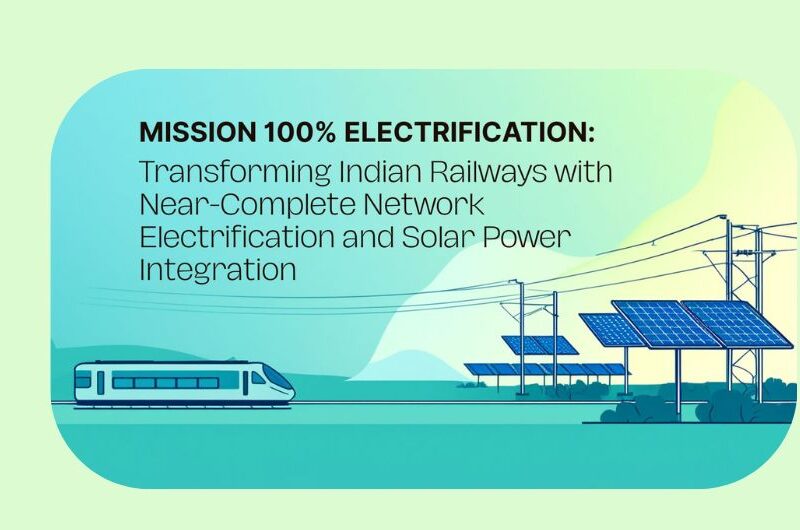
Mission 100% Electrification: Transforming Indian Railways with Near-Complete Network Electrification and Solar Power Integration

Mission 100% Electrification: Transforming Indian Railways with Near-Complete Network Electrification and Solar Power Integration       Key Takeaways   Indian Railways has electrified about 99.2% of its network by November 2025, making it one of the world’s most extensively electrified rail systems.   Electrification pace has surged from 1.42 km/day (2004–2014) to over 15 km/day in 2019- 2025, marking a massive acceleration in modernization.   By November 2025, Indian Railways expanded its solar power capacity to 898 MW, up from 3.68 MW in 2014, marking a transformational growth in renewable energy adoption.       1. Indian Railways electrified about 99.2% of its network by November 2025, making the system among the world’s most extensively electrified rail networks. 2. Electrification speed rose from about 1.42 km per day during 2004–2014 to over 15 km per day in 2019–2025. 3. India’s first electric train ran in 1925 between Bombay Victoria Terminus and Kurla Harbour, using a 1500 Volt DC traction system. 4. By Independence, only 388 route kilometers were electrified, while coal and diesel locomotives continued to dominate most railway operations nationwide. 5. Electrified track share increased from 24% in 2000 to 40% in 2017, then crossed 96% by end-2024. 6. As of November 2025, 69,427 route kilometers were electrified, with 46,900 route kilometers completed between 2014 and 2025. 7. Broad Gauge network totals about 70,001 route kilometers; 99.2% is electrified, leaving only 574 route kilometers pending work. 8. Twenty-five States and Union Territories achieved 100% Broad Gauge electrification, with no remaining route kilometers pending electrification completion. 9. Residual electrification remains in five States, with balances: Assam 197 km, Karnataka 151 km, Tamil Nadu 117 km, Rajasthan 93 km, Goa 16 km. 10. Electrification supports sustainability and economic growth by reducing environmental impact, improving energy security, enhancing operational efficiency, and enabling development along corridors. 11. India’s electrification level compares strongly with major networks, exceeding several large systems, while Switzerland is fully electrified and China remains around eighty-two percent. 12. Indian Railways expanded solar capacity to 898 MW by November 2025, rising from 3.68 MW in 2014, indicating transformational renewable adoption. 13. Solar installations cover 2,626 railway stations, creating a nationwide clean-energy footprint across diverse operational zones and geographic regions for daily services. 14. Of 898 MW solar capacity, 629 MW is used for traction, while 269 MW supports non-traction needs like stations, workshops, buildings, and quarters. 15. Modern electrification uses mechanised cylindrical foundations and automatic wiring trains, accelerating overhead equipment installation with accurate tension control and consistent construction quality.   MCQ: 1. As of November 2025, approximately what share of the Indian Railways network had been electrified? A. 89.2% B. 94.5% C. 99.2% D. 100% 2. Electrification pace increased from about 1.42 km/day (2004–2014) to over 15 km/day mainly during: A. 2010–2014 B. 2014–2019 C. 2019–2025 D. 2021–2024 3. India’s first electric train (1925) ran between: A. Bombay Victoria Terminus and Kurla Harbour B. Howrah and Sealdah C. Madras Central and Tambaram D. Delhi and Agra Cantt 4. The traction system used on India’s first electric train in 1925 was: A. 750 V DC B. 1500 V DC C. 25 kV AC D. 15 kV AC 5. By the time India gained independence, electrified route kilometers were about: A. 188 RKMs B. 388 RKMs C. 3,880 RKMs D. 6,388 RKMs 6. Electrified track share rose from 24% in 2000 to about 40% in: A. 2007 B. 2012 C. 2017 D. 2020 7. Electrified track share crossed 96% by the end of: A. 2022 B. 2023 C. 2024 D. 2025 8. As of November 2025, electrified route kilometers were approximately: A. 46,900 RKMs B. 57,400 RKMs C. 69,427 RKMs D. 70,001 RKMs 9. Route kilometers electrified between 2014 and 2025 were about: A. 19,427 RKMs B. 36,900 RKMs C. 46,900 RKMs D. 69,427 RKMs 10. The total Broad Gauge network length cited was closest to: A. 60,001 RKM B. 65,427 RKM C. 69,427 RKM D. 70,001 RKM 11. The balance Broad Gauge route kilometers pending electrification across five States was: A. 574 RKM B. 740 RKM C. 1,574 RKM D. 5,740 RKM 12. How many States/Union Territories were reported as 100% electrified on Broad Gauge? A. 15 B. 20 C. 25 D. 30 13. As of November 2025, Indian Railways’ commissioned solar power capacity was: A. 98 MW B. 398 MW C. 898 MW D. 1,898 MW 14. Of the commissioned solar capacity, the portion used for traction purposes was: A. 269 MW B. 629 MW C. 898 MW D. 2,626 MW 15. Solar power installations were reported across how many railway stations? A. 629 B. 898 C. 1,426 D. 2,626

More Details

Catalyzing Indigenous Chip Design: Key Features and Outcomes of the Design Linked Incentive (DLI) Scheme

Catalyzing Indigenous Chip Design: Key Features and Outcomes of the Design Linked Incentive (DLI) Scheme     Key Takeaways Semiconductor chip design is the main value driver, contributing up to 50% of value addition, 20–50% of Bill of Materials cost (BOM), and 30–35% of global semiconductor sales via the fabless segment. MeitY’s Design Linked Incentive (DLI) Scheme under the Semicon India Programme aims to build a self-reliant, globally competitive chip design ecosystem. 24 DLI-supported chip design projects target strategic sectors including video surveillance, drone detection, energy metering, microprocessors, satellite communications, and IoT SoCs. DLI supported projects are scaling rapidly, with 16 tape-outs, 6 ASICs chips, 10 patents, 1,000+ engineers engaged, and over 3× private investment leveraged.       1. Chip design drives semiconductor value, contributing up to half value addition, 20–50% bill of materials cost, and 30–35% global sales in fabless segment overall. 2. Design Linked Incentive scheme aims to build a self-reliant, globally competitive fabless ecosystem by supporting domestic startups, MSMEs, and indigenous intellectual property creation domestically. 3. Twenty-four supported chip design projects target strategic domains: video surveillance, drone detection, energy metering, microprocessors, satellite communications, and broadband or IoT systems-on-chip security applications. 4. Supported projects show rapid scaling: sixteen tape-outs completed, six ASIC chips fabricated, ten patents filed, over one thousand engineers engaged, leveraging triple private investment. 5. Fabless companies capture high strategic value because design and IP determine product intelligence, efficiency, and security, while requiring modest capital expenditure relative to fabrication. 6. Eligibility covers startups and MSMEs for incentives plus design infrastructure, while other domestic companies can receive financial incentives for deploying semiconductor designs successfully nationwide. 7. Product design support reimburses up to fifty percent eligible expenditure, capped at fifteen crore rupees per application, covering ICs, chipsets, SoCs, systems, IP cores. 8. Deployment incentive provides six to four percent of net sales turnover for five years, capped at thirty crore rupees, subject to cumulative sales thresholds. 9. ChipIN Centre provides shared infrastructure: remote national EDA tool grid, IP core repository access, MPW prototyping fiscal support, and post-silicon validation assistance for startups. 10. ChipIN democratized advanced EDA access for about one lakh engineers and students across four hundred organizations, including academic institutions and many supported startups nationwide. 11. National shared EDA Grid recorded 54,03,005 cumulative usage hours by ninety-five supported startups as of 2 January 2026, indicating strong nationwide tool adoption rates. 12. Outcomes include ten patents, sixteen tape-outs, six silicon-proven chips, over one thousand specialized engineers trained or engaged, and more than 140 reusable IP cores. 13. Semicon India Programme, with seventy-six thousand crore rupees outlay, supports semiconductor and display manufacturing and design ecosystem, with implementation support from C-DAC as agency. 14. Chips to Startup programme builds capacity across institutions to generate eighty-five thousand industry-ready chip-design professionals, while microprocessor efforts produced VEGA, SHAKTI, AJIT families domestically. 15. Success cases include motor-control BLDC chips, indigenous RISC-V processor IPs, AI-capable surveillance SoCs in 12 nm, broadband GPON solutions, and radar-on-chip development pipelines globally.       MCQ:     1. Semiconductor chip design contributes up to which share of value addition in the semiconductor value chain? A. 10% B. 25% C. 50% D. 75% 2. Design and IP typically account for what share of a semiconductor’s value, as highlighted in the explainer? A. Less than 10% B. About one-third C. More than half D. Nearly all of it 3. Under the scheme, reimbursement for product design support is capped at: A. ₹10 crore per application B. ₹15 crore per application C. ₹20 crore per application D. ₹30 crore per application 4. Deployment-linked incentive under the scheme is provided as: A. 10%–8% of gross sales for 3 years B. 6%–4% of net sales turnover for 5 years C. 4%–2% of net sales turnover for 10 years D. Fixed grant of ₹30 crore for 5 years 5. The deployment-linked incentive cap per application is: A. ₹15 crore B. ₹25 crore C. ₹30 crore D. ₹76,000 crore 6. Minimum cumulative net sales required over Years 1–5 for startups/MSMEs is: A. ₹50 lakh B. ₹1 crore C. ₹2 crore D. ₹5 crore 7. Minimum cumulative net sales required over Years 1–5 for other domestic companies is: A. ₹1 crore B. ₹2 crore C. ₹5 crore D. ₹10 crore 8. The design must be successfully deployed in electronic products for obtaining: A. Product design reimbursement B. Access to EDA tools C. Deployment-linked incentive D. MPW prototyping fiscal support 9. Which set correctly lists the main design infrastructure supports offered through the ChipIN Centre? A. EDA grid, IP core repository, MPW prototyping, post-silicon validation B. Waiver of customs duties, land subsidy, power tariff discount, export rebate C. Patent filing waiver, GST exemption, freight subsidy, credit guarantee D. Salary support, rent subsidy, marketing grant, equity infusion 10. The scheme was launched in: A. December 2019 B. December 2020 C. December 2021 D. December 2022 11. About 1 lakh engineers and students across 400 organizations gained access to advanced EDA tools primarily through: A. A private EDA marketplace B. A centralized facility user base via ChipIN C. Bilateral technology transfer treaties D. A semiconductor import substitution tariff 12. As of 2 January 2026, cumulative usage recorded on the shared EDA Grid was: A. 5,40,305 hours B. 54,03,005 hours C. 5,43,00,500 hours D. 4,05,300 hours 13. Which of the following outcomes is correctly matched with the supported ecosystem performance? A. 16 patents filed, 10 tape-outs completed, 6 chips designed B. 10 patents filed, 16 tape-outs completed, 6 chips fabricated C. 6 patents filed, 16 chips fabricated, 10 tape-outs completed D. 10 tape-outs filed, 6 patents completed, 16 chips fabricated 14. The total outlay mentioned for the broader programme supporting manufacturing and design is: A. ₹7,600 crore B. ₹16,000 crore C. ₹76,000 crore D. ₹1,76,000 crore 15. Chips to Startup capacity-building target is to generate approximately: A. 8,500 industry-ready professionals B. 35,000 industry-ready professionals C. 85,000 industry-ready professionals D. 1,85,000 industry-ready professionals      

More Details

Free IAS Guidance
Start Your Journey Today 🇮🇳

Fill out the form below, and we will be in touch shortly.