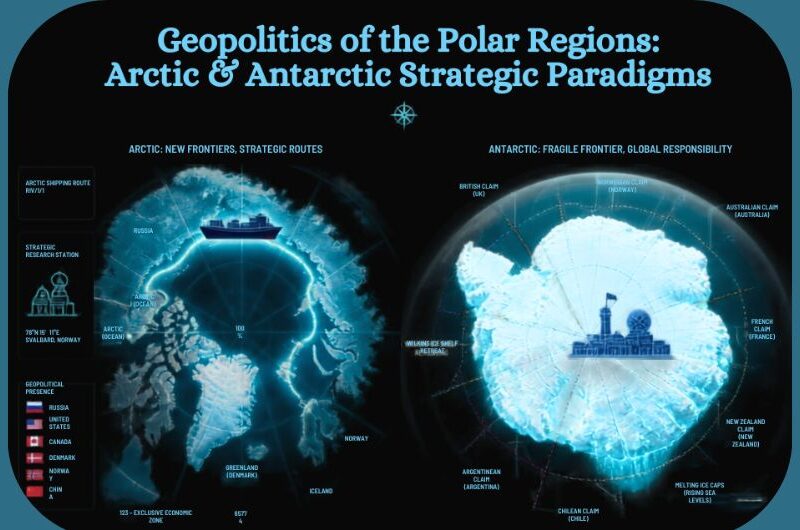
Geopolitics of the Polar Regions: Arctic & Antarctic Strategic Paradigms
1. Polar geopolitics is becoming more important as climate change melts ice, opens new sea routes and makes resources more accessible.
2. The Arctic is a frozen ocean surrounded by land, while Antarctica is a landmass surrounded by the Southern Ocean.
3. The Arctic is shared by eight states: Canada, Denmark, Finland, Iceland, Norway, Russia, Sweden and the United States.
4. Arctic maritime claims are governed mainly by the United Nations Convention on the Law of the Sea (UNCLOS), domestic laws and Exclusive Economic Zones (EEZs).
5. Antarctica is governed by the Antarctic Treaty System (ATS), which preserves it primarily for peaceful purposes and scientific research.
6. Territorial claims in Antarctica are suspended under Article IV of the Antarctic Treaty; no new claim can be asserted or enlarged while the Treaty is in force.
7. The Arctic is increasingly militarised due to nuclear-submarine routes, military bases, deep-water ports and strategic rivalry between Russia and NATO.
8. The Antarctic Treaty permits military personnel and equipment only for peaceful scientific or logistical support; military activities are prohibited.
9. The Arctic holds major untapped deposits of oil, natural gas, nickel, copper and rare earth elements, increasing competition over resources and continental shelves.
10. Commercial mineral-resource activities in Antarctica are prohibited under the 1991 Madrid Protocol, except scientific research.
11. The Northern Sea Route (NSR), along Russia’s Arctic coast, can significantly reduce travel time between Europe and East Asia compared with the Suez Canal route.
12. The Northwest Passage passes through the Canadian Arctic Archipelago. Canada treats it as internal waters, while the United States considers it an international strait.
13. Finland and Sweden joining NATO has increased NATO’s presence in the Arctic. Russia has simultaneously deepened Arctic cooperation with China, which calls itself a “Near-Arctic State”.
14. Antarctic geopolitics is reflected in the expansion of research stations, satellite-tracking facilities, navigation infrastructure, fisheries competition and bioprospecting in the Southern Ocean.
15. India’s polar interests include studying climate and monsoon linkages, protecting sea-route and resource interests, and strengthening research presence through Himadri in the Arctic, Maitri and Bharati in Antarctica, IndARC observatory, the Indian Antarctic Act, 2022 and the Arctic Policy, 2022.
Must Know Terms :
1.Arctic Council
An intergovernmental forum for cooperation among the eight Arctic states and Indigenous communities on sustainable development, environmental protection and scientific issues.
2. Antarctic Treaty System (ATS)
A group of international agreements governing Antarctica. It ensures peaceful use, scientific cooperation, environmental protection and suspension of territorial disputes.
3. Northern Sea Route (NSR)
A shipping route along Russia’s Arctic coast that connects Europe and Asia through the Arctic Ocean and can reduce travel distance compared with the Suez Canal route.
4. Northwest Passage (NWP)
A sea route through the Canadian Arctic Archipelago linking the Atlantic and Pacific Oceans. Canada considers it internal waters, while the United States treats it as an international strait.
5. Madrid Protocol
The Protocol on Environmental Protection to the Antarctic Treaty, adopted in 1991. It designates Antarctica as a natural reserve devoted to peace and science and prohibits commercial mineral-resource activities.
6. Polar Research Vessel (PRV)
A specialised ice-class vessel used for polar expeditions, scientific research, supply of research stations and navigation through ice-covered seas.
MCQ :
1. The Arctic Council is primarily an intergovernmental forum for cooperation on:
(a) Sustainable development, environmental protection and scientific issues
(b) Collective military defence in the Arctic
(c) Regulation of Antarctic mineral extraction
(d) Settlement of all territorial disputes under UNCLOS
2. Which one of the following is not an Arctic State represented in the Arctic Council?
(a) Norway
(b) Canada
(c) India
(d) Russia
3. With reference to the Arctic Council, consider the following statements:
1. It includes all eight Arctic States.
2. Indigenous communities participate through Permanent Participants.
3. It is a military alliance for Arctic defence.
Which of the statements given above are correct?
(a) 1 and 3 only
(b) 1 and 2 only
(c) 2 and 3 only
(d) 1, 2 and 3
4. The Antarctic Treaty System (ATS) is best described as:
(a) A single agreement dealing only with tourism
(b) A regional military alliance of Southern Ocean states
(c) A set of agreements governing peace, science and environmental protection in Antarctica
(d) A framework for allocation of Antarctic territory among claimant states
5. Under the Antarctic Treaty, territorial claims in Antarctica are:
(a) Suspended; no new claim may be asserted or enlarged while the Treaty is in force
(b) Abolished permanently and transferred to the United Nations
(c) Recognised only for countries with research stations
(d) Settled through maritime boundary arbitration
6. The Madrid Protocol is formally associated with:
(a) Regulation of Arctic shipping routes
(b) Environmental protection of Antarctica
(c) Governance of deep-sea mining in the Pacific Ocean
(d) Protection of tropical forests
7. Which one of the following is prohibited under the Madrid Protocol, except for scientific research?
(a) Commercial mineral-resource activities in Antarctica
(b) Scientific cooperation among Treaty parties
(c) Environmental-impact assessment
(d) Peaceful use of Antarctica
8. The Northern Sea Route mainly runs along the:
(a) Canadian Arctic Archipelago
(b) Antarctic coastline
(c) Greenland-Iceland ridge
(d) Russian Arctic coast
9. The strategic importance of the Northern Sea Route lies mainly in its potential to:
(a) Replace all maritime trade through the Indian Ocean
(b) Shorten the shipping distance between Europe and East Asia
(c) Connect Africa directly with Antarctica
(d) Eliminate the need for ice-class vessels
10. The Northwest Passage connects the:
(a) Arctic Ocean and Indian Ocean
(b) Atlantic Ocean and Pacific Ocean
(c) Southern Ocean and Atlantic Ocean
(d) Pacific Ocean and Southern Ocean
11. The Northwest Passage passes through the:
(a) Russian Arctic coast
(b) Norwegian Sea
(c) Canadian Arctic Archipelago
(d) Bering Strait only
12. With reference to the Northwest Passage, consider the following statements:
1. Canada considers it part of its internal waters.
2. The United States considers it an international strait.
3. It passes through the Antarctic Peninsula.
Which of the statements given above is/are correct?
(a) 1 and 2 only
(b) 2 and 3 only
(c) 1 and 3 only
(d) 1, 2 and 3
13. A Polar Research Vessel (PRV) is specially designed for:
(a) Deep-sea oil drilling in tropical waters
(b) Scientific research, logistics and navigation in ice-covered seas
(c) Commercial fishing in coastal waters
(d) River transport during monsoon floods
14. Which one of the following is a key operational use of a Polar Research Vessel?
(a) Supplying polar research stations
(b) Conducting military patrols under the Antarctic Treaty
(c) Managing air traffic over polar regions
(d) Regulating commercial mining in Antarctica
15. Consider the following pairs:
1. Arctic Council — Cooperation among Arctic States and Indigenous communities
2. Madrid Protocol — Prohibition on commercial mineral-resource activities in Antarctica
3. Northern Sea Route — Passage through the Canadian Arctic Archipelago
Which of the pairs given above are correctly matched?
(a) 1 and 2 only
(b) 2 and 3 only
(c) 1 and 3 only
(d) 1, 2 and 3




0 comment