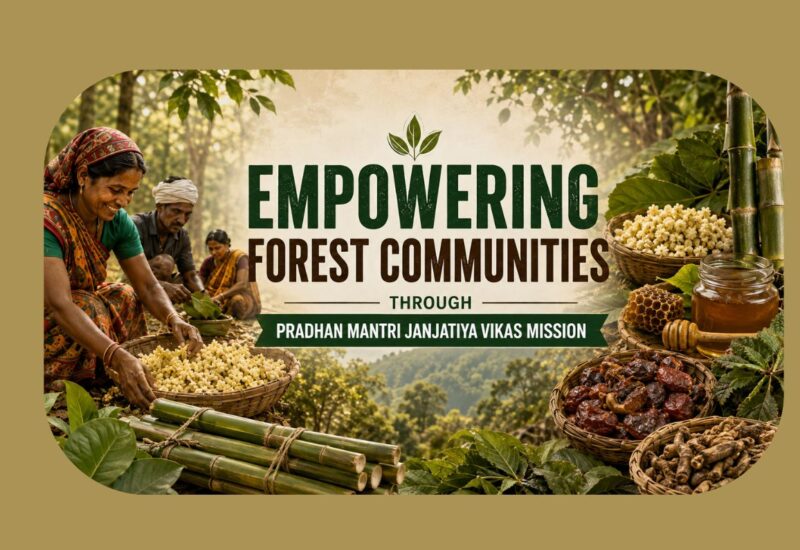
Empowering Forest Communities through Pradhan Mantri Janjatiya Vikas Mission
1. India has about 10.4 crore Scheduled Tribe people, and Minor Forest Produce (MFP) contributes nearly 20–40 percent of the annual income of many forest-dwelling tribal families.
2. Important MFP items include honey, tendu leaves, mahua flowers, tamarind, lac, bamboo, wild herbs, wax, medicinal plants, roots, tubers, cane and tussar cocoons.
3. Tribal gatherers often receive low prices because they sell raw forest produce to middlemen. The Pradhan Mantri Janjatiya Vikas Mission (PMJVM) aims to improve their earnings through value addition, skills, finance and market access.
4. PMJVM was launched in 2021–22. It organises tribal communities into community-owned enterprises and connects them with national and digital markets.
5. The Scheduled Tribes and Other Traditional Forest Dwellers (Recognition of Forest Rights) Act, 2006, also called the Forest Rights Act, recognises the right of forest dwellers to collect, use and sell non-timber forest produce.
6. The Provisions of the Panchayats (Extension to the Scheduled Areas) Act, 1996, gives tribal Gram Panchayats ownership rights over minor forest produce.
7. The government has notified Minimum Support Price (MSP) for 87 MFP items under PMJVM. The Tribal Cooperative Marketing Development Federation of India (TRIFED) procures eligible products at the pre-determined MSP through State implementing agencies.
8. Since 2013–14, State governments have procured 2,67,954 metric tonnes of MFP worth Rs. 693.98 crore under the MSP scheme.
9. The Van Dhan Yojana, launched on 14 April 2018, is part of PMJVM and provides the foundation for Van Dhan Vikas Kendras (VDVKs).
10. A VDVK is formed by clustering 15 Self-Help Groups (SHGs), comprising about 300 tribal members. At least 60 percent of the members must belong to Scheduled Tribe communities.
11. VDVKs provide scientific-harvesting training, primary processing equipment, packaging tools, dryers, decorticators, storage, transport support and working capital through financial institutions, banks and the National Scheduled Tribes Finance and Development Corporation.
12. VDVKs are generally established near local Haat Bazaars, which are important MFP procurement centres. There are more than 5,000 Haats in tribal areas, and they are being modernised with permanent structures, storage, drinking water, shade and weighing facilities.
13. TRIFED provides market intelligence, daily price information and e-commerce support to VDVKs. PMJVM also supports branding, exhibitions, artisan melas, geo-tagging, Geographical Indications, information technology platforms and research support.
14. As of 31 July 2026, 4,172 VDVKs had been sanctioned and 2,911 were functional. They had linked 12.48 lakh tribal members and recorded sales of around Rs. 168 crore.
15. VDVKs support tribal women’s entrepreneurship. The Nyigamane, Ho Yorbe, Medumhagdum VDVK in Leparada district of Arunachal Pradesh was formed in October 2021 with 300 women SHG members; it produces items such as King Chilli Pickle, bamboo shoot pickle, turmeric powder, ginger powder, pineapple jam and fruit squash, and has recorded sales of Rs. 11 lakh since 2022–23.
Must Know Terms :
1. Minor Forest Produce (MFP)
MFP includes non-timber forest products such as honey, tendu leaves, mahua, lac, bamboo, medicinal plants and herbs. It provides an important source of income for tribal communities.
2. Van Dhan Vikas Kendra (VDVK)
A VDVK is a community-owned tribal enterprise that helps forest gatherers process, package and market MFP products. It is formed by clustering 15 Self-Help Groups with about 300 members.
3. Minimum Support Price (MSP)
MSP is a pre-determined price at which the government procures notified MFP items. It protects tribal gatherers from distress sales and low market prices.
4. Tribal Cooperative Marketing Development Federation of India (TRIFED)
TRIFED is an organisation under the Ministry of Tribal Affairs. It supports the marketing, procurement and value addition of tribal products.
5. Van Dhan Yojana
Van Dhan Yojana was launched on 14 April 2018. It supports tribal Self-Help Groups through training, processing equipment, working capital and market linkages.
6. Forest Rights Act, 2006
The Forest Rights Act recognises the rights of Scheduled Tribes and other traditional forest dwellers over forest resources. It gives them the right to collect and sell non-timber forest produce.
MCQ :
1. With reference to Minor Forest Produce, consider the following statements:
1. It includes non-timber forest produce of plant origin.
2. It includes honey, lac, tendu leaves and medicinal plants.
3. It is an important source of income for many forest-dwelling tribal families.
Which of the statements given above are correct?
(a) 1 and 2 only
(b) 2 and 3 only
(c) 1 and 3 only
(d) 1, 2 and 3
2. Minor Forest Produce contributes approximately what share of annual income for many forest-dwelling tribal families?
(a) 5–10 percent
(b) 20–40 percent
(c) 50–60 percent
(d) 70–80 percent
3. The Pradhan Mantri Janjatiya Vikas Mission was launched in:
(a) 2018–19
(b) 2019–20
(c) 2021–22
(d) 2023–24
4. The principal objective of the Pradhan Mantri Janjatiya Vikas Mission is to:
(a) prohibit tribal communities from collecting forest produce
(b) convert forest land into industrial zones
(c) improve tribal income through value addition and market access
(d) replace all local markets with private companies
5. Which one of the following Acts recognises the right of forest dwellers to collect and sell non-timber forest produce?
(a) Forest Conservation Act, 1980
(b) Forest Rights Act, 2006
(c) Wildlife Protection Act, 1972
(d) Biological Diversity Act, 2002
6. The Provisions of the Panchayats (Extension to the Scheduled Areas) Act, 1996, grants ownership rights over minor forest produce to:
(a) State Forest Departments
(b) District Collectors
(c) Tribal Gram Panchayats
(d) Private forest contractors
7. The government has notified Minimum Support Price for how many Minor Forest Produce items under the Pradhan Mantri Janjatiya Vikas Mission?
(a) 57
(b) 67
(c) 77
(d) 87
8. Which organisation procures eligible Minor Forest Produce at the pre-determined Minimum Support Price through State implementing agencies?
(a) Tribal Cooperative Marketing Development Federation of India
(b) Food Corporation of India
(c) National Agricultural Cooperative Marketing Federation of India
(d) National Bank for Agriculture and Rural Development
9. Since 2013–14, State governments have procured Minor Forest Produce worth approximately:
(a) Rs. 168 crore
(b) Rs. 693.98 crore
(c) Rs. 1,248 crore
(d) Rs. 2,911 crore
10. Van Dhan Yojana was launched on:
(a) 14 April 2018
(b) 26 January 2019
(c) 15 August 2020
(d) 2 October 2021
11. A Van Dhan Vikas Kendra is generally formed by clustering:
(a) 5 Self-Help Groups with 100 members
(b) 10 Self-Help Groups with 200 members
(c) 15 Self-Help Groups with about 300 members
(d) 20 Self-Help Groups with about 500 members
12. At least what proportion of members in a Van Dhan Vikas Kendra must belong to Scheduled Tribe communities?
(a) 40 percent
(b) 50 percent
(c) 60 percent
(d) 75 percent
13. Which of the following support is provided through Van Dhan Vikas Kendras?
1. Scientific-harvesting training
2. Primary processing equipment
3. Storage and transport support
4. Working capital through financial institutions
Select the correct answer using the code given below:
(a) 1 and 2 only
(b) 2 and 3 only
(c) 1, 3 and 4 only
(d) 1, 2, 3 and 4
14. With reference to Haat Bazaars under the Pradhan Mantri Janjatiya Vikas Mission, consider the following statements:
1. There are more than 5,000 Haats in tribal areas.
2. They are important procurement points for Minor Forest Produce.
3. They are being modernised with facilities such as storage and weighing equipment.
Which of the statements given above are correct?
(a) 1 and 2 only
(b) 2 and 3 only
(c) 1 and 3 only
(d) 1, 2 and 3
15. As of 31 July 2026, which one of the following correctly represents the status of Van Dhan Vikas Kendras?
(a) 2,911 sanctioned and 4,172 functional
(b) 4,172 sanctioned and 2,911 functional
(c) 4,172 sanctioned and 12.48 lakh functional
(d) 2,911 sanctioned and 12.48 lakh functional


0 comment