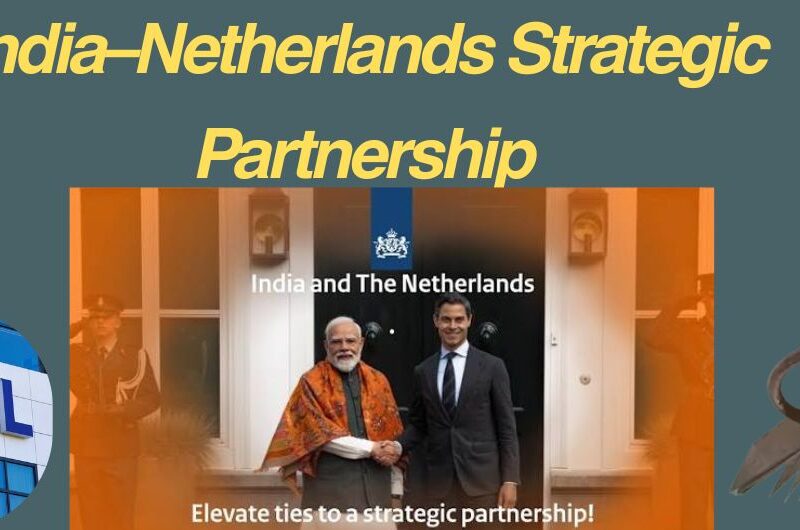
India–Netherlands Strategic Partnership
1. India and the Netherlands established diplomatic relations in 1947 and elevated ties to a Strategic Partnership for 2026–2030 during Prime Minister Narendra Modi’s May 2026 visit.
2. The Netherlands is one of India’s major trade partners in Europe, with bilateral trade worth USD 27.8 billion in 2024–25.
3. The Netherlands is the fourth-largest investor in India, with cumulative Foreign Direct Investment (FDI) of USD 55.6 billion.
4. India has a merchandise trade surplus of USD 17.393 billion with the Netherlands.
5. More than 300 Dutch companies operate in India, and over 300 Indian companies are present in the Netherlands.
6. India and the Netherlands launched semiconductor cooperation in 2024 for skill development, research, startups, and technology collaboration.
7. Cooperation between Tata Electronics and ASML will support India’s semiconductor fabrication facility at Dholera, Gujarat.
8. The India–Netherlands Roadmap on Green Hydrogen focuses on clean energy, investment, production, use, and export of green hydrogen.
9. A Joint Working Group on Renewable Energy was set up to cooperate on green hydrogen, bioenergy, renewables, battery storage, and circular feedstocks.
10. Dutch technical cooperation will support Gujarat’s Kalpasar Project, which proposes a freshwater reservoir across the Gulf of Khambhat.
11. The Netherlands returned 11th-century Chola Copper Plates to India, written in Tamil and Sanskrit.
12. The Netherlands has around 2.4 lakh people of Indian origin, including nearly 2 lakh Hindustani-Surinami community members.
13. An Indo-Dutch Centre of Excellence for Flowers will be established in West Tripura to promote floriculture and rural livelihoods.
14. An Indo-Dutch Centre of Excellence for Dairy Training will be set up at the Centre of Excellence for Animal Husbandry (CEAH), Bengaluru.
15. India and the Netherlands signed a Customs Mutual Administrative Assistance Agreement to improve customs cooperation, trade facilitation, and enforcement.
Must Know Terms :
1. Strategic Partnership (2026–2030): India and the Netherlands elevated their relationship to a Strategic Partnership during Prime Minister Narendra Modi’s May 2026 visit. It focuses on trade, technology, clean energy, defence, innovation, education, and people-to-people ties.
2. Semiconductor Partnership: Launched in 2024, it promotes cooperation in semiconductor manufacturing, skill development, research, startup support, and advanced chip technologies. It also supports India’s Semiconductor Mission.
3. Green Hydrogen Roadmap: A bilateral roadmap to strengthen cooperation in green hydrogen production, technology, investment, infrastructure, and exports, supporting both countries’ clean energy transition.
4. Kalpasar Project: A proposed freshwater reservoir across the Gulf of Khambhat in Gujarat. The Netherlands is providing technical expertise in water management, irrigation, tidal power, and sustainable infrastructure.
5. Chola Copper Plates: The Netherlands returned the 11th-century Chola Copper Plates to India. These Tamil and Sanskrit inscriptions record land grants made by Chola rulers and are an important part of India’s cultural heritage.
6. ASML: ASML, the world’s leading semiconductor equipment manufacturer based in the Netherlands, is partnering with Tata Electronics to support India’s semiconductor fabrication ecosystem, particularly the Dholera semiconductor project.
- Core Pillar of the Reference: The Kalpasar Project
The Kalpasar Project is a mega-engineering concept proposing the construction of a 30-kilometre barrier dam across the Gulf of Khambhat.
- The Gulf Challenge: The Gulf of Khambhat experiences extreme tidal ranges, heavy siltation, and high salinity.
- The Dutch Parallel: The project directly mirrors the historic Afsluitdijk Dam in the Netherlands. Built nearly a century ago, the 32 km Dutch dam closed off the saltwater Zuiderzee gulf, turning it into a massive freshwater lake (IJsselmeer).
- Institutional Framework: The Ministry of Jal Shakti (India) and the Ministry of Infrastructure and Water Management (Netherlands) signed a Letter of Intent (LoI) for technical cooperation explicitly targeting Kalpasar.
- Strategic Utility: The project uses Dutch land-reclamation and tidal flood control technologies to create a 10 billion cubic metre freshwater reservoir. This secures drinking and agricultural water for the drought-prone Saurashtra region, while integrating tidal power generation and an over-sea transport link.
MCQ :
1. With reference to India–Netherlands relations, consider the following statements:
1. India and the Netherlands established diplomatic relations in 1947.
2. Bilateral relations were elevated to a Strategic Partnership for 2026–2030 during Prime Minister Narendra Modi’s visit in May 2026.
3. The Strategic Partnership focuses only on trade and investment cooperation.
Which of the statements given above is/are correct?
A. 1 and 2 only
B. 2 only
C. 1 and 3 only
D. 1, 2 and 3
2. Which of the following correctly describes India’s trade relations with the Netherlands?
A. India has a trade deficit with the Netherlands.
B. The Netherlands is India’s largest trading partner globally.
C. India enjoys a merchandise trade surplus with the Netherlands.
D. Bilateral trade is below USD 10 billion.
3. Consider the following statements regarding the India–Netherlands Semiconductor Partnership:
1. It was launched in 2024.
2. It supports skill development and research collaboration.
3. It focuses exclusively on semiconductor imports.
Which of the statements given above is/are correct?
A. 1 and 2 only
B. 2 and 3 only
C. 1 only
D. 1, 2 and 3
4. Tata Electronics has partnered with which Netherlands-based company to strengthen India’s semiconductor ecosystem?
A. Philips
B. ASML
C. NXP Semiconductors
D. Shell
5. The India–Netherlands Green Hydrogen Roadmap primarily aims to:
A. Promote nuclear cooperation
B. Develop coal gasification technologies
C. Strengthen cooperation in green hydrogen production and trade
D. Establish a joint petroleum reserve
6. With reference to the Joint Working Group on Renewable Energy, consider the following statements:
1. It focuses on green hydrogen.
2. It promotes cooperation in battery storage technologies.
3. It also covers bioenergy and circular feedstocks.
Which of the statements given above is/are correct?
A. 1 only
B. 2 and 3 only
C. 1 and 3 only
D. 1, 2 and 3
7. The Kalpasar Project proposes to construct:
A. A desalination plant on the Arabian Sea coast
B. A freshwater reservoir across the Gulf of Khambhat
C. A hydroelectric dam on the Narmada River
D. A navigation canal linking Gujarat and Maharashtra
8. Which one of the following countries serves as the primary technical partner for the Kalpasar Project?
A. France
B. Germany
C. Japan
D. Netherlands
9. The proposed barrier dam under the Kalpasar Project will be approximately:
A. 15 km long
B. 22 km long
C. 30 km long
D. 45 km long
10. The technical inspiration for the Kalpasar Project is primarily drawn from which Dutch infrastructure project?
A. Delta Works
B. Oosterscheldekering
C. Afsluitdijk Dam
D. Maeslantkering
11. The Afsluitdijk Dam in the Netherlands was built to:
A. Connect the Netherlands with Belgium
B. Convert the saltwater Zuiderzee into the freshwater IJsselmeer
C. Prevent river flooding from the Rhine only
D. Generate offshore wind energy
12. The Letter of Intent (LoI) for technical cooperation on the Kalpasar Project was signed between:
A. NITI Aayog and the Dutch Parliament
B. Ministry of Jal Shakti and the Ministry of Infrastructure and Water Management of the Netherlands
C. Ministry of External Affairs and the Dutch Foreign Ministry
D. Ministry of Environment and Rijkswaterstaat
13. Which of the following is NOT an intended objective of the Kalpasar Project?
A. Creation of a freshwater reservoir
B. Tidal power generation
C. Over-sea transport connectivity
D. Offshore crude oil extraction
14. The proposed freshwater reservoir under the Kalpasar Project is expected to have a storage capacity of approximately:
A. 2 billion cubic metres
B. 5 billion cubic metres
C. 10 billion cubic metres
D. 20 billion cubic metres
15. The primary region expected to benefit from the freshwater storage created under the Kalpasar Project is:
A. Kutch
B. North Gujarat
C. Saurashtra
D. Konkan Coast

0 comment