Great Nicobar Development Plan
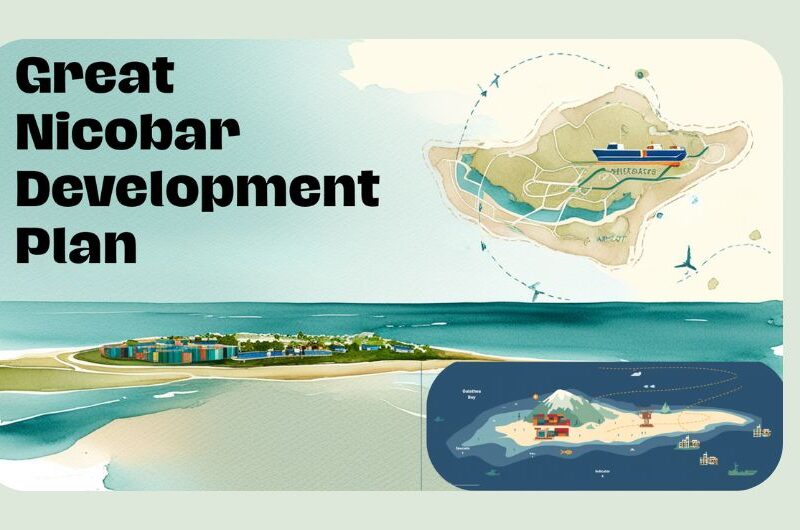
1. The Great Nicobar Project aims to develop Great Nicobar Island into a strategic maritime and economic hub by leveraging its location near the East-West international shipping route.
2. The project site lies about 40 nautical miles from the East-West shipping route, giving it strong potential for transshipment activity and strategic maritime relevance in the Indian Ocean region.
3. The project includes an International Container Transshipment Terminal at Galathea Bay with a planned capacity of 14.2 million TEU and natural water depth exceeding 20 metres.
4. A Greenfield International Airport is part of the project and is designed for 4000 Peak Hour Passengers, with future handling capacity expected to rise significantly.
5. The project also includes a 450 MVA gas and solar-based power plant to provide uninterrupted energy for the port, airport, township, and associated infrastructure.
6. A new township covering 16,610 hectares has been planned to support residential, commercial, institutional, and service needs arising from port-led development on the island.
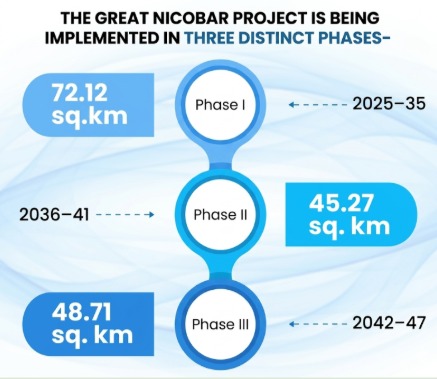
7. The Great Nicobar Project will be implemented in three phases: Phase I from 2025 to 2035, Phase II from 2036 to 2041, and Phase III from 2042 to 2047.
8. The total project area is 166.10 square kilometres, comprising 35.35 square kilometres of revenue land and 130.75 square kilometres of forest land.
9. The project received prior Environmental Clearance under the EIA Notification, 2006 after screening, scoping, public consultation, and appraisal under the statutory environmental process.
10. The Environmental Clearance contains 42 specific conditions covering air, water, noise, waste management, marine ecology, human health, and disaster management, supported by an Environment Management Plan.
11. Three independent monitoring committees have been constituted to oversee pollution matters, biodiversity matters, and welfare issues concerning the Shompen and Nicobarese communities.
12. The project will divert 1.82 percent of the total forest cover of the Andaman and Nicobar Islands, with a maximum estimated felling of 7.11 lakh trees.
13. Compensatory afforestation for Phase I diversion of 48.65 square kilometres of forest is planned over 97.30 square kilometres of land identified in Haryana.
14. Great Nicobar has 751.070 square kilometres of notified Tribal Reserve, and after de-notification and re-notification measures, the reserve will record a net increase of 3.912 square kilometres.
15. The island is inhabited by about 237 Shompen and around 1,094 Nicobarese, and no displacement of these tribal communities has been proposed under the project framework.
Must Know Terms :
1.ICTT
ICTT stands for International Container Transshipment Terminal, a core component of the Great Nicobar Project planned at Galathea Bay. It is designed with a capacity of 14.2 million TEU and benefits from natural water depth exceeding 20 metres. Located about 40 nautical miles from the East-West shipping route, it aims to reduce dependence on Colombo, Singapore, and Klang for transshipment.
2. GalatheaBay
Galathea Bay is the site selected for the transshipment port under the Great Nicobar Project. Its strategic value comes from proximity to the East-West international shipping route and deep natural waters. The bay is expected to serve gateway and transshipment cargo, strengthen India’s maritime position in the Indian Ocean Region, and support defence, trade, logistics, and long-term regional development objectives.
3. EIA
EIA refers to Environmental Impact Assessment, the statutory process used to examine likely environmental consequences of a proposed project before approval. The Great Nicobar Project received clearance under the EIA Notification, 2006 after screening, scoping, public consultation, and appraisal. It assesses impacts on ecology, pollution, human health, and disaster risk, helping authorities attach conditions and mitigation requirements to development plans.
4. EMP
EMP stands for Environment Management Plan, a document prepared to minimise environmental impacts during construction and operation of a project. For Great Nicobar, it includes mitigation measures related to air, water, noise, waste management, marine ecology, and disaster response. The project’s environmental clearance is supported by this plan, which guides compliance, monitoring, and sustainable implementation throughout different development phases overall.
5. Shompen
Shompen are a Particularly Vulnerable Tribal Group inhabiting Great Nicobar Island, traditionally living as hunter-gatherers in forested areas. Their estimated population in the project document is about 237. The Great Nicobar Project states that no displacement of Shompen is proposed. Their welfare is monitored through a dedicated independent committee, and project implementation is aligned with the Shompen Policy, 2015 framework.
6. CompensatoryAfforestation
Compensatory Afforestation is the plantation of trees and restoration of forest area to offset forest diversion for a project. For Great Nicobar Phase I, diversion of 48.65 square kilometres of forest is proposed, while 97.30 square kilometres of land in Haryana have been identified for compensatory afforestation. This arrangement was chosen because local afforestation on the islands was considered unfeasible.
Key Takeaways
a) The Great Nicobar Project seeks to transform Great Nicobar into a strategic maritime and economic hub by leveraging its proximity (about 40 nautical miles) to the East–West shipping route and reducing dependence on foreign transshipment ports keeping in view the defense and National Security purpose
b) It includes major infrastructure components: a 14.2 million twenty foot equivalent unit( MTEU) International Container Transshipment Terminal, a Greenfield International Airport (4000 Peak Hour Passengers-PHP)., a 450 MVA gas–solar power plant, and a planned township.
c) The development follows a regulated environmental framework, with clearance under the EIA Notification, 2006 and ICRZ Notification, 2019, 42 compliance conditions, diversion of 1.82% of island forest cover, and compensatory afforestation planned over 97.30 sq. km.
d) Tribal welfare remains central, with no displacement proposed for Shompen and Nicobarese communities and a net increase in notified tribal reserve area through re-notification measures.
MCQ :
1. With reference to the Great Nicobar Project, consider the following statements:
1. It seeks to develop Great Nicobar as a strategic maritime and economic hub.
2. The project site lies close to the East-West international shipping route.
3. It aims to reduce India’s dependence on foreign transshipment ports.
Which of the statements given above are correct?
A) 1 and 2 only
B) 1, 2 and 3
C) 2 and 3 only
D) 1 only
2. The proposed International Container Transshipment Terminal under the Great Nicobar Project is planned at:
A) Campbell Bay
B) Port Blair
C) Galathea Bay
D) Car Nicobar
3. The planned handling capacity of the International Container Transshipment Terminal under the Great Nicobar Project is:
A) 14.2 million TEU
B) 12.4 million TEU
C) 10.2 million TEU
D) 16.2 million TEU
4. The proposed Greenfield International Airport under the Great Nicobar Project is designed for:
A) 2000 Peak Hour Passengers
B) 3000 Peak Hour Passengers
C) 5000 Peak Hour Passengers
D) 4000 Peak Hour Passengers
5. The power component of the Great Nicobar Project consists of a:
A) 400 MVA coal-based power plant
B) 450 MVA gas and solar-based power plant
C) 500 MVA hydro-based power plant
D) 350 MVA diesel-based power plant
6. The planned township under the Great Nicobar Project covers:
A) 14,610 hectares
B) 15,610 hectares
C) 16,610 hectares
D) 17,610 hectares
7. Which of the following correctly represents the implementation phases of the Great Nicobar Project?
A) Phase I: 2025–35, Phase II: 2036–41, Phase III: 2042–47
B) Phase I: 2025–30, Phase II: 2031–40, Phase III: 2041–47
C) Phase I: 2026–35, Phase II: 2036–42, Phase III: 2043–47
D) Phase I: 2025–34, Phase II: 2035–41, Phase III: 2042–48
8. The total project area of the Great Nicobar Project is:
A) 156.10 square kilometres
B) 176.10 square kilometres
C) 160.16 square kilometres
D) 166.10 square kilometres
9. The Great Nicobar Project received prior Environmental Clearance under:
A) Forest Conservation Rules, 2022
B) EIA Notification, 2006
C) Wildlife Protection Act, 1972
D) Biological Diversity Act, 2002
10. The Environmental Clearance for the project contains how many specific compliance conditions?
A) 24
B) 36
C) 42
D) 48
11. Which of the following is correct regarding the forest impact of the Great Nicobar Project?
A) It will divert 1.82 percent of the total forest cover of the Andaman and Nicobar Islands
B) It will divert 3.82 percent of the total forest cover of the islands
C) It will divert 2.18 percent of the total forest cover of the islands
D) It will divert 4.12 percent of the total forest cover of the islands
12. Compensatory afforestation for Phase I forest diversion is planned over:
A) 87.30 square kilometres in Odisha
B) 97.30 square kilometres in Madhya Pradesh
C) 94.30 square kilometres in Haryana
D) 97.30 square kilometres in Haryana
13. Great Nicobar has how much officially notified Tribal Reserve area at present?
A) 651.070 square kilometres
B) 751.070 square kilometres
C) 851.070 square kilometres
D) 551.070 square kilometres
14. After de-notification and re-notification measures, the Tribal Reserve in Great Nicobar will record a net increase of:
A) 2.912 square kilometres
B) 4.912 square kilometres
C) 3.912 square kilometres
D) 5.912 square kilometres
15. With reference to the tribal communities inhabiting Great Nicobar Island, consider the following statements:
1. The Shompen are a Particularly Vulnerable Tribal Group.
2. About 237 Shompen and around 1,094 Nicobarese inhabit the island.
3. No displacement of these tribal communities has been proposed under the project.
Which of the statements given above are correct?
A) 1, 2 and 3
B) 1 and 2 only
C) 2 and 3 only
D) 1 only




0 comment