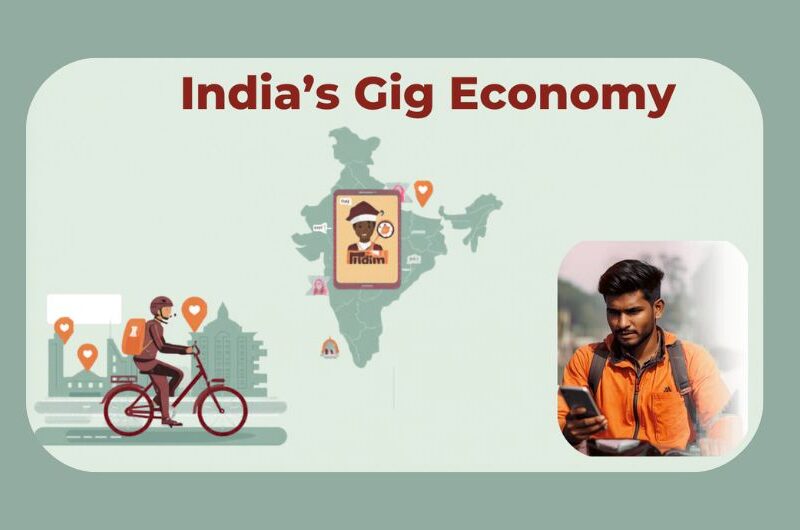
India’s Gig Economy
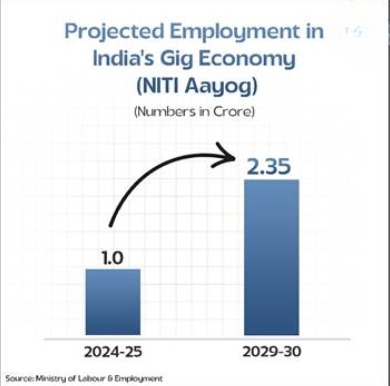
1. India’s gig workforce is projected to expand from 1 crore workers in 2024–25 to 2.35 crore by 2029–30, reflecting rapid growth in app-based and platform-mediated employment.
2. The Code on Social Security, 2020 gave legal recognition to gig workers and platform workers, formally bringing them within the framework of social security and welfare provisions.
3. Gig workers earn livelihoods outside the traditional employer-employee structure, while platform workers form a subset whose work is mediated through online applications or digital aggregator platforms.
4. Social security provisions for gig and platform workers include life cover, disability protection, accident insurance, health benefits, maternity support, and old-age protection under statutory schemes.
5. Union Budget 2025–26 announced registration of online platform workers on the e-Shram portal, identity cards, and healthcare coverage under Ayushman Bharat Pradhan Mantri Jan Arogya Yojana (PM-JAY).
6. Ayushman Bharat Pradhan Mantri Jan Arogya Yojana provides health coverage of ₹5 lakh per family annually for secondary and tertiary hospitalization across over 31,000 empanelled hospitals.
7. The platform worker component under Ayushman Bharat PM-JAY had been announced, but the scheme for platform workers was yet to be launched at reporting time.
8. The Social Security Code, 2020 consolidated and simplified nine central labour laws related to social security, creating a unified legal framework for broader worker coverage.
9. The Code extends social security beyond organised employees to include unorganised workers, self-employed persons, and, for the first time, gig and platform workers.
10. Central and State Governments can frame schemes covering provident fund, pension, Employees’ State Insurance (ESI), gratuity, maternity benefits, life cover, old-age protection, and crèche facilities.
11. The Code provides for a Social Security Fund to support unorganised, gig, and platform workers through contributions from governments, aggregators or platforms, and sometimes workers.
12. A National Social Security Board can be constituted under the Code to oversee welfare measures and broader support mechanisms for gig and platform workers nationwide.
13. The e-Shram portal was launched on 26 August 2021 to build a National Database of Unorganised Workers, including migrant, agriculture, and platform workers.
14. By 3 August 2025, more than 30.98 crore unorganised workers had registered on e-Shram, including over 3.37 lakh platform and gig workers nationwide.
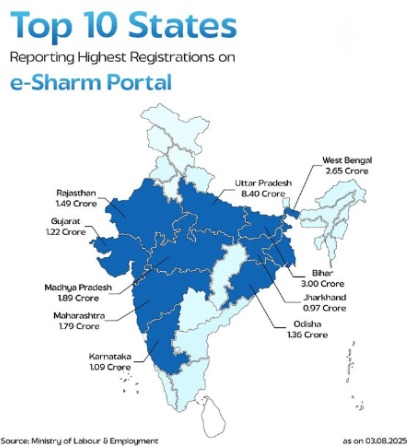
15. Uttar Pradesh recorded 8.39 crore registrations on e-Shram, followed by Bihar with 3.00 crore and West Bengal with 2.64 crore, alongside strong female participation.
Must Know Terms :
1.Aggregator
Aggregator is the digital intermediary through which platform workers receive tasks, customers, and payments. The Social Security Code, 2020 recognized platform work linked to such digital platforms. Under this framework, aggregators can contribute to the Social Security Fund meant for unorganised, gig, and platform workers. Their role became more important as India’s gig workforce was projected to rise from 1 crore in 2024–25 to 2.35 crore by 2029–30.
2.Unorganised
Unorganised refers to workers outside regular formal employment structures, often without fixed contracts or stable social security. The Social Security Code, 2020 extended protection to this category along with self-employed, gig, and platform workers. The e-Shram portal was launched on 26 August 2021 to build the National Database of Unorganised Workers. By 3 August 2025, registrations crossed 30.98 crore, showing the scale of this workforce across India.
3.Empanelled
Empanelled means officially approved and listed under a government scheme to provide services. Under Ayushman Bharat Pradhan Mantri Jan Arogya Yojana, treatment is available through more than 31,000 public and private empanelled hospitals. Union Budget 2025–26 announced healthcare coverage for online platform workers under this scheme. Although that worker-specific component had not yet been launched at the reported stage, the empanelled network already existed for large-scale delivery.
4.Gratuity
Gratuity is a statutory retirement-related lump sum benefit included in India’s labour welfare structure. The Social Security Code, 2020 consolidated nine central labour laws, including the Payment of Gratuity Act, 1972, into one broader framework. Its inclusion shows that worker welfare under the Code was not limited to accident or health support alone. The Code placed gratuity alongside pension, provident fund, maternity support, and life cover.
5.Maternity
Maternity benefits are formally included in the Social Security Code, 2020 as part of the wider social protection framework available for workers. The Code merged nine central labour laws, including the Maternity Benefit Act, 1961. It extended social security architecture beyond organised workers to include unorganised, self-employed, gig, and platform workers. This made maternity support part of a broader legal system covering health, disability, old-age protection, and welfare.
6.Crèche
Crèche refers to childcare support facilities recognised within the social security framework. The Social Security Code, 2020 specifically listed crèche facilities among welfare measures that governments may include in schemes for workers. This placed childcare alongside pension, provident fund, gratuity, maternity benefits, and life cover. Its inclusion is significant because the Code sought wider labour protection after consolidating nine central labour laws into a single legal structure.
Key takeaways
a) India’s gig workforce is projected to grow from 1 crore in 2024–25 to 2.35 crore by 2029–30.
b) Code on Social Security, 2020provides legal recognition and social security benefits to gig and platform workers.
c) e-Shram portalhas registered over 98 crore unorganised workers, including 3.37 lakh platform workers.
d) Uttar Pradesh, Bihar, and West Bengalhave the highest registrations, with strong female participation.
MCQ :
1. India’s gig workforce is projected to reach what level by 2029–30?
A) 1.85 crore
B) 2.35 crore
C) 2.75 crore
D) 3.25 crore
2. Legal recognition to gig workers and platform workers was provided by:
A) Code on Social Security, 2020
B) Industrial Relations Code, 2020
C) Payment of Wages Act, 1936
D) Factories Act, 1948
3. Platform workers are best identified as workers whose services are mediated through:
A) Cooperative societies
B) Public sector units
C) Digital aggregator platforms
D) Panchayat institutions
4. Which of the following is included in social security provisions for gig and platform workers?
A) Old-age protection
B) Land ownership support
C) Export subsidy
D) Housing tax rebate
5. Union Budget 2025–26 announced registration of online platform workers on which portal?
A) DigiLocker
B) e-Shram
C) GeM
D) UMANG
6. Ayushman Bharat Pradhan Mantri Jan Arogya Yojana provides annual health coverage of:
A) ₹2 lakh per family
B) ₹3 lakh per family
C) ₹5 lakh per family
D) ₹7 lakh per family
7. Treatment under Ayushman Bharat Pradhan Mantri Jan Arogya Yojana is available through more than how many empanelled hospitals?
A) 21,000
B) 26,000
C) 31,000
D) 36,000
8. The Social Security Code, 2020 consolidated how many central labour laws related to social security?
A) Seven
B) Eight
C) Nine
D) Ten
9. Which category was brought under the social security framework for the first time through the Code?
A) Only organised factory workers
B) Only government employees
C) Only pensioners
D) Gig and platform workers
10. Which among the following can be covered under schemes framed by Central and State Governments under the Code?
A) Crèche facilities
B) Customs duty relief
C) Export licensing
D) Corporate tax exemption
11. The Social Security Fund under the Code is meant to support:
A) Only organised industrial workers
B) Unorganised, gig, and platform workers
C) Only central government employees
D) Only self-help groups
12. Under the Code, welfare measures for gig and platform workers can be overseen by:
A) National Human Rights Commission
B) Finance Commission
C) National Social Security Board
D) Inter-State Council
13. The e-Shram portal was launched on:
A) 15 August 2020
B) 26 January 2021
C) 26 August 2021
D) 2 October 2021
14. By 3 August 2025, more than how many unorganised workers had registered on e-Shram?
A) 20.98 crore
B) 25.98 crore
C) 28.98 crore
D) 30.98 crore
15. Which state recorded the highest number of e-Shram registrations mentioned here?
A) Bihar
B) Uttar Pradesh
C) West Bengal
D) Maharashtra




0 comment