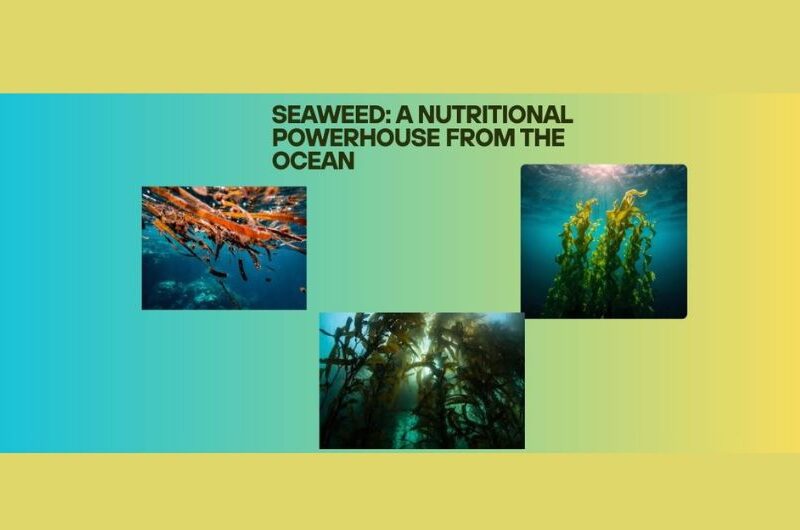
Ocean-to-Plate: Seaweed Farming and India’s Blue Economy Push 1. Seaweed is a nutrient rich marine plant containing vitamins, minerals, amino acids, and 54 trace elements, linked with reduced risks of diabetes, arthritis, heart disease, hypertension, and cancers. 2. Cultivation occurs in shallow coastal waters and needs no land, freshwater, fertilizers, or pesticides, positioning seaweed as an eco friendly crop suited for climate resilience, low input livelihoods. 3. Seaweed supplies inputs for food, cosmetics, fertilizers, medicines, and industrial hydrocolloids, enabling diversified value chains beyond fisheries and creating new employment opportunities for coastal women and youth nationwide. 4. Alginate is a thickening extract from brown seaweeds, valued around US$ 213 million, largely wild harvested, used in foods, cosmetics, and medical products for stability and texture control.5. Agar derives from red seaweeds, cultivated since the 1960s, valued about US$ 132 million, used in desserts, jams, and laboratory culture media for microbiology work and biotechnology research. 6. Carrageenan is extracted from certain red seaweeds such as Irish Moss, valued near US$ 240 million, widely used in dairy products, ice creams, and toothpaste for thickening applications. 7. Women farmers in Mandapam, Tamil Nadu began seaweed enterprise after training, investing ₹27,000 with cooperative support, overcoming cyclones and marketing hurdles, and producing 36,000 tonnes seaweed and jobs. 8. The global seaweed industry is valued near US$ 5.6 billion; a World Bank estimate suggests ten emerging markets could expand to about US$ 11.8 billion by 2030 collectively. 9. India hosts about 844 seaweed species, around 60 commercially valuable, and national agencies are promoting farming through policies, infrastructure support, and collaboration with states and research institutes actively. 10. Pradhan Mantri Matsya Sampada Yojana began in June 2020 with investment of ₹20,050 crore for fisheries development, making seaweed cultivation a priority component within sector modernization efforts nationally. 11. From 2020 to 2025, ₹640 crore is allocated for seaweed cultivation, including ₹194.09 crore for a Park in Tamil Nadu and a Brood Bank in Daman and Diu. Key Seaweed Developments in India: 12. Operational support includes approval of 46,095 rafts and 65,330 monocline tubenets, enabling farmers to scale cultivation structures and improve harvest consistency across coastal production clusters rapidly each season. 13. National targets aim to raise seaweed output to 1.12 million tonnes within five years, supporting nutrition security, green industry inputs, and alternative incomes that reduce dependence on fishing. 14. Seaweed based biostimulants, regulated under the Fertilizer Control Order 1985, enhance plant processes, nutrient uptake, and stress tolerance, complementing organic initiatives like PKVY and MOVCDNER since 2015–16 nationally. 15. CSIR CSMCRI developed tissue culture for Kappaphycus alvarezii, distributing seedlings in Tamil Nadu districts; farmers produced 30 tonnes in two cycles with 20–30% growth and improved carrageenan quality. Must Know Terms : 1. PMMSY (Pradhan Mantri Matsya Sampada Yojana): Launched in June 2020 with an investment outlay of ₹20,050 crore, it strengthens fisheries value chains and treats seaweed as a priority livelihood. For 2020–2025, ₹640 crore is earmarked for seaweed cultivation support, infrastructure, and capacity building. A key target is scaling seaweed output to 1.12 million tonnes within five years for coastal households. 2. NFDB (National Fisheries Development Board): NFDB supports policy execution, project appraisal, and capacity building for fisheries and aquaculture, including seaweed value chains. It facilitates state partnerships, training, and convergence with research institutes to move seaweed from pilot activity to commercial enterprise. By backing inputs, post-harvest handling, and market linkages, it helps coastal communities diversify incomes beyond capture fishing at scale. 3. Multipurpose Seaweed Park (Tamil Nadu): Planned under public support, the park is designed as a hub for processing, quality testing, product development, and entrepreneurship. It can enable value addition into food, cosmetics, pharma inputs, and agricultural biostimulants, reducing raw-material wastage. The initiative is part of the larger seaweed push, with a portion of ₹194.09 crore funding allocated for key projects. 4. Seaweed Brood Bank (Daman and Diu): A brood bank maintains healthy, high-quality seaweed seed material to ensure reliable supply for farmers. It supports genetic quality, disease control, and rapid multiplication, helping stabilize production across seasons. Alongside the Seaweed Park, it is funded within a ₹194.09 crore project component. Strong seed systems reduce crop failure risks and improve commercial consistency overall. 5. Biostimulant (Seaweed-based): Seaweed is recognised among eight biostimulant categories used to enhance plant performance without acting as a direct fertiliser. It improves nutrient uptake, stress tolerance, and soil biological activity. Quality of seaweed-derived biostimulants is regulated under the Fertilizer (Control) Order, 1985, aligning formulations, labelling, and standards. This links marine biomass with sustainable agriculture and resilience gains for farmers nationwide. 6. Kappaphycus alvarezii (Elkhorn sea moss): A commercially valuable seaweed cultivated for carrageenan used in food, pharmaceuticals, and cosmetics. In Tamil Nadu, CSIR-CSMCRI introduced tissue-culture propagation to supply uniform, disease-free seedlings. Farmers in Ramanathapuram, Pudukottai, and Tuticorin reported 30 tonnes in two cycles with 20–30% higher growth and improved carrageenan quality, strengthening scalable coastal enterprises. Improves seed supply and farmer profitability. Summary Seaweed is a nutrient-rich marine plant, packed with vitamins, minerals and amino acids. It contains 54 trace elements and essential nutrientsthat help fight diseases like cancer, diabetes, arthritis, heart problems and high blood pressure. Seaweed is a sea plant that grows in the ocean and seas. Seaweed cultivation requires no land, freshwater, fertilizers or pesticides, making it sustainable. The $5.6 billion seaweed industryis booming, with India’s production increasing steadily. Under one of its components, the Pradhan Mantri Matsya Sampada Yojana (PMMSY) aims to boost seaweed production to 12 million tonnesin five years. MCQ 1.Seaweed cultivation is considered sustainable mainly because it requires: (a) Land and canal irrigation (b) No land, freshwater, fertilizers, or pesticides (c) Intensive pesticide schedules (d) High freshwater pumping 2.The five year production target mentioned for seaweed is: (a) 0.12 million tonnes (b) 1.12 million tonnes (c) 2.12 million tonnes (d) 11.2 million tonnes 3.The scheme launched in June 2020 with ₹20,050 crore investment is: (a) PKVY (b) PMMSY (c) MOVCDNER (d) NFDB Export Mission 4.The total budget stated for seaweed
More Details