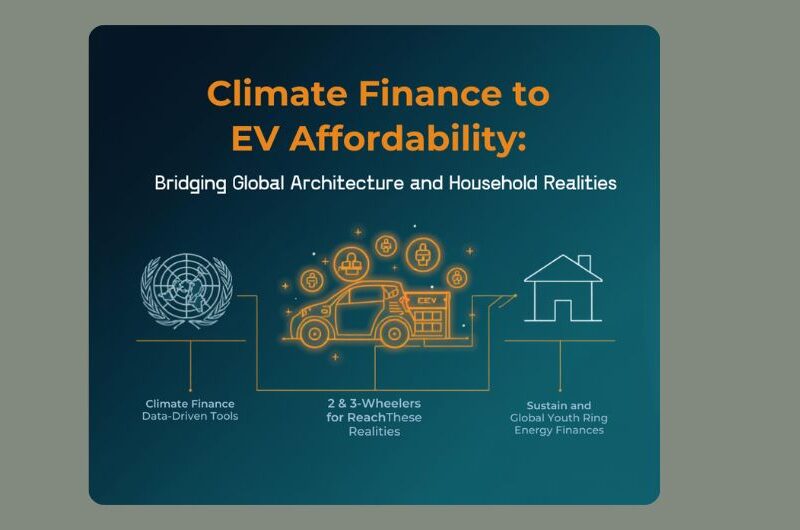
Climate Finance to EV Affordability: Bridging Global Architecture and Household Realities 1. India’s climate transition funding links global mechanisms with domestic innovation, especially electric mobility, creating a finance tension that requires simultaneous action across diplomacy, markets, and institutions. 2. India’s climate financing need is estimated at $1.5–$2.5 trillion by 2030, far above current inflows; India rejected a $300 billion NCQG baseline by 2035 as inadequate. 3. International climate finance is described as loan- and equity-heavy with limited grants, increasing repayment burdens; debt servicing in many LMICs exceeds estimated NDC spending needs. 4. MDBs provide large climate volumes mainly via debt while not matching debt-relief participation; private mobilisation biases funds toward commercially viable projects, underserving LDCs and SIDS. 5. India frames climate finance as obligation tied to historical responsibility, seeking predictable concessional flows for adaptation and loss; weak global terms raise local capital costs. 6. India sold over 1.5 million EVs in FY2024, but affordability constraints remain, especially in two- and three-wheelers, because upfront prices dominate purchase decisions. 7. EVs are described as costing 1.5–2× comparable ICE models; EV loan rates often exceed 20% while ICE loans are near 10%, sharply worsening monthly affordability. 8. Lenders price EV risk higher due to unclear resale values, battery degradation variation, and thin secondary markets; mainstream banks lack experience in 2W/3W lending. 9. NBFCs dominate vehicle credit but often delay EV entry due to technology risk and valuation doubts; early losses from low-quality e-rickshaw batteries reinforced caution and pricing. 10. Risk-sharing tools like credit guarantees and first-loss facilities can reduce default risk and enable longer tenors and cheaper rates; an SBI-managed instrument withdrew on viability concerns. 11. Implementation moved to SIDBI, reflecting need for development-finance intermediaries; high rates and sparse channels risk excluding tier II/III households and deepening transport poverty. 12. A domestic climate finance taxonomy can standardise climate-aligned activities; country-determined criteria can include realistic transition pathways aligned to development priorities, not imported templates. 13. A government-backed EV finance institution could refinance NBFCs and micro-lenders, using blended capital from budgets and multilateral concessional funds to lower cost of capital. 14. Market design options include battery-as-a-service, battery identifiers and health records, cashflow-matched loans, charging-linked finance, insurance pools, clear swapping standards, and data-driven underwriting. 15. Co-benefits include lower oil imports and air pollution; scaling needs local capacity, procurement levers, resale ecosystems, carbon-market revenues, targeted interest subvention, and accountability reporting. Must Know Terms : 1.NCQG Baseline NCQG Baseline: The New Collective Quantified Goal (NCQG) is the post-2025 climate-finance goal set “in extension” of the earlier USD 100-billion goal under the Paris decision framework. The agreed headline level is at least USD 300 billion per year by 2035 for developing countries’ climate action, with developed countries taking the lead, and alongside a wider scaling pathway to enable at least USD 1.3 trillion per year by 2035 from all sources (public/private, bilateral/multilateral, including alternative sources). 2.Loan-Heavy Climate Finance Loan-Heavy Climate Finance: Public climate finance to developing countries has been dominated by loans, especially for middle-income recipients. Over 2016–2022, loans represented about 85% of public climate finance provided to LMICs, 87% to UMICs, and 92% to high-income developing countries; grants were much higher mainly in LICs (about 64% grants). Concessionality differs by channel: over 2016–2022, about 79% of bilateral-provider loans were concessional, while only about 41% of multilateral climate-fund loans and about 23% of MDB climate loans were concessional. 3.EV Interest Rate Spread EV Interest Rate Spread: The measurable difference in borrowing cost between EV loans and comparable ICE vehicle loans, usually expressed in percentage points or basis points (bps). Example (India, May 2025): EV car-loan rates were reported as low as 8.15% versus 8.30% for non-electric car loans, implying an EV “green discount” spread of 0.15 percentage points = 15 bps (before borrower credit-score and tenure adjustments). 4.Risk-Sharing Facilities Risk-Sharing Facilities: Structured finance vehicles where a public/DFI partner shares a defined portion of credit losses with lenders or investors to unlock longer-tenor lending at lower risk. Standard definition (portfolio RSF): the guarantor reimburses the originator for an agreed share of principal losses on a portfolio of eligible assets. Example (GCF–IDB FP048): a climate-smart agriculture risk-sharing facility for MSMEs in Guatemala and Mexico approved with USD 20 million GCF support, within a total stated project investment of about USD 158 million, designed to help lenders offer longer-term loans for climate-smart investments. 5.Climate Finance Taxonomy Climate Finance Taxonomy: A classification system that defines which activities qualify as “climate-aligned” (mitigation, adaptation, transition, etc.) to guide capital flows and reduce greenwashing. India’s draft “Climate Finance Taxonomy” framework was released for public consultation by the Department of Economic Affairs (Ministry of Finance) in May 2025, explicitly linked to enabling larger resource flows for climate-friendly activities while maintaining reliable and affordable energy access. In practice, taxonomies are used by banks, bond issuers, and regulators to standardise disclosure and product labels. 6.Battery-as-a-Service and Data Infrastructure Battery-as-a-Service (BaaS): A model where the battery is owned/managed by a battery provider (not the EV buyer) and the user pays for energy/service (swap/lease/rent), reducing upfront EV cost and enabling faster “refuel” via swapping. India’s draft Battery Swapping Policy (20 Apr 2022) mandates lifecycle traceability: a Unique Identification Number (UIN) assigned at manufacturing for each battery pack; required technical data mapped to the UIN; swapping operators must store usage history and performance data against the UIN across the battery lifecycle; UINs also for swapping stations. It also specifies data/communication standards (e.g., open protocols such as OCPP for back-end interoperability), encourages data-sharing agreements, allows nodal authorities access to tracked information, and requires certain consumer-facing information (availability, battery type, compatibility, performance) to be made openly available in a standard format. MCQ 1. India’s estimated climate financing need by 2030 is stated as: (a) $0.5–$1.0 trillion (b) $1.0–$1.5 trillion (c) $1.5–$2.5 trillion (d) $3.0–$4.0 trillion 2. India rejected which NCQG baseline level and timing? (a) $100B annually by 2030 (b) $200B annually by 2040 (c) $300B annually by 2035 (d) $500B annually by 2050 3. International climate finance is
More Details