Best UPSC and MPPSC IAS Coaching Classes in Gwalior

Expanding India’s Trade Footprint: New FTAs and Strategic Market Access Gains

Expanding India’s Trade Footprint: New FTAs and Strategic Market Access Gains     1) India ranks 3rd among Global South economies in trade partnership diversity, as per United Nations Conference on Trade and Development (UNCTAD) Trade and Development Report 2025, and its diversity index score is higher than all Global North countries.   2) India–European Union (EU) Free Trade Agreement (FTA) negotiations were concluded in January 2026 and described as the “Mother of All Deals,” marking a major strategic trade milestone in 2026.   3) India concluded FTAs in Financial Year (FY) 2025-26 with the United Kingdom (UK), Oman, and New Zealand, expanding market access across Europe, the Gulf, and Oceania.   4) India concluded the first round of Israel FTA negotiations and formally launched trade negotiations with the Gulf Cooperation Council (GCC) in February 2026, widening the West Asia trade agenda.   5) India is expanding negotiations with ASEAN, Mexico, and Canada, indicating a push to widen trade architecture beyond traditional partners and deepen global value chain integration.   6) The India–EU FTA provides preferential access across 97% of EU tariff lines, covering 99.5% of trade value, while retaining policy flexibility for sensitive sectors and development priorities.   7) Under the India–EU FTA, 70.4% of tariff lines covering 90.7% of India’s exports get immediate duty elimination, benefiting textiles, leather-footwear, tea, coffee, spices, toys, sports goods, gems-jewellery, and marine products.   8) In the India–EU FTA, 20.3% tariff lines covering 2.9% of exports get zero duty in 3–5 years, and 6.1% tariff lines covering 6% of exports get preferential access via reductions or tariff-rate quotas.   9) Labour-intensive exports gaining from the India–EU FTA exceed INR 2.87 lakh crore (USD 33 billion), covering textiles-apparel, marine, leather-footwear, chemicals, plastics-rubber, sports goods, toys, and gems-jewellery.   10) The EU offered services commitments across 144 subsectors, including Information Technology/Information Technology enabled Services (IT/ITeS), professional, education, and business services, creating a stable platform for Indian services exports.   11) India–Oman Comprehensive Economic Partnership Agreement (CEPA) was signed in December 2025, providing zero-duty access on 98.08% of Oman tariff lines, covering 99.38% of India’s exports by value.   12) The India–Oman CEPA is the first instance of a partner extending commitments on traditional medicine across all modes of supply, strengthening opportunities for India’s AYUSH sector through an institutional framework.   13) India–New Zealand FTA (concluded 2025) eliminates duties on 100% of New Zealand tariff lines from entry into force, giving zero-duty access for all Indian exports and supporting farmers and Micro, Small and Medium Enterprises (MSMEs).   14) India–UK Comprehensive Economic and Trade Agreement (CETA) signed in 2025: bilateral trade is USD 56 billion, the target is doubling by 2030, and agriculture/processed food exports are projected to rise over 50% in three years.   15) India–UK CETA includes a Double Contribution Convention (DCC) removing dual social security contributions, with estimated savings over ₹4,000 crore for Indian companies and professionals working in the UK.     Must Know Terms : 1) Trade Partnership Diversity Index:  Measures how widely a country’s trade is spread across partners; higher implies lower concentration risk. UNCTAD Trade and Development Report 2025 places India 3rd among Global South economies on partnership diversity and notes India’s score exceeds all Global North countries. The metric is used to assess resilience to shocks by limiting overdependence on a few markets.   2) Tariff-rate quotas (TRQs): Allow a fixed quantity of imports at a lower tariff, with higher tariffs above the quota. In the India–EU FTA package described, 6.1% of tariff lines covering about 6% of India’s exports obtain preferential access through reductions or TRQs. TRQs typically apply to sensitive items where full liberalisation is politically difficult yet controlled market access is granted.   3) Double Contribution Convention: Removes dual social security payments when professionals are temporarily posted abroad. Under India–UK CETA (signed 2025), a DCC is included to avoid simultaneous contributions in India and the UK for eligible workers and employers. The stated estimated savings exceed ₹4,000 crore for Indian companies and professionals working in the UK, improving cost competitiveness overall for talent abroad.   4) Modes of supply: Classify how services trade is delivered—cross-border supply, consumption abroad, commercial presence, and presence of natural persons. India–Oman CEPA is described as the first case where a partner extended commitments on traditional medicine across all modes of supply, strengthening market certainty for India’s AYUSH services. In the India–EU context, EU offered commitments across 144 services subsectors.   5) Duty Elimination Schedule: Timeline for cutting tariffs to zero or preferential rates, often split into immediate and phased tranches. In the India–EU FTA description, 70.4% of tariff lines covering 90.7% of India’s exports receive immediate duty elimination; 20.3% tariff lines covering 2.9% exports get zero duty in 3–5 years. Remaining lines may get reductions or TRQs for exporters.   6) Preferential Market Access: Partners apply lower tariffs than they apply to non-partners. India–EU FTA is described as giving preferential access across 97% of EU tariff lines, covering 99.5% of trade value. India–Oman CEPA gives zero-duty access on 98.08% of Oman tariff lines covering 99.38% of India’s exports by value; New Zealand offers 100% zero-duty from entry immediately.   MCQ 1. India ranks among Global South economies in trade partnership diversity at: A) 1st B) 2nd C) 3rd D) 5th 2. The India–EU FTA negotiations were concluded in: A) January 2025 B) January 2026 C) December 2025 D) February 2026 3. FTAs concluded by India in FY 2025-26 include agreements with: A) UK, Oman and New Zealand B) EU, Canada and Mexico C) USA, Oman and Israel D) Japan, UK and GCC 4. India formally launched trade negotiations with which grouping in February 2026? A) ASEAN B) African Union C) Gulf Cooperation Council D) European Free Trade Association 5. India is expanding negotiations beyond traditional partners to deepen: A) Currency union mechanisms B) Global value chain integration C) Agricultural subsidies D) Monetary coordination frameworks 6. The India–EU FTA provides preferential access across what percentage of EU tariff lines? A)

More Details
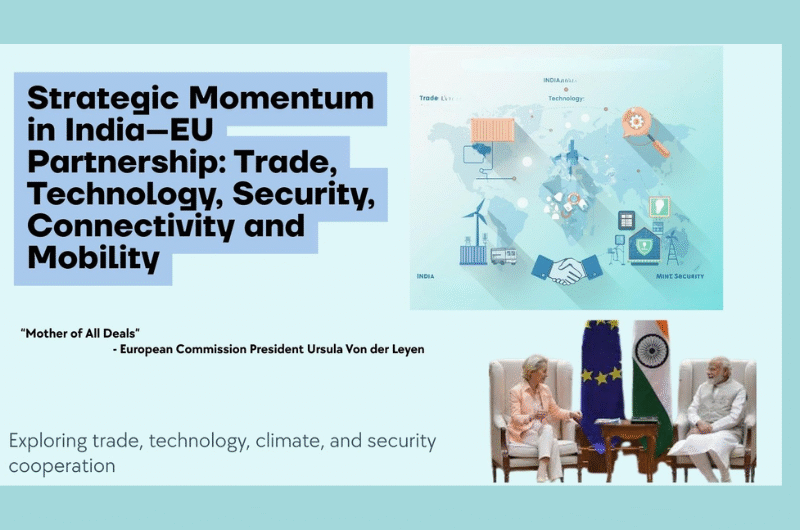
Strategic Momentum in India–EU Partnership: Trade, Technology, Security, Connectivity and Mobility

Strategic Momentum in India–EU Partnership: Trade, Technology, Security, Connectivity and Mobility     “Mother of All Deals”                                                                                                                                                                    –  European Commission President Ursula Von der Leyen       1. India–EU ties gain strategic momentum ahead of New Delhi summit, aiming for a new Joint Strategic Agenda and revival of long-pending Free Trade Agreement negotiations across sectors rapidly. 2. EU became India’s largest goods trading partner, with bilateral merchandise trade about $136 billion in 2024–25, covering machinery, transport equipment, chemicals, metals, mineral products and textiles overall strength. 3. Services trade expanded steadily from 2019 to 2024: Indian exports to the EU rose from €19 billion to €37 billion, while EU exports reached €29 billion there too. 4. Partnership is guided by the 2020 roadmap to 2025, spanning trade, investment, security, defence, climate action, clean energy, digital transition, connectivity, space, agriculture and people-to-people exchanges today widely. 5. Diplomatic links date to 1962 when India engaged the European Economic Community, later formalised through the 1993 Joint Political Statement and 1994 Cooperation Agreement strengthening political-economic cooperation frameworks. 6. The first summit in Lisbon, June 2000, began annual high-level dialogues; in 2004 at The Hague, ties were upgraded to a Strategic Partnership broadening cooperation beyond trade alone. 7. Recent acceleration includes resuming trade and investment talks in May 2021 and launching the Trade and Technology Council in April 2022 for digital and green cooperation jointly implemented. 8. The EU College of Commissioners, led by President Ursula von der Leyen, visited New Delhi in February 2025—the first such visit to a non-European bilateral partner ever recorded. 9. Leaders met alongside multilateral forums including G7 and G20, most recently June 2025 in Canada, and maintained regular telephonic contact through September 2025 calls at top levels often. 10. Security and defence cooperation advanced in 2025, with agreement to explore a Security and Defence Partnership and ministerial-level interactions on defence and space industries for shared strategic outcomes. 11. Maritime cooperation includes joint naval exercises in the Indian Ocean (June 2025), Gulf of Guinea (October 2023) and Gulf of Aden (June 2021), plus escort operations near Somalia. 12. Energy-climate ties centre on the Clean Energy and Climate Partnership launched 2016; Phase III adopted November 2024, expanding work on renewables, infrastructure, methane reduction and technology transfer initiatives. 13. EU joined the International Solar Alliance in 2018; the European Investment Bank funds sustainable transport and metro projects, while the EU joined CDRI in March 2021 for resilience. 14. Scientific cooperation includes a July 2020 Euratom R&D agreement on peaceful nuclear energy uses, and India’s associate membership of CERN since 2017, supporting frontier research links globally visible. 15. Mobility links are substantial: 931,607 Indian citizens lived in the EU by end-2024, including 16,268 Blue Card holders; over 6,000 Erasmus Mundus scholarships awarded across two decades collectively.   Must Know Terms:   1) India–EU Free Trade Agreement (FTA): Long-pending negotiations aim to reduce tariffs, align standards, and expand market access for goods and services. It matters for export growth, investment confidence, and resilient supply chains. In this topic, both sides seek to “advance” FTA talks ahead of the summit, signalling political intent to convert strategic goodwill into binding economic rules.   2) Joint Strategic Agenda: A proposed guiding document to steer India–EU cooperation beyond the existing Roadmap to 2025. It structures priorities, timelines, and deliverables across trade, technology, climate, security, connectivity, and people-to-people links. Its value is coordination: it converts multiple dialogues into measurable actions, reducing fragmentation between sectoral tracks and ensuring continuity across leadership changes.   3) Trade and Technology Council (TTC): A high-level platform launched to deepen cooperation in digital and green technologies, standards, innovation, and trusted supply chains. It matters because strategic technologies increasingly decide competitiveness and security. In this topic, TTC ministerial meetings reflect a shift from broad dialogues to implementation—working groups can drive outcomes on semiconductors, AI governance, clean-tech value chains, and regulatory alignment.   4) Clean Energy and Climate Partnership (CECP): The core framework for India–EU collaboration on climate action and energy transition, established in 2016 and expanded through successive phases. It covers renewables, methane reduction, infrastructure resilience, finance, and technology transfer. Its significance is practical support—mobilising expertise and capital to accelerate decarbonisation while balancing development needs, and linking climate goals with industrial policy.   5) India–EU Connectivity Partnership (2021): A strategic initiative to develop sustainable, inclusive, resilient connectivity across transport, digital infrastructure, and energy networks. It matters for diversification away from single-route dependencies and for creating transparent, high-standard infrastructure models. In this topic, it supports movement of goods, services, data, and capital, and complements corridor-style initiatives through coordinated planning and financing.   6) Common Agenda on Migration and Mobility (CAMM) (2016): A structured framework to manage legal migration, skilled mobility, social security issues, and orderly pathways, aligning EU demographic needs with India’s workforce advantages. It matters for people-to-people ties and economic complementarity. In this topic, dialogues propose mechanisms like a Legal Gateway Office and youth mobility frameworks to operationalise access.     Key Takeaways   India’s engagement with the EU highlights its strategic focus on Europe, aligned with the upcoming India-EU Summit and the ongoing Free Trade Agreement. Bilateral trade volume reached approximately $136 billion in 2024-25, making the EU India’s largest goods trading partner. Between 2019 and 2024, India-EU bilateral trade in services grew steadily, with Indian exports rising from €19 billion to €37 billion and EU exports to India increasing to €29 billion. As of 2024, over 931,607 Indians resided in the EU, including 16,268 Blue Card holders, and in the past 20

More Details

Free IAS Guidance
Start Your Journey Today 🇮🇳

Fill out the form below, and we will be in touch shortly.