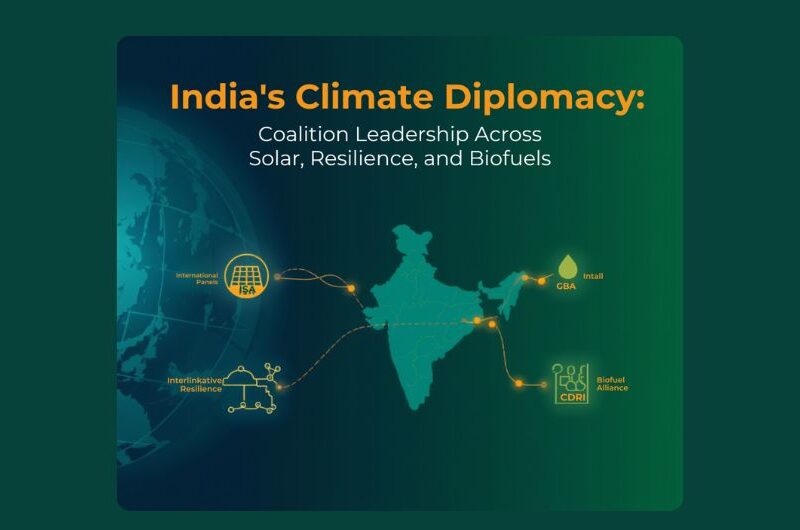
India’s Climate Diplomacy: Coalition Leadership Across Solar, Resilience, and Biofuels 1. India’s climate diplomacy balances development for 1.4 billion people with climate goals, using low per-capita emissions and equity framing to argue for developmental space with ambition. 2. India commits to cut GDP emissions intensity 45% from 2005 by 2030 and targets net zero by 2070; early 50% installed non-fossil electricity capacity strengthens credibility internationally. 3. Diplomatic posture is described as shifting from defensive burden-sharing to proactive coalition building, offering deployable solutions, training, and affordability-oriented implementation lessons to partners. 4. Domestic action combines renewables expansion, efficiency programmes, and sustainable lifestyles, while regulators increasingly integrate climate risks to strengthen resilience and support green investments and transition finance. 5. International Solar Alliance (ISA) launched in 2015 with France; treaty-based headquarters in India boosts convening power and continuity within India’s diplomatic architecture. 6. ISA’s “Towards 1000” agenda targets mobilising $1 trillion and enabling 1,000 GW solar by 2030; it supports access via decentralised solar while avoiding long-term carbon lock-in. 7. ISA uses demand pooling, procurement aggregation, and standardisation to de-risk projects; training strengthens planning, installation, operations, and regulatory capacity across members. 8. ISA faces constraints: limited dominance in low-cost manufacturing, supply concentration, policy volatility, grid weakness, and permitting delays that can erode investor confidence despite pooled demand. 9. CDRI launched in 2019 to shift from response to prevention, focusing on cascading failures across power, transport, telecom, and water to maintain lifeline continuity during extremes. 10. CDRI develops toolkits, standards, and risk-assessment methodologies; resilient island initiatives support small islands facing cyclones, sea-level rise, and service disruptions in critical systems. 11. Resilience finance is framed around quantifying avoided losses, but fragmentation across ministries, weak hazard mapping, and difficulty converting plans into bankable projects slow execution. 12. Nature-based solutions—wetlands, mangroves, and urban green spaces—are treated as protective assets complementing engineered infrastructure and strengthening service reliability during shocks. 13. Global Biofuels Alliance (GBA) launched in 2023 to align policies and standards for sustainable biofuels; it links mitigation with energy security by reducing oil import dependence. 14. GBA targets hard-to-electrify sectors via SAF and advanced biodiesel; second/third-generation biofuels use residues and algae but require safeguards against land conversion and biodiversity loss. 15. Combined platforms (ISA, CDRI, GBA) widen India’s leadership across mitigation, adaptation, and hard-sector transition, but delivery depends on concessional finance, risk-sharing, storage, skills, standards, data, and just transition. Must Know Terms : 1.Equity and Climate Justice Frame Equity and Climate Justice Frame: Anchored in Paris Agreement Article 2.2, which states implementation will reflect “equity” and CBDR–RC “in the light of different national circumstances.” In practice, it frames burden-sharing using measurable axes: historical cumulative emissions, per-capita emissions, capability/HDI, and vulnerability. It drives claims on (i) grant-based finance vs loans, (ii) adaptation priority, (iii) loss-and-damage support, and (iv) technology transfer on fair terms. 2.International Solar Alliance (ISA) International Solar Alliance (ISA): Treaty-based intergovernmental organisation headquartered in Gurugram (India) at NISE. Its official portal currently displays 112 Member Countries and 14 Signatory Countries. ISA’s core function is to scale solar deployment via programmatic support, standardisation, and finance mobilisation across member states; membership is open to UN members. It is widely cited as one of India’s flagship climate institutions with a dedicated international legal framework. 3.One Sun One World One Grid One Sun One World One Grid: Proposed by India in October 2018 at the first ISA Assembly as a transnational clean-power grid concept to move renewable electricity across time zones. In May 2021, India and the UK agreed to merge OSOWOG with the UK’s Green Grids Initiative and jointly launch the combined initiative at COP26 (Glasgow, Nov 2021). The operational logic is measurable: higher renewable utilisation, lower curtailment, and smoother peak balancing through cross-border interconnections. 4.Coalition for Disaster Resilient Infrastructure (CDRI) Coalition for Disaster Resilient Infrastructure (CDRI): Launched in September 2019 (UN Climate Action Summit, New York) to strengthen resilience of infrastructure systems to climate and disaster risks. CDRI’s official “About” page states 53 member countries and 12 partner organizations; CDRI’s site dashboard currently shows 65 members (plus project and funding counters). It functions as a coalition platform—standards, knowledge, technical support, and pipeline development for resilient infrastructure investments. 5.Global Biofuels Alliance (GBA) Global Biofuels Alliance (GBA): Launched on 9 September 2023 on the sidelines of the G20 Summit in New Delhi as India’s Chair initiative. Official releases state 19 countries and 12 international organisations agreed to join at launch. The coalition’s stated purpose is to accelerate global biofuel uptake through (i) technology advancement, (ii) stronger standards/certification, (iii) capacity-building and technical support for national programmes, and (iv) acting as a knowledge repository/expert hub. 6.Risk-Sharing and Sovereign Guarantees Risk-Sharing and Sovereign Guarantees: A Risk Sharing Facility (RSF) is a bilateral loss-sharing structure where a guarantor (e.g., IFC) reimburses a lender/originator for an agreed portion of principal losses on a defined portfolio of eligible assets—used to expand lending into new/underserved segments without full risk retention. Sovereign (government) guarantees are legally binding state commitments to backstop specified obligations or losses if defined triggers occur; IMF treats guarantees as contingent liabilities that can create significant fiscal risk if called. MCQ 1. India’s 2030 emissions-intensity commitment in the passage is: (a) 33% from 2019 levels (b) 40% from 2010 levels (c) 45% from 2005 levels (d) 50% from 1990 levels 2. India’s stated net-zero target year is: (a) 2050 (b) 2060 (c) 2070 (d) 2100 3. The passage states India achieved 50% installed electricity capacity from non-fossil sources: (a) After 2030 (b) Exactly in 2030 (c) Earlier than the 2030 timeline (d) Not achieved 4. ISA is described as launched in: (a) 2010 (b) 2015 (c) 2019 (d) 2023 5. ISA is described as launched with: (a) Sweden (b) France (c) Japan (d) Brazil 6. ISA’s “Towards 1000” agenda targets: (a) $100B and 100 GW by 2030 (b) $1T and 1,000 GW by 2030 (c) $1T and 500 GW by 2040 (d) $500B and 1,000 GW by 2050 7. ISA aims to improve bankability primarily through: (a) Ending private investment (b) Demand pooling
More Details