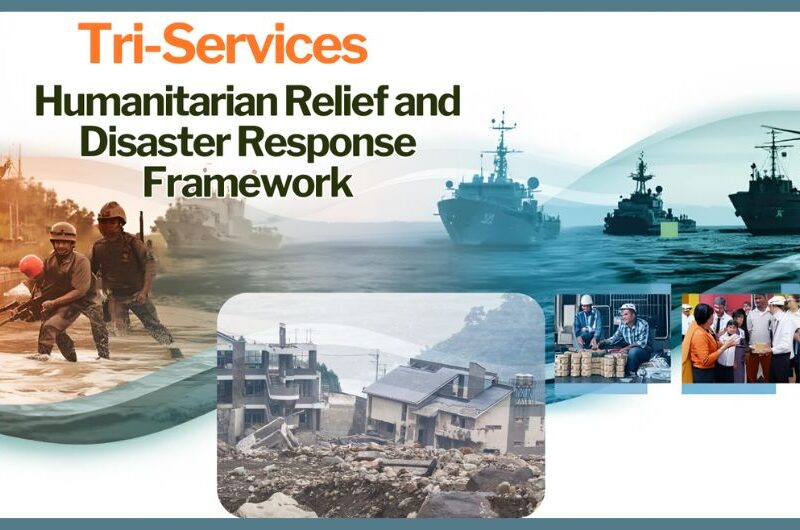
Tri-Services Humanitarian Relief and Disaster Response Framework 1. Indian Armed Forces safeguard sovereignty yet also act as first responders, delivering humanitarian, medical, and disaster relief, augmenting civilian capacities during major emergencies across India and partner countries. 2. The 2004 Indian Ocean tsunami was a watershed for India’s HADR, requiring tri-services coordination; Army, Navy, Air Force, and Coast Guard mobilised manpower, equipment, and logistics across land, sea, and air. 3. During Operation Seawave on 26 December 2004, the IAF launched search-and-rescue missions with Mi-8 helicopters from Car Nicobar, sustaining intensive Andaman operations using IL-76, AN-32, HS-748 aircraft, and helicopters. 4. After the tsunami, about 20,900 personnel were deployed; 40 naval/coast guard ships, 34 aircraft, and 42 helicopters participated; 28,734 people were rescued on the mainland, and over 6,000 stranded persons were evacuated from islands. 5. Operation Castor aided Maldives after the tsunami: INS Mysore, INS Udaygiri, and INS Aditya sailed to Malé with helicopters, water purification plants, medical teams, supplies, and relief equipment. 6. Operation Rainbow assisted Sri Lanka after the tsunami: a Dornier aircraft delivered a medical team and 600 kg of supplies to Colombo on 26 December; naval vessels reached Galle and Trincomalee on 27 December. 7. The Disaster Management Act, 2005 governs domestic response through NDMA, SDMAs, and DDMAs; states hold primary responsibility while the Centre provides support; the NCMC under the Cabinet Secretary oversees command, control, and coordination. 8. International HADR policy follows the Prime Minister’s 10-point DRR agenda (Agenda 10); NDMA issued International HADR Guidelines in October 2024, stressing sovereignty, transparency, accountability, ethics, and inclusivity as operational principles. 9. The MEA is the nodal ministry for overseas HADR; its Rapid Response Cell, established in 2021, coordinates with NDMA, NDRF, Armed Forces, and the Airports Authority, enabling faster diplomatic and logistics integration. 10. The MHA operates a 24×7 Integrated Control Room for Emergency Response, coordinating with NDRF, NDMA, and MEA for HADR activities; NDMA manages central control room operations and mission coordination nationwide. 11. Operation Samudra Setu began on 5 May 2020; over about 55 days, the Indian Navy repatriated 3,992 citizens by sea using INS Jalashwa, Airavat, Shardul, and Magar, covering around 23,000 km. 12. Operation Ganga during the Ukraine conflict (Feb–Mar 2022) evacuated 18,282 citizens through 90 flights, including 76 commercial and 14 IAF flights, with government funding ensuring zero evacuation cost. 13. Operation Dost responded to the 6 February 2023 Türkiye–Syria earthquake; India sent over 250 personnel and more than 135 tonnes of aid on five C-17 aircraft, and established an army field hospital at Iskenderun with specialist teams. 14. Operation Brahma, after the 28 March 2025 Myanmar earthquake, delivered around 750 tonnes of aid; a field hospital treated over 2,500 patients; six aircraft and five naval ships transported relief material. 15. Operation Sagar Bandhu was launched on 28 November 2025 after Cyclone Ditwah in Sri Lanka; it delivered 1,058 tonnes of relief, evacuated 264 people by Mi-17 helicopters, and opened a Bailey Bridge on 23 December. Must Know Terms : 1.Humanitarian Assistance and Disaster Relief (HADR) HADR: Relief support activated when civilian capacity is strained, focused on life-saving assistance, evacuation, medical care, logistics, and restoration of essential services. Overseas assistance is routed through the Ministry of External Affairs, which receives the request and coordinates with national disaster-management authorities, armed forces, civil aviation and port/airport operators. The Home Ministry maintains a 24×7 emergency control-room mechanism for coordination with national response forces and state administrations. Standard military contributions include airlift/medevac (Air Force), sealift and offshore evacuation (Navy), engineering and medical units (Army), and maritime search-and-rescue (Coast Guard). During Cyclone Fani (May 2019), deployment figures included 19 Army columns, 09 Engineering Task Force, 27 aircraft/helicopters, and 16 armed forces ships for relief and rescue operations. 2.Operation Seawave (2004) Operation Seawave: India’s large tri-services response after the Indian Ocean tsunami of 26 December 2004, covering mainland support, Andaman & Nicobar operations, and external assistance. Immediate search-and-rescue began on 26 December 2004 with Mi-8 helicopters operating from Car Nicobar airfield, followed by sustained air effort using IL-76, AN-32, HS-748 aircraft and multiple helicopter types for relief airlift, evacuation, and reconnaissance. The overall response scale is recorded as around 20,900 personnel mobilised, with 40 naval/coast-guard ships, 34 aircraft, and 42 helicopters. Recorded outcomes include 28,734 persons rescued on the mainland, more than 6,000 stranded people moved from Andaman & Nicobar to the mainland, and about 6.36 lakh people shifted to safer locations and housed in 930 relief camps. Regional assistance included Maldives support (ships arriving 28–30 December 2004) and Sri Lanka support with medical teams and supplies delivered starting 26 December 2004, and ships reaching Galle and Trincomalee on 27 December 2004. 3.Disaster Management Act, 2005 Disaster Management Act, 2005: The legal basis for India’s disaster governance architecture at national, state, and district levels. NDMA was constituted by executive order on 30 May 2005 and later notified under Section 3(1) on 27 September 2006. The National Executive Committee is constituted under Section 8, chaired by the Union Home Secretary, with secretary-level members from key ministries and the Chief of Integrated Defence Staff as an ex-officio member. The National Disaster Response Force is constituted under Section 44; the current structure is 16 battalions, each with 1,149 personnel. The National Disaster Response Fund is constituted under Section 46 to supplement State Disaster Response Funds in disasters of severe nature when state resources are inadequate. SDRF is constituted under Section 48(1)(a); states may use up to 10% of SDRF for local disasters not in the notified list, subject to state norms and approvals. 4.National Crisis Management Committee (NCMC) NCMC: The highest-level crisis coordination body chaired by the Cabinet Secretary for major disasters with serious or national ramifications. It coordinates inter-ministerial actions, reviews resource mobilisation, and issues directions for national-level response execution. Statutory recognition for this crisis coordination mechanism was formalised through amendments notified to take effect on 9 April 2025, embedding it more clearly within the national disaster-management legal framework. 5.Rapid Response Cell (RRC) Rapid Response Cell (RRC): An
More Details