Best UPSC and MPPSC IAS Coaching Classes in Gwalior

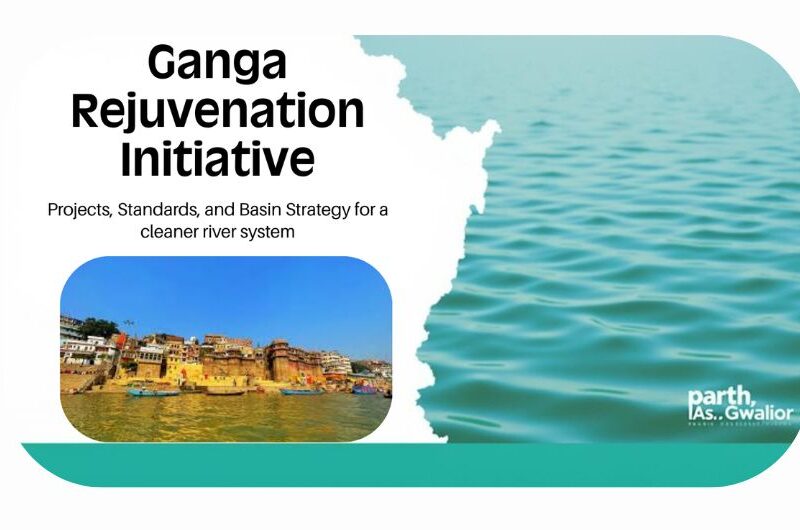
Ganga Rejuvenation: Projects, Standards, and Basin Strategy

Ganga Rejuvenation: Projects, Standards, and Basin Strategy     1. Namami Gange began in June 2014 as an integrated mission for pollution abatement, conservation, and rejuvenation of National River Ganga. 2. The programme originally had ₹20,000 crore outlay up to March 2021, later extended to March 2026 with ₹22,500 crore. 3. For 2025–26, the National Ganga Plan has an outlay of ₹3,400 crore to expand treatment and improve water quality. 4. The stated aim includes achieving prescribed bathing standards through stronger sewage treatment and industrial discharge regulation by 2025. 5. The Ganga basin is India’s largest, covering about 27% land area and supporting nearly 47% of the population. 6. The basin spans more than 11 states, with around 65.57% land under agriculture and 3.47% under water bodies. 7. Despite high precipitation share, the basin remains highly water-stressed, reflecting low per-capita rainwater availability. 8. Rejuvenation vision emphasizes Aviral Dhara, Nirmal Dhara, and protection of geological and ecological integrity. 9. Basin management planning follows an integrated river-basin approach with multi-sectoral and multi-agency interventions. 10. Four intervention pillars include pollution abatement, ecological flow improvement, people–river connect, and research-policy support. 11. By 31 January 2025, 492 projects worth ₹40,121.48 crore had been initiated under the mission framework. 12. Of these, 307 projects were completed and operational, indicating substantial progress across multiple intervention areas. 13. Sewage infrastructure remains central: 206 projects were initiated with ₹33,003.63 crore sanctioned for implementation. 14. Sewerage outcomes include 127 completed projects that directly reduce untreated sewage inflows into the river system. 15. Biodiversity and afforestation actions include 56 projects with over ₹905.62 crore committed, and 39 already completed.     MCQ   1. With reference to the Namami Gange programme, consider the following statements: 1. It was approved as an integrated conservation mission in June 2014. 2. It was approved as a flagship programme by the Union Government. 3. Its twin objectives include pollution abatement and rejuvenation of the Ganga. Which of the statements given above is/are correct? (a) 1 and 2 only (b) 2 and 3 only (c) 1 and 3 only (d) 1, 2 and 3 2. The extended budgetary outlay of the Namami Gange Programme up to March 2026 is: (a) ₹20,000 crore (b) ₹22,500 crore (c) ₹3,400 crore (d) ₹40,121.48 crore 3. The financial outlay mentioned for the National Ganga Plan for the year 2025–26 is: (a) ₹905.62 crore (b) ₹3,400 crore (c) ₹22,500 crore (d) ₹33,003.63 crore 4. The Ganga River Basin is described as: (a) Covering about 47% of India’s land mass and supporting 27% population (b) Covering about 27% of India’s land mass and supporting about 47% population (c) Covering about 11% of India’s land mass and supporting about 65.57% population (d) Covering about 27% of India’s land mass and supporting about 27% population 5. As per the given description, the majority share of the Ganga basin land-use is under: (a) Water bodies (b) Agriculture (c) Forests (d) Urban settlements 6. The trio of terms most directly linked to the stated vision of Ganga rejuvenation is: (a) Jal Shakti, Swachhata, Sanitation (b) Aviral Dhara, Nirmal Dhara, Ecological integrity (c) Carbon neutrality, Circularity, Climate resilience (d) Flood control, Inland navigation, Hydropower 7. The Ganga River Basin Management Plan (GRBMP) is stated to be developed by: (a) A consortium of seven IITs (b) A consortium of seven IIMs (c) A consortium of seven Central Universities (d) A consortium of seven national laboratories 8. Match the following intervention pillars: List-I A. Nirmal Ganga B. Aviral Ganga C. Jan Ganga D. Gyan Ganga List-II 1. Pollution abatement 2. Improving ecology and flow 3. People–river connect 4. Research and policy support Select the correct answer using the code given below: (a) A-2, B-1, C-3, D-4 (b) A-1, B-2, C-3, D-4 (c) A-1, B-3, C-2, D-4 (d) A-3, B-2, C-1, D-4 9. As of 31 January 2025, the total number of projects launched and their value were: (a) 307 projects worth ₹40,121.48 crore (b) 492 projects worth ₹40,121.48 crore (c) 492 projects worth ₹33,003.63 crore (d) 206 projects worth ₹40,121.48 crore 10. As of 31 January 2025, the number of completed and operational projects was: (a) 127 (b) 206 (c) 307 (d) 492 11. Consider the following statements: 1. Sewage infrastructure projects initiated were 206 in number. 2. Funds sanctioned for sewage infrastructure projects were ₹33,003.63 crore. 3. Completed sewerage projects were 127 in number. Which of the statements given above is/are correct? (a) 1 only (b) 1 and 2 only (c) 2 and 3 only (d) 1, 2 and 3 12. The recently approved project in Varanasi included interception and diversion of the Durga Drain and construction of a sewage treatment plant of: (a) 17 MLD (b) 60 MLD (c) 75 MLD (d) 127 MLD 13. The Varanasi project mentioned is stated to be based on: (a) DBOT model (b) EPC model (c) Hybrid annuity model (d) TOT model 14. The approved initiative to prevent untreated sewage from entering Varuna in Bhadohi includes STPs of capacities: (a) 60, 17 and 5 MLD (b) 20, 6.25 and 4.5 MLD (c) 17, 5 and 3 MLD (d) 75, 60 and 3 MLD 15. With reference to biodiversity and afforestation under the programme, consider the following statements: 1. 56 projects were undertaken with funding commitment over ₹905.62 crore. 2. 39 such projects have been successfully concluded. Which of the statements given above is/are correct? (a) 1 only (b) 2 only (c) Both 1 and 2 (d) Neither 1 nor 2        

More Details
Project Cheetah: Reintroduction and Expansion in India

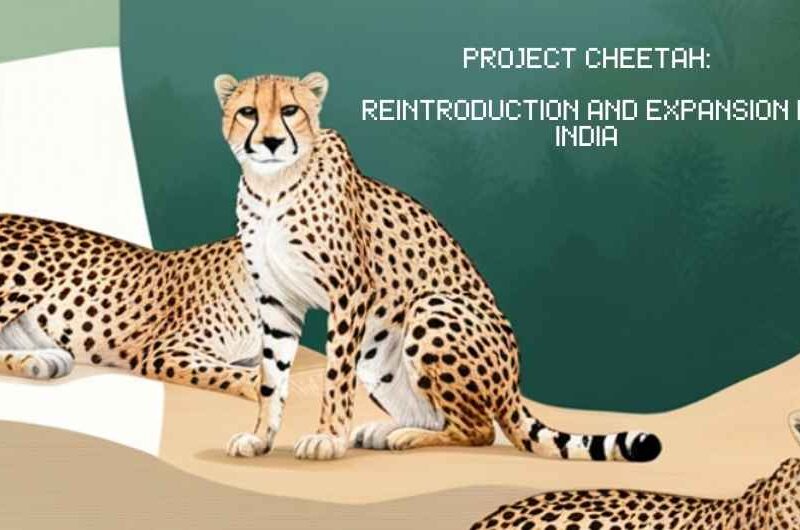
Project Cheetah: Reintroduction and Expansion in India   Snapshot   World’s first inter-continental translocation of a large carnivore successfully completed with 20 cheetahs from Namibia and South Africa (2022-23) coming to India. Prime Minister Shri Narendra Modi personally released the first eight cheetahs on 17 September 2022 As of December 2025, India has a total of 30 cheetahs – 12 adults, 9 sub-adults, and 9 cubs – comprising 11 founder animals and 19 India-born individuals. Mukhi, the first cheetah cub born on Indian soil, has herself become a mother to five healthy cubs. Over 450 Cheetah Mitras, 380 direct jobs, and 5% eco-tourism revenue share created for local communities around Kuno. India is on track to establish a self-sustaining metapopulation of 60–70 cheetahs across 17,000 km² by 2032, with Gandhi Sagar Wildlife Sanctuary ready for the next phase.         1.Project Cheetah began on 17 September 2022, reintroducing cheetahs to India at Kuno National Park through intercontinental wild-to-wild translocation as flagship grassland restoration programme. 2.Twenty cheetahs were brought during 2022–23: eight from Namibia and twelve from South Africa, establishing founder stock for population recovery efforts as founders. 3.As of December 2025, the Kuno population totals thirty cheetahs: twelve adults, nine sub-adults, and nine cubs, with nineteen India-born individuals within Kuno landscape. 4.The Asiatic cheetah was declared extinct in India in 1952, following severe hunting, poaching, habitat loss, prey decline, and low reproductive rates in landscapes. 5.The last confirmed wild cheetah sighting occurred in 1947, when three animals were shot in Koriya district forests in present-day Chhattisgarh in preindependence India. 6.Kuno was chosen after relocating twenty-four villages, moving 1,545 families and creating around 6,258 hectares of inviolate grassland habitat for cheetahs for future releases. 7.A phased approach uses quarantine, acclimatization bomas, and soft-release protocols, followed by monitored releases into open wilderness from 2024 onward guided by reintroduction standards. 8.The long-term target is a self-sustaining metapopulation of sixty to seventy cheetahs across about 17,000 square kilometres by 2032, linking multiple habitats nationally coordinated. 9.Gandhi Sagar Wildlife Sanctuary is planned as a second node, with 368 square kilometres sanctuary area and roughly 2,500 square kilometres potential habitat nearby. 10.Monitoring employs GPS collars, camera traps, and distance sampling on 734–816 kilometre transects to track prey, habitat conditions, movements, and survival regularly updated. 11.Early breeding indicates habitat suitability, with multiple litters recorded from 2023 onward, including second-generation births when an India-born female produced cubs with careful monitoring. 12.Mukhi, the first cub born on Indian soil, later delivered five cubs in November 2025, marking strengthened genetic continuity within the reintroduced population successfully. 13.Ranging data show large home ranges: Aasha covers 121 square kilometres, her male cubs 1,508, and the Agni–Vayu coalition 1,819 square kilometres also. 14.Community integration includes over 450 Cheetah Mitras across eighty villages, plus employment for trackers, patrol workers, and locally trained safari guides via local development. 15.The International Big Cat Alliance, launched 9 April 2023 and headquartered in India, has ₹150 crore support for five years till 2027–28 globally.     MCQ:   1. With reference to Project Cheetah, consider the following statements: 1. It began on 17 September 2022 at Kuno National Park. 2. It involved intercontinental wild-to-wild translocation. Which of the statements given above is/are correct? A. 1 only B. 2 only C. Both 1 and 2 D. Neither 1 nor 2 2. Consider the following: 1. Eight cheetahs were brought from Namibia. 2. Twelve cheetahs were brought from South Africa. The above numbers relate to cheetah translocations to India during: A. 2020–21 B. 2021–22 C. 2022–23 D. 2023–24 3. As of December 2025, the Kuno cheetah population totals 30, consisting of: A. 12 adults, 9 sub-adults, 9 cubs B. 9 adults, 12 sub-adults, 9 cubs C. 12 adults, 12 sub-adults, 6 cubs D. 10 adults, 10 sub-adults, 10 cubs 4. The Asiatic cheetah was declared extinct in India in: A. 1947 B. 1952 C. 1962 D. 1972 5. The last confirmed wild cheetah sighting in India (1947) is associated with: A. Gir forests in Gujarat B. Koriya district forests in present-day Chhattisgarh C. Sundarbans in West Bengal D. Corbett landscape in Uttarakhand 6. Kuno was selected after relocating: A. 12 villages and 750 families, creating about 3,000 hectares inviolate habitat B. 18 villages and 1,200 families, creating about 5,000 hectares inviolate habitat C. 24 villages and 1,545 families, creating about 6,258 hectares inviolate habitat D. 30 villages and 1,800 families, creating about 8,000 hectares inviolate habitat 7. Which of the following best describes the phased approach used in Project Cheetah? A. Immediate hard release without acclimatization or quarantine B. Quarantine, acclimatization bomas, soft-release, followed by monitored releases into wilderness C. Captive breeding in zoos first, then release after five generations D. Relocation only within India without any enclosure-based acclimatization 8. The long-term target under Project Cheetah is to establish: A. 30–40 cheetahs across 10,000 sq km by 2030 B. 60–70 cheetahs across about 17,000 sq km by 2032 C. 80–90 cheetahs across about 25,000 sq km by 2035 D. 100 cheetahs across 30,000 sq km by 2040 9. Gandhi Sagar Wildlife Sanctuary is planned primarily as: A. A third node with 700 sq km sanctuary and 5,000 sq km habitat B. A second node with 368 sq km sanctuary and ~2,500 sq km potential habitat C. A first node with 368 sq km sanctuary and 1,000 sq km habitat D. A corridor-only site without any sanctuary area 10. Monitoring under Project Cheetah includes which of the following? 1. GPS collars 2. Camera traps 3. Distance sampling on 734–816 km transects Select the correct answer using the code below: A. 1 and 2 only B. 2 and 3 only C. 1 and 3 only D. 1, 2 and 3 11. Evidence cited for habitat suitability at Kuno includes: A. Absence of predators and complete prey elimination B. Multiple litters recorded from 2023 onward, including second-generation births C. No dispersal outside bomas after release D. Zero mortality for all founders since introduction 12. Mukhi is known for which of the following? A. Being the first founder male from South Africa

More Details

Free IAS Guidance
Start Your Journey Today 🇮🇳

Fill out the form below, and we will be in touch shortly.