Best UPSC and MPPSC IAS Coaching Classes in Gwalior

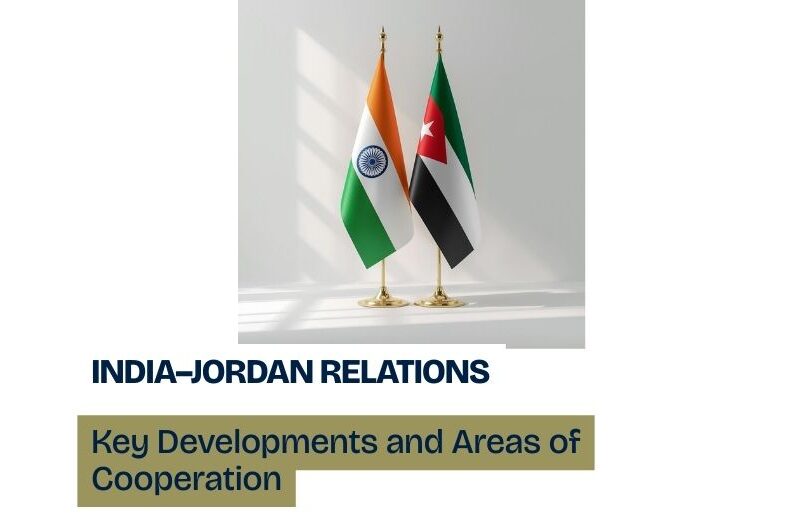
India–Jordan Relations: Key Developments and Areas of Cooperation

India–Jordan Relations: Key Developments and Areas of Cooperation     Key Takeaways PM Narendra Modi visited Jordan on December 15-16, 2025, his first full-fledged visit to the country. Five MoUs were signed in the areas of renewable energy, water resource management, cultural exchange, digital solution and twinning between Petra and Ellora This year is the 75th anniversary of the establishment of diplomatic relations between the two countries. India is Jordan’s third largest trading partner. The two countries aim to enhance bilateral trade to US$ 5 billion over the next 5 years. Jordan is a leading supplier of phosphates and potash fertilizers for India. Around 17,500 Indian nationals currently live in Jordan, mostly working in textiles, construction, manufacturing, healthcare etc.     1. The Prime Minister visited Jordan on 15–16 December 2025, marking his first full-fledged bilateral visit and holding detailed discussions with King Abdullah II. 2. The visit coincided with the seventy-fifth anniversary of diplomatic relations, highlighting the long-standing partnership formally established between India and Jordan in 1950. 3. Five memoranda of understanding were signed covering renewable energy, water resource management, cultural exchange, digital solutions, and twinning of Petra with Ellora. 4. India is Jordan’s third largest trading partner, with both sides proposing to enhance bilateral trade to five billion US dollars within five years. 5. Jordan serves as a leading supplier of phosphates and potash fertilizers to India, supporting agricultural and fertilizer security through sustained commercial cooperation. 6. Around seventeen thousand five hundred Indian nationals currently reside in Jordan, employed across textiles, construction, manufacturing, healthcare, education, and information technology sectors. 7. High-level political engagement includes regular leadership interactions, foreign office consultations, and structured dialogue mechanisms sustaining momentum in bilateral relations. 8. Trade and economic cooperation is anchored by institutional frameworks such as the Trade and Economic Joint Committee established under the 1976 Trade Agreement. 9. Joint ventures like the Jordan India Fertiliser Company produce phosphoric acid for Indian markets, reflecting deep integration in fertilizer supply chains. 10. Defence cooperation is guided by a memorandum signed in 2018, complemented by exchanges between armed forces and participation in joint defence-related events. 11. The India–Jordan Center of Excellence in Information Technology was inaugurated in 2021 to build advanced digital and software skills among Jordanian professionals. 12. Educational cooperation includes training programmes, scholarships, and technical courses, with thousands of Jordanians having graduated from Indian higher education institutions. 13. Cultural relations remain vibrant through regular exchanges in music, dance, cinema, yoga events, and participation in major cultural festivals in Jordan. 14. During the visit, leaders discussed cooperation in digital infrastructure, renewable energy, agriculture, innovation, health, tourism, and people-to-people linkages. 15. Both sides reaffirmed strong commitment against terrorism, shared regional security concerns, and emphasized peace, stability, and strategic alignment in West Asia.   MCQ:   1. The Prime Minister’s visit to Jordan mentioned in the text took place on: A. 10–11 December 2025 B. 15–16 December 2025 C. 16–17 December 2025 D. 18–19 December 20252. The bilateral discussions during the visit were held with: A. President of Jordan B. King Abdullah II C. Prime Minister of Jordan only D. Speaker of the Jordanian Parliament3. The visit is described as the Prime Minister’s: A. Second official state visit to Jordan B. First full-fledged bilateral visit to Jordan C. First visit to West Asia D. First transit visit to Jordan 4. The year 2025 marked the: A. 50th anniversary of diplomatic relations B. 60th anniversary of diplomatic relations C. 75th anniversary of diplomatic relations D. 80th anniversary of diplomatic relations 5. Diplomatic relations between the two countries are stated to be established in: A. 1947 B. 1950 C. 1960 D. 1976 6. How many MoUs were signed during the visit, as stated in the text? A. Three B. Five C. Seven D. Ten 7. Which of the following areas was covered by the signed outcomes? A. Nuclear power cooperation B. Water resource management C. Space launch partnership D. Fisheries agreement 8. The twinning initiative mentioned was between: A. Petra and Ajanta B. Petra and Ellora C. Jerash and Hampi D. Aqaba and Konark 9. India is described as Jordan’s: A. Largest trading partner B. Second largest trading partner C. Third largest trading partner D. Fourth largest trading partner 10. The proposed bilateral trade target over the next five years was: A. US$ 2 billion B. US$ 3 billion C. US$ 5 billion D. US$ 10 billion 11. Jordan is highlighted as a leading supplier to India of: A. Rare earth minerals B. Phosphates and potash fertilizers C. Crude oil and LNG D. Copper and zinc 12. Approximately how many Indian nationals are stated to live in Jordan? A. Around 7,500 B. Around 12,500 C. Around 17,500 D. Around 27,500 13. The Trade and Economic Joint Committee (TEJC) is noted as being set up under the: A. 1950 Diplomatic Agreement B. 1960 Friendship Treaty C. 1976 Trade Agreement D. 2009 Tourism Agreement 14. The India–Jordan Center of Excellence in Information Technology (IJCOEIT) was inaugurated in: A. 2018 B. 2020 C. 2021 D. 2023 15. Which one of the following was explicitly reaffirmed by both sides during the visit? A. Support for a single regional military bloc B. Commitment against terrorism in all forms C. Adoption of a common currency mechanism D. A bilateral customs union arrangement  

More Details

India–Ethiopia Strategic Partnership: Key Developments and Cooperation Areas

India–Ethiopia Strategic Partnership: Key Developments and Cooperation Areas   Key Takeaways PM Narendra Modi visited Ethiopia on 16-17 December 2025, on his first bilateral visit. He was conferred with ‘Great Honor Nishan of Ethiopia’ country’s highest honour during Addis Ababa visit. India and Ethiopia have elevated their bilateral ties to a Strategic Partnership, marking a new phase of cooperation. India, Ethiopia signed eight MoUs, agreements, including that for establishing a Data Centre at Ethiopia’s Ministry of Foreign Affairs and for debt restructuring under the G20 Common Framework. Over 675 Indian companies are registered with the Ethiopian Investment Commission, with total investments over USD 6.5 billion, especially in key sectors of manufacturing and pharmaceuticals, creating over 75,000 local jobs. Bilateral ties are supported by structured dialogues such as Foreign Office Consultations and Joint Trade Committee meetings. High-level political engagement is also sustained through Prime Minister-level meetings on the sidelines of G20 and BRICS Summits, and regular External Affairs Minister interactions. India–Ethiopia total trade stood at US$ 550.19 million in FY 2024–25. Indian exports are US$ 476.81 million and imports US$ 73.38 million, making the relationship strongly export-driven.     1. Prime Minister Narendra Modi visited Ethiopia on 16–17 December 2025 during a three-nation tour, arriving in Addis Ababa for formal talks with Abiy Ahmed. 2. He received the Great Honor Nishan of Ethiopia, the country’s highest award, in Addis Ababa, recognising contributions toward strengthening the bilateral partnership publicly, significantly. 3. Leaders elevated relations to a Strategic Partnership, signalling expanded cooperation in trade, investment, technology, skilling, education, defence, ICT, and people-to-people linkages across multiple sectors. 4. Eight agreements and MoUs were signed, including establishing a data centre at Ethiopia’s foreign ministry and formal debt restructuring under the G20 Common Framework. 5. Historical ties span over two millennia, including Axumite-era trade and exchanges via Adulis, linking Indian merchants with Ethiopian gold and ivory maritime routes early. 6. Formal diplomatic relations began in 1950, evolving into collaboration on trade, investment, capacity building, and development cooperation supported by structured institutional mechanisms today regularly. 7. High-level engagement occurs through regular meetings alongside G20 and BRICS summits, supplemented by ministerial interactions, telephonic conversations, Foreign Office Consultations, and Joint Trade Committees. 8. India–Ethiopia trade in FY 2024–25 totaled US$550.19 million, with exports US$476.81 million and imports US$73.38 million, yielding a surplus, making the relationship strongly export-driven. 9. Over 675 Indian companies are registered in Ethiopia, with investments exceeding US$6.5 billion, especially in manufacturing and pharmaceuticals, supporting substantial local employment across regions. 10. Indian investment is described as creating over 75,000 local jobs, alongside industrial capacity in essential sectors, including textiles, manufacturing, and pharmaceuticals production for Ethiopia. 11. Ethiopia benefits under India’s duty-free tariff preference for least developed countries, supporting market access and encouraging diversification and deeper economic cooperation for mutual benefit. 12. Recent exchanges included defence cooperation talks, parliamentary delegations, election-board study visit, and participation in textiles, health, solar energy, and governance programmes in Addis Ababa. 13. In 2025, a multi-party Indian parliamentary delegation met Ethiopian leaders and African Union representatives during May–June, emphasising zero tolerance toward terrorism and mutual solidarity. 14. Cooperation priorities discussed included digital public infrastructure, health security, digital health, traditional medicine, Jan Aushadhi Kendra, food security, natural farming, agri-tech, and innovation partnerships. 15. Both sides highlighted collaboration on climate action, renewable energy, disaster risk reduction, and engagement with international initiatives such as IBCA, CDRI, GBA, and ISA.         MCQ: 1. With reference to the visit mentioned, the Prime Minister’s visit to Ethiopia took place on: A. 10–11 November 2025 B. 16–17 December 2025 C. 26–27 December 2025 D. 1–2 January 2026 2. The Prime Minister arrived in Ethiopia for formal talks in: A. Addis Ababa B. Gondar C. Dire Dawa D. Mekelle 3. The Great Honor Nishan of Ethiopia, mentioned in the text, is: A. A state-level military decoration B. Ethiopia’s highest award C. An award of the African Union D. An economic merit award for investors 4. The bilateral relationship was elevated to a: A. Comprehensive Economic Partnership B. Strategic Partnership C. Defence Alliance Treaty D. Customs Union Arrangement 5. How many agreements and MoUs were signed during the visit as stated? A. Four B. Six C. Eight D. Ten 6. Which of the following was included among the signed outcomes? A. Establishing a data centre at Ethiopia’s foreign ministry B. Setting up a nuclear research facility C. Launching a single-currency trade settlement D. Establishing a joint space station programme 7. The debt restructuring mentioned was under the: A. Paris Club Mechanism B. G20 Common Framework C. IMF Extended Fund Facility D. World Bank Debt Service Suspension Initiative only 8. The text notes that historical ties span over: A. 500 years B. 1,000 years C. 2,000 years D. 3,500 years 9. The Axumite-era exchanges referenced in the text involved maritime links via: A. Massawa B. Adulis C. Berbera D. Mombasa 10. Formal diplomatic relations between the two countries began in: A. 1947 B. 1950 C. 1956 D. 1962 11. High-level engagement is described as occurring alongside: A. ASEAN and SCO summits B. G20 and BRICS summits C. SAARC and BIMSTEC summits D. Commonwealth and NAM summits only 12. India–Ethiopia trade in FY 2024–25 was approximately: A. US$150.19 million B. US$350.19 million C. US$550.19 million D. US$750.19 million 13. As per the text, India’s exports to Ethiopia in FY 2024–25 were about: A. US$176.81 million B. US$276.81 million C. US$476.81 million D. US$676.81 million 14. Over how many Indian companies are registered in Ethiopia, as stated? A. Over 275 B. Over 475 C. Over 675 D. Over 875 15. Ethiopia benefits under India’s: A. Export Credit Guarantee Scheme for developed countries B. Duty-free tariff preference for least developed countries C. Customs Union with African states D. Preferential market access only for landlocked countries

More Details

Free IAS Guidance
Start Your Journey Today 🇮🇳

Fill out the form below, and we will be in touch shortly.