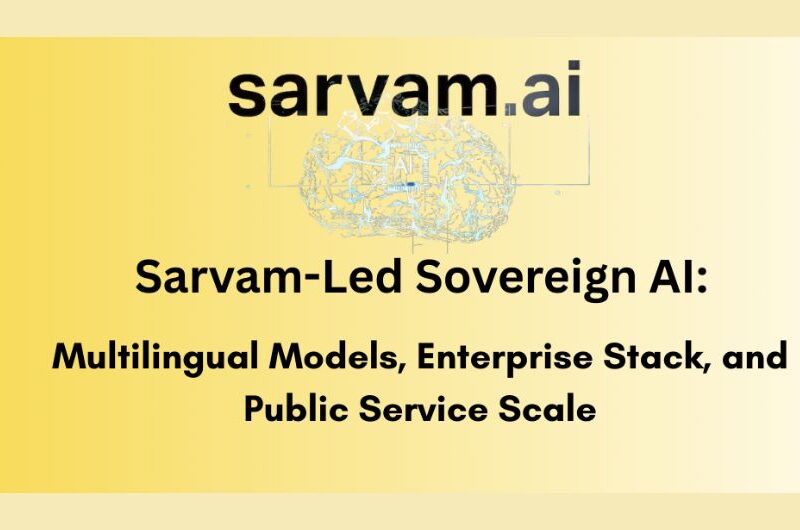
Sarvam-Led Sovereign AI: Multilingual Models, Enterprise Stack, and Public Service Scale
1. India’s AI push is linked to building indigenous systems trained on Indian languages, local datasets, and governance contexts, so public services and citizen engagement remain relevant and reliable.
2. Sarvam AI (Artificial Intelligence) is positioned as an India-built, end-to-end platform where development, deployment, and governance occur domestically, aiming to reduce dependence on foreign AI infrastructure.
3. A major policy emphasis is “sovereign” foundational models—LLMs (Large Language Models) and speech models aligned with national priorities, accessibility needs, and multilingual communication across India’s linguistic diversity.
4. Sarvam AI (Artificial Intelligence) is one of 12 organisations selected under the Innovation Centre pillar of the IndiaAI Mission, receiving financial and compute support totaling ₹246.72 crore for foundational model development.
5. Its focus includes voice-based interfaces and document processing, targeting citizen-centric applications that can improve access, ease-of-use, and service delivery in multilingual settings.
6. Bulbul, a text-to-speech model, provides output in 11 Indian languages and offers 39 distinct speaker voices, expanding usable voice options for large-scale deployments.
7. Saaras, a speech-to-text model, supports all 22 scheduled languages and handles 8 kHz (kilohertz) telephony audio, improving transcription for calls and mixed-quality speech channels.
8. Saaras also processes code-mixed speech, a common Indian communication pattern, helping recognition when speakers blend languages within a single sentence during conversations.
9. Vision, the document-understanding component, is built for 22+ Indian languages, mixed scripts, and handwritten text, supporting extraction and interpretation of forms and records.
10. The conversational platform claims 100 million+ interactions handled with under 500 ms (milliseconds) latency, enabling fast responses for high-volume customer or citizen service environments.
11. The same conversational system is described as deployable within 24 hours and reporting up to 10x (ten times) ROI (Return on Investment), indicating an enterprise-focused, rapid implementation design.
12. Sarvam for Work is presented as a unified enterprise AI (Artificial Intelligence) platform supporting build–debug–optimize workflows, and designed to integrate with any model, data source, or infrastructure.
13. Content tools include multilingual video dubbing with voice cloning and audio-visual synchronisation, plus document translation that preserves layout and tone with built-in review and editing.
14. UIDAI (Unique Identification Authority of India) collaboration includes AI (Artificial Intelligence) voice interaction for Aadhaar services, real-time fraud detection, and multilingual support; a custom GenAI (Generative Artificial Intelligence) stack is planned on secure on-premise infrastructure for 10 languages.
15. Public-sector compute and research infrastructure includes Odisha’s 50 MW (megawatt) AI (Artificial Intelligence) capacity hub and Tamil Nadu–IIT (Indian Institute of Technology) Madras Digital Sangam, anchored by a 20 MW (megawatt) AI (Artificial Intelligence) data centre.
Must Know Terms :
1.Bulbul: Bulbul v3 is a text-to-speech model/API (Application Programming Interface) that supports 11 languages: Hindi, Bengali, Tamil, Telugu, Gujarati, Kannada, Malayalam, Marathi, Punjabi, Odia, and English (Indian accent). It supports output formats MP3, WAV, AAC, OPUS, FLAC, PCM (Pulse Code Modulation; LINEAR16), μ-law (Mu-law) (MULAW) and A-law (ALAW). Output sample rates supported include 8 kHz (kilohertz), 16 kHz (kilohertz), 22.05 kHz (kilohertz), and 24 kHz (kilohertz).
2.Saaras: Saaras v3 is a speech-to-text model/API (Application Programming Interface) that supports 22 Indian languages with automatic language detection. It is described as handling code-mixed audio within the same recording. It supports multiple operating modes including synchronous transcription for short inputs, batch transcription for longer files, and streaming transcription for real-time use cases.
3.Code-mixing: Code-mixing is the mixing of linguistic units such as words, phrases, or clauses from two languages within a single sentence or utterance. A commonly cited typology describes three code-mixing patterns: insertion, alternation, and congruent lexicalization. A practical distinction is that code-mixing occurs within the same syntactic unit, while switching between sentences is usually classified as inter-sentential code-switching.
4.Telephony: Narrowband telephony audio commonly uses 8 kHz (kilohertz) sampling. Classic voice systems use μ-law (Mu-law) (MULAW) and A-law (ALAW) companding encodings at 64 kbps (kilobits per second), and many IVR (Interactive Voice Response) or call-centre pipelines still accept 8 kHz PCM (Pulse Code Modulation)/μ-law (Mu-law)/A-law streams for compatibility with legacy voice infrastructure.
5.Zonation: Zonation means division into distinct zones based on a controlling factor, and it is used in ecology as well as land-use planning. In intertidal ecology, vertical zonation forms visible bands of organisms between low and high tide lines. In land-use regulation, zoning divides land into districts with legally defined permitted uses and density rules.
6.On-premise: On-premises deployment means software, hardware, and data are hosted and operated on customer-controlled servers within an organization’s own facilities rather than on a public cloud. It is typically chosen for data sovereignty, regulatory compliance, lower-latency control, and internal security policy requirements, as compared to cloud/SaaS (Software as a Service) models where the provider hosts and runs the infrastructure.
MCQ
1. The initiative described emphasizes “sovereign” AI mainly to:
A) Shift all AI training overseas for scale
B) Prioritize models rooted in Indian languages, data, and governance needs
C) Replace multilingual systems with English-only services
D) Stop using speech technologies entirely
2. The platform approach highlighted is best described as:
A) Hardware-only, without deployment tools
B) End-to-end development and governance within India
C) Only third-party cloud dependence
D) Limited to entertainment applications
3. The number of organisations selected under the Innovation Centre pillar mentioned is:
A) 8
B) 10
C) 12
D) 20
4. The financial and compute support amount referenced is:
A) ₹46.72 crore
B) ₹146.72 crore
C) ₹246.72 crore
D) ₹346.72 crore
5. The text-to-speech model named Bulbul is described as supporting:
A) 6 languages and 10 voices
B) 11 languages and 39 speaker voices
C) 22 languages and 11 voices
D) 39 languages and 22 voices
6. The speech-to-text model Saaras is described as supporting:
A) 11 Indian languages only
B) 15 Indian languages with manual detection
C) 22 scheduled languages with telephony focus
D) 22 scheduled languages with code-mixed handling
7. Telephony audio sampling frequently referenced for narrowband speech is:
A) 4 kHz
B) 8 kHz
C) 16 kHz
D) 24 kHz
8. “Code-mixed speech” refers to:
A) Mixing two scripts in handwriting only
B) Mixing words/phrases from two languages within one utterance
C) Switching only between paragraphs in writing
D) Using only technical terminology in speech
9. The document-understanding component described is designed for:
A) Only printed English documents
B) 22+ Indian languages, mixed scripts, and handwritten text
C) Only numeric spreadsheets
D) Only satellite images
10. The conversational system’s interaction scale is described as:
A) 10 million+ interactions
B) 50 million+ interactions
C) 100 million+ interactions
D) 500 million+ interactions
11. The latency claim for the conversational platform is:
A) Under 50 ms
B) Under 500 ms
C) Under 5 seconds
D) Over 1 minute
12. The deployment timeline stated for the conversational system is:
A) Within 7 days
B) Within 72 hours
C) Within 24 hours
D) Within 24 weeks
13. The ROI claim mentioned for the conversational offering is:
A) Up to 2x
B) Up to 5x
C) Up to 8x
D) Up to 10x
14. The collaboration referenced for Aadhaar services includes:
A) Single-language chatbot only
B) AI voice interaction plus fraud detection and multilingual support
C) Only biometric hardware upgrades
D) Only document scanning without speech
15. The compute infrastructure examples include a hub of:
A) 5 MW in Odisha and 2 MW in Tamil Nadu
B) 20 MW in Odisha and 50 MW in Tamil Nadu
C) 50 MW in Odisha and a 20 MW data centre anchor in Tamil Nadu
D) 100 MW in both states

0 comment