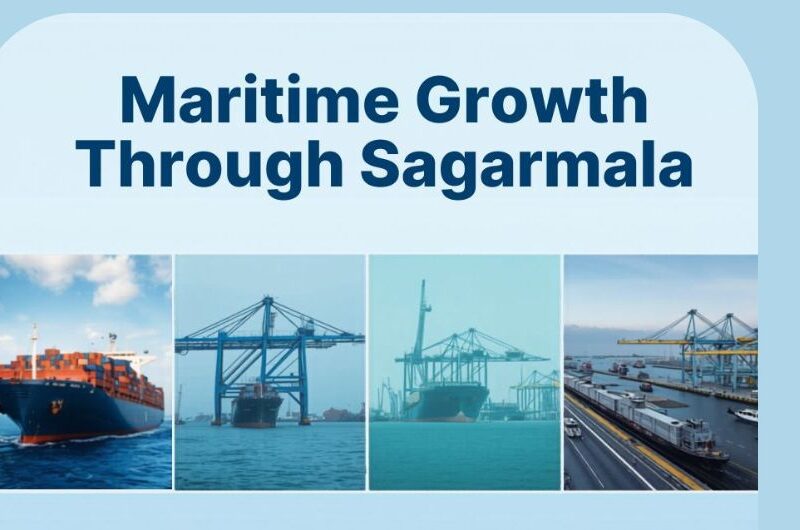
Maritime Growth Through Sagarmala
1. Sagarmala was launched in March 2015 as a port-led development programme to modernize ports, improve logistics efficiency, reduce transportation costs, and integrate maritime transport with road, rail, coastal shipping, and inland waterways.
2. India’s maritime significance rests on its about 11,099-kilometre coastline, nearly 14,500 kilometres of potentially navigable waterways, and the fact that around 95 percent of trade by volume moves through maritime routes.
3. India’s port structure consists of 12 major ports under the Union government and more than 200 non-major ports under State Maritime Boards or State Governments, reflecting a dual administrative framework.
4. The programme architecture is built around five major pillars: port modernization and new port development, port connectivity enhancement, port-led industrialization, coastal community development, and coastal shipping with inland waterways transport.
5. Port modernization under Sagarmala is not limited to physical expansion; it also includes mechanization, digital systems, removal of infrastructure gaps, and operational improvements to raise efficiency and handling capacity.
6. Port connectivity enhancement is conceptually important because it links ports with hinterland regions through multimodal logistics, enabling faster cargo evacuation and reducing dependence on costlier or congested transport chains.
7. Port-led industrialization is based on the economic logic that industries located near ports gain lower logistics costs, quicker market access, and stronger integration with both domestic production networks and global trade flows.
8. Coastal community development is a social dimension of maritime policy, focusing on livelihoods, fisheries, tourism, skill development, and sustainable economic opportunities for populations living in coastal regions.
9. Under the programme, 845 projects worth ₹6.06 lakh crore have been taken up; as of 24 March 2026, 315 projects worth ₹1.57 lakh crore were completed.
10. Coastal berth development is a measurable infrastructure outcome, where 7 completed projects worth ₹494 crore added 9.84 million tonnes per annum cargo-handling capacity, directly strengthening port-side logistics capabilities.
11. India’s major ports handled a record 915.17 million tonnes of cargo in FY 2025–26, exceeding the annual target of 904 million tonnes and recording year-on-year growth of 7.06 percent.
12. Operational efficiency at ports improved sharply, with average vessel turnaround time falling from 96 hours in 2014 to 49.5 hours in 2025, indicating faster cargo handling and reduced delays.
13. Inland waterways cargo movement rose from 18.10 million tonnes in FY 2013–14 to 145.50 million tonnes in FY 2024–25, showing about 700 percent growth and diversification of logistics modes.
14. Passenger and vehicle water transport has expanded through Ro-Pax and ferry services, where 29 projects were taken up, 17 completed, and important routes significantly reduced travel distance and time.
15. Sagarmala 2.0 represents the next phase with a wider national vision, proposed budgetary support of ₹85,482 crore, and expected investment of ₹3.6 lakh crore for maritime modernization and coastal development.
Must Know Terms :
1. Mechanization: Mechanization means use of machines in port work such as cranes, conveyors, loaders, and automated cargo systems. It increases cargo-handling speed, reduces manual delay, improves safety, and raises port productivity. Under Sagarmala, mechanization is part of port modernization. It helps ports handle larger cargo volumes efficiently and supports faster vessel turnaround and better logistics performance across terminals.
2.Hinterland: Hinterland means the inland region linked to a port for movement of goods. It includes production centres, industrial areas, markets, warehouses, and transport corridors connected through road, rail, and waterways. Strong hinterland connectivity is necessary for quick cargo evacuation. It reduces logistics cost, prevents congestion at ports, and improves trade flow between ports and inland economic regions.
3.Ro-Pax: Ro-Pax means roll-on/roll-off passenger service. It carries both passengers and vehicles such as cars, buses, and trucks on the same vessel. Under Sagarmala, 29 Ro-Pax and ferry projects were taken up. These services improve coastal transport, reduce road travel time, and support efficient water-based mobility. Ghogha–Hazira and Mumbai–Mandwa are important examples mentioned in the text.
4.Multimodal: Multimodal means use of multiple transport modes in one integrated logistics chain. In Sagarmala, it links ports with road, rail, coastal shipping, and inland waterways. Its purpose is seamless cargo movement from port to destination. Multimodal connectivity reduces transport bottlenecks, lowers logistics cost, and improves supply chain efficiency. It is central to port connectivity enhancement under the programme.
5.Bascule: Bascule is a movable bridge that opens to allow ships or water traffic to pass. The text mentions renovation of the historic Bascule Bridge at Syama Prasad Mookerjee Port, Kolkata. This work combines heritage preservation with infrastructure improvement. Once modernized, the bridge is expected to allow safer, faster, and more efficient movement of cargo and vehicles within port premises.
6.Catalyze: Catalyze means to trigger or accelerate a larger process. In the text, Sagarmala 2.0 is expected to catalyze investment. It has proposed budgetary support of ₹85,482 crore and aims to generate total investment of ₹3.6 lakh crore. The term is important because it shows government funding is meant to attract wider public and private investment in maritime infrastructure.
Key Takeaways
a) Sagarmala is implementing 845 projects worth ₹6.06 lakh crore, with 315 projects worth ₹1.57 lakh crore completed.
b) The completion of 7 coastal berth projects has added 9.84 million tonnes per annum of cargo handling capacity.
c) India’s major ports handled a record 915 million tonnes of cargo in FY 2025–26.
d) Sagarmala 2.0, supported with ₹85,482 crore, aims to catalyze ₹3.6 lakh crore in investment.
MCQ :
1. The Sagarmala Programme was launched in:
A) March 2015
B) July 2014
C) January 2016
D) August 2017
2. Which of the following is one of the five pillars of the Sagarmala Programme?
A) Universal telecom expansion
B) Port connectivity enhancement
C) Defence industrial corridors
D) Urban metro integration
3. India’s maritime trade significance is reflected in the fact that about what share of the country’s trade by volume is handled through maritime routes?
A) About 70 percent
B) About 80 percent
C) About 95 percent
D) About 60 percent
4. In India’s port structure, the non-major ports are under the jurisdiction of:
A) Ministry of Commerce and Industry
B) NITI Aayog
C) Inland Waterways Authority of India
D) State Maritime Boards or State Governments
5. Under the Sagarmala Programme, the total number of projects taken up is:
A) 745
B) 845
C) 915
D) 315
6. As of 24 March 2026, completed Sagarmala projects were worth:
A) ₹1.57 lakh crore
B) ₹6.06 lakh crore
C) ₹85,482 crore
D) ₹3.6 lakh crore
7. The completed coastal berth projects under Sagarmala added how much cargo-handling capacity?
A) 7.06 million tonnes per annum
B) 14.50 million tonnes per annum
C) 18.10 million tonnes per annum
D) 9.84 million tonnes per annum
8. India’s major ports handled a record cargo volume of how much in FY 2025–26?
A) 915.17 million tonnes
B) 904 million tonnes
C) 845 million tonnes
D) 145.50 million tonnes
9. Average vessel turnaround time at Indian ports declined from 96 hours in 2014 to:
A) 59.5 hours
B) 49.5 hours
C) 39.5 hours
D) 69.5 hours
10. Cargo movement through inland waterways in FY 2024–25 stood at:
A) 115.50 MTPA
B) 125.50 MTPA
C) 145.50 MTPA
D) 155.50 MTPA
11. Under Sagarmala, the number of Ro-Pax and passenger ferry projects taken up was:
A) 17
B) 11
C) 29
D) 24
12. The Ghogha–Hazira Ro-Pax service reduced travel time from nearly 10 hours by road to about:
A) 6 hours by sea
B) 4 hours by sea
C) 5 hours by sea
D) 3 hours by sea
13. Sagarmala Finance Corporation Limited emerged after the restructuring of:
A) Inland Waterways Authority of India
B) Maritime States Development Council
C) National Sagarmala Apex Committee
D) Sagarmala Development Company Limited
14. Sagarmala 2.0 proposes budgetary support of:
A) ₹85,482 crore
B) ₹4,300 crore
C) ₹1.57 lakh crore
D) ₹52.69 crore
15. Sagarmala 2.0 aims to catalyze total investment of:
A) ₹6.06 lakh crore
B) ₹1 crore
C) ₹3.6 lakh crore
D) ₹85,482 crore



0 comment