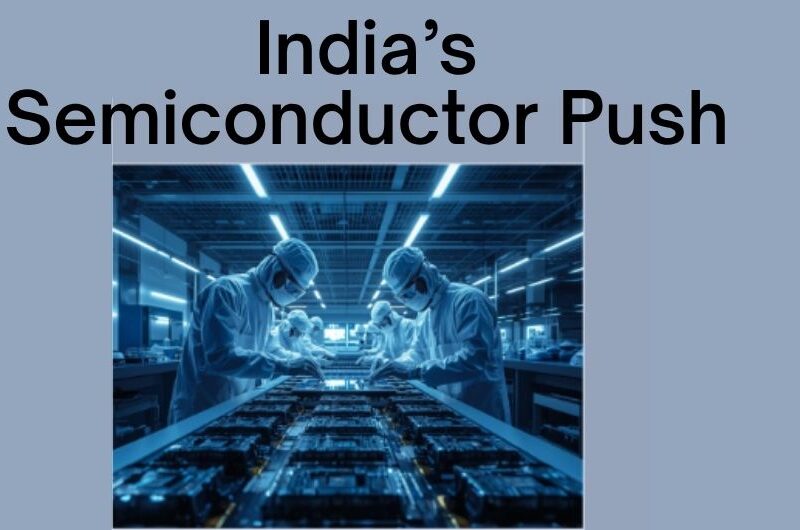
India’s Semiconductor Push
1. India Semiconductor Mission (ISM) was launched in 2021, and the government announced a ₹76,000 crore incentive programme to build a domestic semiconductor and display ecosystem.
2. Out of the ₹76,000 crore programme outlay, nearly ₹65,000 crore had already been committed by September 2025 toward approved semiconductor initiatives.
3. SEMICON India 2025 was scheduled to be inaugurated on 2 September 2025 in New Delhi as the fourth edition of India’s flagship semiconductor event.
4. SEMICON India 2025 was jointly organised by the India Semiconductor Mission under the Ministry of Electronics and Information Technology and SEMI, the global semiconductor industry association.
5. The 2025 edition featured nearly 350 exhibiting companies from 33 countries and regions, making it India’s largest semiconductor and electronics show.
6. The event was expected to attract over 15,000 visitors and included 6 country roundtables, 4 country pavilions, and participation from 9 Indian states.
7. Under the Design Linked Incentive scheme, 23 chip design projects had been sanctioned to support startups and innovators in India’s semiconductor design ecosystem.
8. In May 2025, two advanced semiconductor design facilities focused on 3-nanometer chip design were inaugurated in Noida and Bengaluru.
9. India had 10 approved semiconductor projects across 6 states, with a combined investment of about ₹1.60 lakh crore by September 2025.
10. Micron Technology’s semiconductor facility in Sanand, Gujarat, approved in June 2023, involved an investment of ₹22,516 crore and was under implementation.
11. Tata Electronics, in partnership with Powerchip Semiconductor Manufacturing Corporation, was setting up a semiconductor fab in Dholera, Gujarat, with an investment of about ₹91,000 crore and capacity of 50,000 wafers per month.
12. Tata Semiconductor Assembly and Test Private Limited in Morigaon, Assam, involved an investment of ₹27,000 crore with Phase 1 expected to be commissioned by April 2026.
13. On 28 August 2025, CG Power inaugurated one of India’s first end-to-end Outsourced Semiconductor Assembly and Test pilot line facilities in Sanand, Gujarat.
14. CG Semi’s facility involved an investment of over ₹7,600 crore, with the G1 unit handling around 0.5 million units per day and the G2 facility planned to scale to 14.5 million units per day.
15. More than 60,000 students had already benefited from semiconductor training programmes, helping prepare India’s future workforce for chip design, manufacturing, and packaging.
Must Know Terms :
1.ISM
India Semiconductor Mission (ISM) is the nodal institutional framework launched in 2021 to build India’s semiconductor and display ecosystem. It implements the ₹76,000 crore semiconductor programme, supports fabrication, packaging, display manufacturing, design, and skill development, and serves as the main agency for scheme execution. By September 2025, India had 10 approved semiconductor projects across 6 states under this broader mission.
2.OSAT
Outsourced Semiconductor Assembly and Test (OSAT) refers to the stage where semiconductor chips are assembled, packaged, tested, and prepared for final use. It is a critical segment of the semiconductor value chain because manufacturing does not end at wafer fabrication. In August 2025, one of India’s first end-to-end OSAT pilot line facilities was inaugurated in Sanand, Gujarat by CG Power.
3.DLI
Design Linked Incentive (DLI) is the support scheme aimed at strengthening India’s chip design ecosystem by helping startups, innovators, and domestic firms working in semiconductor design. It provides incentives and design support for indigenous development. By September 2025, 23 chip design projects had been sanctioned under this scheme, indicating India’s effort to move from chip consumption toward original design capability.
4.ATMP
Assembly, Testing, Marking and Packaging (ATMP) is the post-fabrication stage in semiconductor manufacturing where chips are assembled into usable forms, tested for performance, marked, and packaged for deployment. It is an essential industrial capability because it links manufacturing with commercial output. India’s approved semiconductor projects include major ATMP facilities, including new units in Gujarat, Odisha, Punjab, and Andhra Pradesh.
5.EDA
Electronic Design Automation (EDA) refers to specialised software tools used to design, simulate, verify, and optimise semiconductor chips and electronic systems. These tools are essential in modern chip development because advanced semiconductors cannot be designed manually. Under the India Semiconductor Mission, support for EDA tools has been recognised as necessary for expanding India’s semiconductor design industry and enabling early-stage startup innovation.
6.SiC
Silicon Carbide (SiC) is an advanced semiconductor material that performs better than traditional silicon in high-temperature, high-voltage, and high-power conditions. It is especially important for electric vehicles, power electronics, defence systems, radars, and space technologies. In India’s semiconductor roadmap, Silicon Carbide has gained strategic importance, and one commercial Silicon Carbide fab in Odisha had been approved by 2025.
Key Takeaways
A) PM Modi to inaugurate SEMICON India 2025: India’s biggest Semiconductor & Electronics show to be held in Yashobhoomi, New Delhi from 2–4 September 2025.
B) Theme for SEMICON 2025 is: “Building the Next Semiconductor Powerhouse”.
C) Bharat to welcome 33 nations, 50+ global CXOs, 350 exhibitors and 50+ visionary global speakers at SEMICON India 2025.
D) Event to highlight robust local semiconductor ecosystem expansion and industry trends.
E) SEMICON India to address complex challenges of tomorrow while fostering collaboration across the semiconductor ecosystem towards Atmanirbhar Bharat.
F) India’s chip market is booming, set to hit $100–110 Bn by 2030.
G) India Semiconductor Mission (₹76,000 Cr outlay) boosts local manufacturing, design, and talent.
H) Total approved projects under ISM reaches to 10 with cumulative investments of around Rs.1.60 lakh crore in 6 states.
I) On 28th August, CG-Semi launched India’s first OSAT Pilot Line in Gujarat to produce the country’s first ‘Made in India’ chip.
MCQ
1. India Semiconductor Mission (ISM) was launched in:
A) 2020
B) 2022
C) 2021
D) 2023
2. The incentive programme announced to build a domestic semiconductor and display ecosystem is worth:
A) ₹66,000 crore
B) ₹76,000 crore
C) ₹86,000 crore
D) ₹96,000 crore
3. By September 2025, nearly how much of the programme outlay had already been committed?
A) ₹55,000 crore
B) ₹60,000 crore
C) ₹70,000 crore
D) ₹65,000 crore
4. SEMICON India 2025 was scheduled to be inaugurated on:
A) 1 September 2025
B) 2 September 2025
C) 28 August 2025
D) 4 September 2025
5. SEMICON India 2025 was jointly organised by ISM and:
A) IEEE
B) NASSCOM
C) SEMI
D) STPI
6. The 2025 edition featured nearly how many exhibiting companies?
A) 250
B) 300
C) 350
D) 400
7. Exhibiting companies at SEMICON India 2025 came from how many countries and regions?
A) 23
B) 33
C) 43
D) 53
8. The event was expected to attract over how many visitors?
A) 10,000
B) 12,000
C) 15,000
D) 18,000
9. How many chip design projects had been sanctioned under the Design Linked Incentive scheme?
A) 21
B) 22
C) 23
D) 24
10. In May 2025, advanced semiconductor design facilities focused on which chip-design node were inaugurated in Noida and Bengaluru?
A) 5-nanometer
B) 3-nanometer
C) 7-nanometer
D) 10-nanometer
11. By September 2025, India had how many approved semiconductor projects across 6 states?
A) 8
B) 9
C) 10
D) 11
12. The combined investment of these approved semiconductor projects was about:
A) ₹1.20 lakh crore
B) ₹1.40 lakh crore
C) ₹1.80 lakh crore
D) ₹1.60 lakh crore
13. Micron Technology’s semiconductor facility in Sanand, Gujarat, involved an investment of:
A) ₹22,516 crore
B) ₹27,000 crore
C) ₹7,600 crore
D) ₹3,307 crore
14. Tata Electronics, with Powerchip Semiconductor Manufacturing Corporation, is setting up a semiconductor fab in:
A) Sanand
B) Morigaon
C) Dholera
D) Mohali
15. Tata Electronics’ semiconductor fab in Dholera is planned with a capacity of:
A) 40,000 wafers per month
B) 50,000 wafers per month
C) 60,000 wafers per month
D) 70,000 wafers per month




0 comment