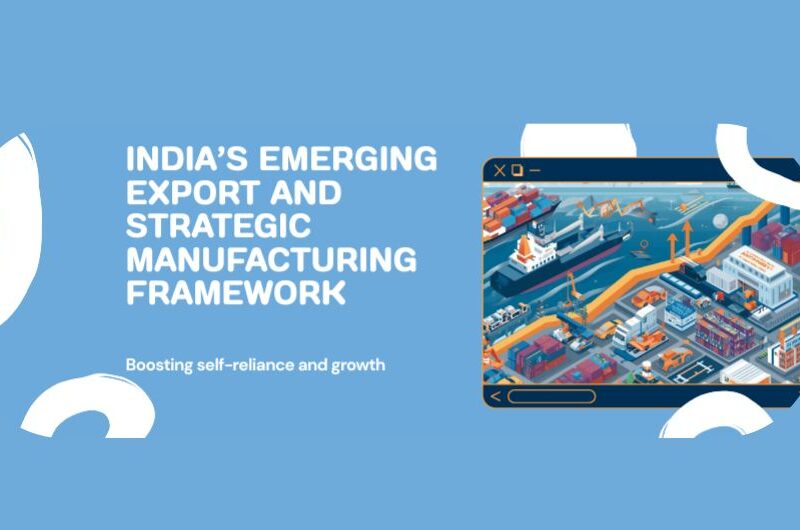
India’s Emerging Export and Strategic Manufacturing Framework
1. India’s cumulative exports during April-January 2025-26 reached USD 720.76 billion, recording 6.15 percent year-on-year growth, indicating resilient external performance despite continuing global uncertainty and trade-policy disruptions worldwide.
2. Services exports during April-January 2025-26 stood at USD 354.13 billion, registering 10.57 percent growth over the previous year and reinforcing India’s strength in technology, professional, and business services.
3. India combined targeted import substitution with export orientation, especially in critical sectors, to reduce strategic dependence while maintaining long-term competitiveness in changing global trade and supply-chain conditions.
4. The 2026-27 budget emphasized domestic manufacturing expansion through Biopharma SHAKTI, Semiconductor Mission 2.0, electronics component support, Rare Earth Corridors, Chemical Parks, and incentives for capital goods manufacturing.
5. Customs duty reductions on aviation parts, lithium-ion cell manufacturing, and defence and civil aviation components were proposed to lower production costs in aerospace, electronics engineering, and energy-storage hardware.
6. India’s electronics production increased from ₹1.9 lakh crore in 2014-15 to ₹11.3 lakh crore in 2024-25, reflecting rapid scale-up in domestic manufacturing capacity and sustained policy-driven sectoral transformation.
7. Mobile manufacturing output rose from ₹18,000 crore in 2014-15 to ₹5.45 lakh crore in 2024-25, while India became the world’s second-largest mobile phone manufacturer with over 300 units.
8. India Semiconductor Mission 2.0 was launched to support equipment, materials, full-stack domestic intellectual property, and stronger supply chains, while electronics component manufacturing support received an expanded ₹40,000 crore outlay.
9. In August 2025, India inaugurated an end-to-end OSAT facility in Sanand, Gujarat, while semiconductor design facilities launched earlier focused on advanced 3-nanometer chip design capabilities.
10. The automotive sector provides direct and indirect employment to over 30 million people, while total vehicle production rose from 22,652 thousand units in FY21 to 31,028 thousand units.
11. India’s pharmaceutical sector recorded an annual turnover of ₹4.72 lakh crore in FY25, ranking third globally by volume and eleventh by value in pharmaceutical production.
12. The bulk drugs incentive scheme mobilised ₹4,763 crore by September 2025 and created annual manufacturing capacity of 55,000 metric tonnes for 26 critical products of strategic importance.
13. At least 65 percent of India’s defence equipment is now domestically manufactured, while indigenous defence production rose to a record ₹1.54 lakh crore in FY 2024-25.
14. Defence exports reached ₹23,622 crore in FY 2024-25, up from less than ₹1,000 crore in 2014, with Indian defence products now reaching over 100 countries globally.
15. Export Promotion Mission, with ₹25,060 crore outlay for FY 2025-26 to FY 2030-31, supports trade finance, compliance, logistics, warehousing, e-commerce exports, and market-readiness for MSMEs and new exporters.
Must Know Terms :
1. OSAT
OSAT means Outsourced Semiconductor Assembly and Test. It is the stage where fabricated semiconductor wafers are cut into chips, packaged, assembled, and tested before commercial use. In August 2025, India inaugurated one of its first end-to-end OSAT facilities at Sanand, Gujarat. OSAT capability is important because it supports semiconductor value addition, reduces downstream import dependence, and strengthens electronics supply-chain security.
2.TRACE
TRACE stands for Trade Regulations, Accreditation and Compliance Enablement. It operates under the Export Promotion Mission and helps exporters satisfy international testing, inspection, certification, and regulatory requirements. The scheme reimburses 60 percent of eligible costs under the Positive List and 75 percent under the Priority Positive List. Support is capped at ₹25 lakh per Import Export Code annually, improving compliance readiness for global market access.
3.FLOW
FLOW means Facilitating Logistics, Overseas Warehousing and Fulfilment. It is a support mechanism under the Export Promotion Mission that helps exporters build or access overseas warehousing, fulfilment systems, and e-commerce export hubs. The intervention provides up to 30 percent of approved project cost for a maximum of three years. It is designed to improve delivery efficiency, storage access, and export competitiveness, especially for smaller firms.
4.LIFT
LIFT stands for Logistics Interventions for Freight and Transport. It is an Export Promotion Mission measure created to offset freight disadvantages faced by exporters located in low export-intensity districts. The scheme reimburses up to 30 percent of eligible freight costs, subject to a ceiling of ₹20 lakh per Import Export Code in a financial year. It aims to reduce logistics burdens and improve regional export participation.
5.INSIGHT
INSIGHT means Integrated Support for Trade Intelligence and Facilitation. It strengthens exporter capacity-building, district-level trade facilitation, and intelligence systems under the Districts as Export Hubs framework. The measure supports project costs up to 50 percent for eligible entities. Central and State government institutions, along with Indian Missions abroad, can receive support up to 100 percent within notified ceilings, improving trade information and institutional export support.
6.ECMS
ECMS stands for Electronics Component Manufacturing Scheme. It was notified in 2025 with an outlay of ₹22,919 crore to strengthen domestic component manufacturing and integrate India’s electronics industry with global value chains. The scheme provides turnover-linked, capital expenditure, and hybrid incentives. As investment commitments reached nearly double the original target, the Union Budget 2026-27 increased the scheme outlay to ₹40,000 crore.
Key Takeaways
- Cumulative exports reached USD 720.76 billion Apr-Jan 2025-26 (+6.15% YoY)
- During Apr-Jan 2025-26, services exports reached USD 354.13 billion (+10.57% YoY)
- Sectors such as electronics, automobiles, pharmaceuticals and defense manufacturing are expanding through targeted policy support
- Institutional reforms like the Export Promotion Mission (EPM) enhances trade finance, logistics, compliance, and market access
- Union Budget 2026-27 focuses on scaling strategic manufacturing, thereby strengthen export competitiveness
MCQ :
1. During April-January 2025-26, India’s cumulative exports were estimated at:
A) USD 720.76 billion
B) USD 679.02 billion
C) USD 354.13 billion
D) USD 387.50 billion
2. Services exports during April-January 2025-26 were estimated at:
A) USD 320.28 billion
B) USD 354.13 billion
C) USD 188.80 billion
D) USD 720.76 billion
3. Which of the following was highlighted in the 2026-27 budget as part of domestic manufacturing expansion?
A) Green Hydrogen Sovereignty Fund
B) National Steel Export Board
C) India Semiconductor Mission 2.0
D) Universal Port Liberalisation Scheme
4. The proposed customs duty reductions mentioned in the content covered aviation parts, lithium-ion cell manufacturing, and:
A) pharmaceutical packaging material
B) parts for defence and civil aviation
C) edible oil processing machinery
D) railway signalling assemblies
5. India’s electronics production increased from ₹1.9 lakh crore in 2014-15 to which level in 2024-25?
A) ₹8.3 lakh crore
B) ₹9.7 lakh crore
C) ₹10.1 lakh crore
D) ₹11.3 lakh crore
6. Mobile manufacturing output in India rose from ₹18,000 crore in 2014-15 to:
A) ₹5.45 lakh crore
B) ₹4.72 lakh crore
C) ₹1.54 lakh crore
D) ₹11.3 lakh crore
7. India Semiconductor Mission 2.0 was launched mainly to support:
A) full-stack domestic intellectual property and stronger supply chains
B) only telecom tower expansion in rural areas
C) exclusive import of advanced semiconductor wafers
D) complete privatization of electronics clusters
8. One of India’s first end-to-end OSAT facilities was inaugurated in August 2025 at:
A) Noida, Uttar Pradesh
B) Pune, Maharashtra
C) Sanand, Gujarat
D) Sriperumbudur, Tamil Nadu
9. The automotive sector in India provides direct and indirect employment to:
A) over 20 million people
B) over 25 million people
C) over 30 million people
D) over 40 million people
10. India’s pharmaceutical sector recorded an annual turnover of ______ in FY25.
A) ₹3.72 lakh crore
B) ₹4.72 lakh crore
C) ₹5.72 lakh crore
D) ₹6.72 lakh crore
11. By September 2025, the bulk drugs incentive scheme had created annual manufacturing capacity of:
A) 55,000 metric tonnes for 26 critical products
B) 26,000 metric tonnes for 55 products
C) 45,000 metric tonnes for 20 strategic products
D) 60,000 metric tonnes for 30 products
12. Indigenous defence production in India reached a record level of ______ in FY 2024-25.
A) ₹1.27 lakh crore
B) ₹2.09 lakh crore
C) ₹1.54 lakh crore
D) ₹23,622 crore
13. Defence exports in FY 2024-25 stood at:
A) ₹50,000 crore
B) ₹9,145 crore
C) ₹1,000 crore
D) ₹23,622 crore
14. The Export Promotion Mission has an outlay of ₹25,060 crore for the period:
A) FY 2025-26 to FY 2030-31
B) FY 2024-25 to FY 2028-29
C) FY 2026-27 to FY 2031-32
D) FY 2025-26 to FY 2029-30
15. TRACE under the Export Promotion Mission is related to:
A) freight reimbursement in low export-intensity districts
B) overseas warehousing and fulfilment support
C) testing, inspection, certification, and regulatory compliance support
D) semiconductor component capital incentives



0 comment