
India’s Cloud and AI Infrastructure Push
1. Budget 2026–27 proposes a tax holiday till 2047 for eligible foreign cloud service providers using India-based data centres for global operations, aiming to strengthen India’s digital infrastructure position.
2. The policy targets foreign companies providing global cloud services through Indian data centre infrastructure, while ensuring domestic transactions remain taxable through Indian reseller entities under specified conditions.
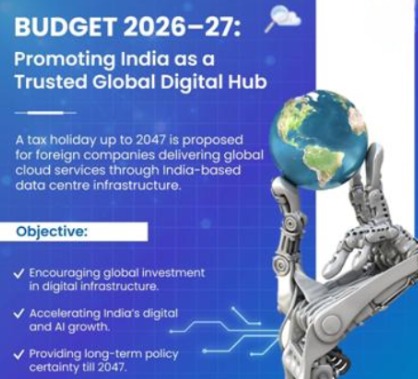
3. Income from global cloud operations routed through India-based data centres will not be taxed in India for eligible foreign providers during Tax Year 2026–27 to 2046–47.
4. Eligibility requires the foreign company to be notified, data centre services to be procured from an Indian company, and the facility to be notified by MeitY [Ministry of Electronics and Information Technology].
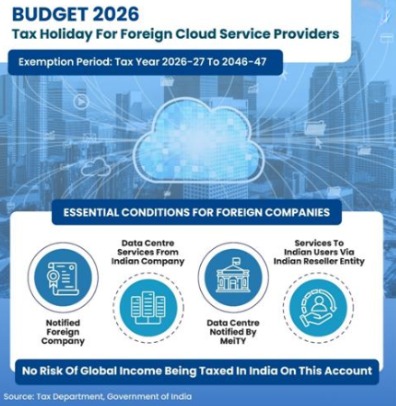
5. Services to Indian users must be delivered through an Indian reseller company, ensuring domestic operations continue within India’s tax framework despite the tax holiday on global operations.
6. Domestic profits remain taxable, including resident Indian data centre services to the global entity and resale of cloud services to Indian customers by resident Indian resellers.
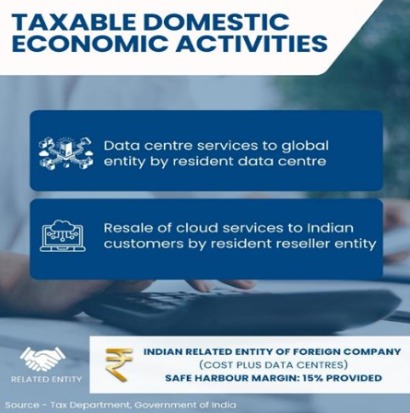
7. Where the Indian data centre company is a related entity operating as a cost-plus centre, the Budget proposes a safe harbour margin of 15 percent.
8. UNCTAD [United Nations Conference on Trade and Development] reported that data centres accounted for more than one-fifth of global greenfield project values in 2025, with announced investments exceeding 270 billion US dollars.
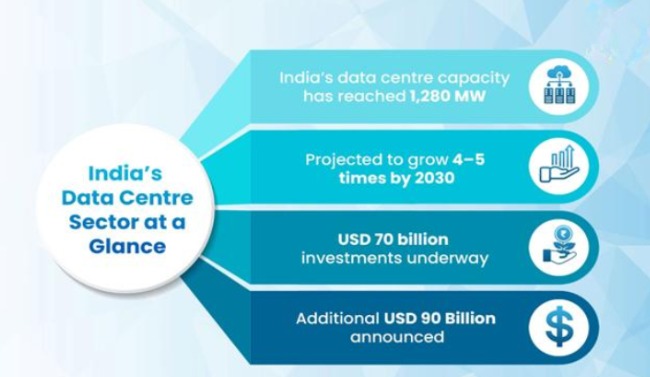
9. Industry estimates indicate India’s cloud data centre capacity has reached around 1,280 megawatts and is projected to grow four to five times by 2030.
10. Nearly 70 billion US dollars of investments are underway in India’s data centre sector, while another 90 billion dollars in projects have already been announced.
11. India Semiconductor Mission 2.0 was announced in the Budget, with focus on semiconductor equipment, materials, design ecosystem expansion, talent development, and 1,000 crore rupees allocation.
12. The Electronics Components Manufacturing Scheme (ECMS) allocation was raised from about 22,000 crore rupees to 40,000 crore rupees in Budget 2026–27, and the scheme received 149 applications.
13. Budget proposals for IT services include one Information Technology Services category, 15.5 percent common safe harbour margin, 2,000 crore threshold, automation, and faster unilateral APA [Advance Pricing Agreement] processing.
14. Under Digital India, GI Cloud [Government of India Cloud] MeghRaj has been established for government cloud requirements, providing secure, scalable, and elastic cloud facilities through the NIC [National Informatics Centre].
15. The measure aligns cloud incentives with semiconductor, electronics, and IT reforms, positioning India as a long-term destination for global cloud and AI infrastructure investment.
Must Know Terms :
1. MeitY
MeitY stands for Ministry of Electronics and Information Technology. In this framework, MeitY notifies eligible data centre facilities for the proposed tax holiday. This notification is a mandatory condition for foreign cloud providers seeking the exemption. MeitY also anchors wider digital infrastructure policy in India, including electronics, semiconductor, data governance, and technology ecosystem measures linked with Budget 2026–27 reforms.
2.UNCTAD
UNCTAD stands for United Nations Conference on Trade and Development. It reported that data centres accounted for more than one-fifth of global greenfield project values in 2025. Announced investments exceeded 270 billion US dollars. This statistic was used to underline the rising global competition for cloud and AI infrastructure investment. UNCTAD’s assessment highlights data centres as a major driver of international capital flows.
3.MeghRaj
MeghRaj is India’s GI Cloud created under the Digital India initiative to meet government cloud requirements. It provides secure, scalable, and elastic cloud services for e-governance delivery through the National Informatics Centre. It is part of India’s public digital infrastructure architecture. National Data Centres under this ecosystem operate with layered security frameworks and support wider adoption of government cloud-based digital services.
4.APA
APA means Advance Pricing Agreement under the Income-tax framework. A unilateral APA is an agreement between a taxpayer and the Central Board of Direct Taxes to determine transfer pricing for specified transactions in advance for a fixed period. Budget 2026–27 proposes faster processing of unilateral APAs for IT services. This supports tax certainty, reduces disputes, and improves predictability for technology and service sector firms.
5.ECMS
ECMS stands for Electronics Components Manufacturing Scheme. In Budget 2026–27, its allocation was increased from about 22,000 crore rupees to 40,000 crore rupees. The scheme received 149 applications, showing strong industry interest. ECMS is intended to strengthen domestic production of electronics components. It forms part of the wider electronics and semiconductor ecosystem that supports digital infrastructure, cloud expansion, and advanced computing systems.
6.SafeHarbour
SafeHarbour refers to a specified profit margin accepted under tax rules for certain transactions if prescribed conditions are met, reducing detailed scrutiny. In this policy framework, a 15 percent safe harbour margin is proposed where an Indian data centre is a related cost-plus entity of the foreign company. Budget 2026–27 also proposes a 15.5 percent common safe harbour margin for Information Technology Services.
Key Takeaways
a. Tax holiday till 2047proposed for eligible foreign cloud providers using India-based data centres for global operations
b. Structured eligibility framework, including notified entities, use of Indian data centres, and Indian reseller requirement for domestic services
c. Domestic transactions continue under existing tax provisions, with a proposed 15% safe harbour margin for related data centre entities
d. Part of a broader digital and semiconductor ecosystem push under Budget 2026–27to position India as a global cloud and AI infrastructure hub
MCQ :
1. Budget 2026–27 proposes a tax holiday till which year for eligible foreign cloud service providers using India-based data centres for global operations?
A) 2035
B) 2040
C) 2047
D) 2050
2. The proposed tax holiday is meant for foreign cloud service providers using India-based data centres mainly for:
A) domestic retail sales only
B) global operations
C) defence procurement only
D) state government payroll systems
3. Under the proposed framework, services to Indian users must be provided through:
A) a foreign parent entity directly
B) an Indian reseller company
C) a state-owned telecom operator only
D) any offshore branch office
4. Which ministry must notify the eligible data centre facility under the proposed framework?
A) Ministry of Finance
B) Ministry of Commerce and Industry
C) MeitY
D) Ministry of Corporate Affairs
5. Under the proposal, income from eligible global cloud operations routed through India-based data centres will remain exempt in India from Tax Year 2026–27 up to:
A) Tax Year 2035–36
B) Tax Year 2040–41
C) Tax Year 2044–45
D) Tax Year 2046–47
6. Domestic profits under this framework will remain taxable, including:
A) only foreign cloud income
B) only exports of software services
C) resident data centre services and cloud resale to Indian customers
D) only semiconductor design income
7. Where the Indian data centre company is a related entity operating as a cost-plus centre, the proposed safe harbour margin is:
A) 10 percent
B) 12 percent
C) 15 percent
D) 18 percent
8. UNCTAD reported that data centres accounted for more than what share of global greenfield project values in 2025?
A) one-tenth
B) one-fifth
C) one-third
D) one-half
9. Announced global data centre investments in 2025, as cited, exceeded:
A) 170 billion US dollars
B) 220 billion US dollars
C) 270 billion US dollars
D) 320 billion US dollars
10. India’s cloud data centre capacity has reached around:
A) 980 MW
B) 1,080 MW
C) 1,180 MW
D) 1,280 MW
11. Investments already underway in India’s data centre sector are estimated at nearly:
A) 40 billion US dollars
B) 55 billion US dollars
C) 70 billion US dollars
D) 90 billion US dollars
12. Additional announced projects in India’s data centre sector amount to around:
A) 50 billion US dollars
B) 70 billion US dollars
C) 90 billion US dollars
D) 110 billion US dollars
13. India Semiconductor Mission 2.0 received what allocation in FY 2026–27?
A) 500 crore rupees
B) 750 crore rupees
C) 1,000 crore rupees
D) 1,500 crore rupees
14. The allocation for the Electronics Components Manufacturing Scheme in Budget 2026–27 was increased to:
A) 30,000 crore rupees
B) 35,000 crore rupees
C) 40,000 crore rupees
D) 45,000 crore rupees
15. Budget proposals for IT services include a common safe harbour margin of:
A) 14.5 percent
B) 15 percent
C) 15.5 percent
D) 16 percent




0 comment