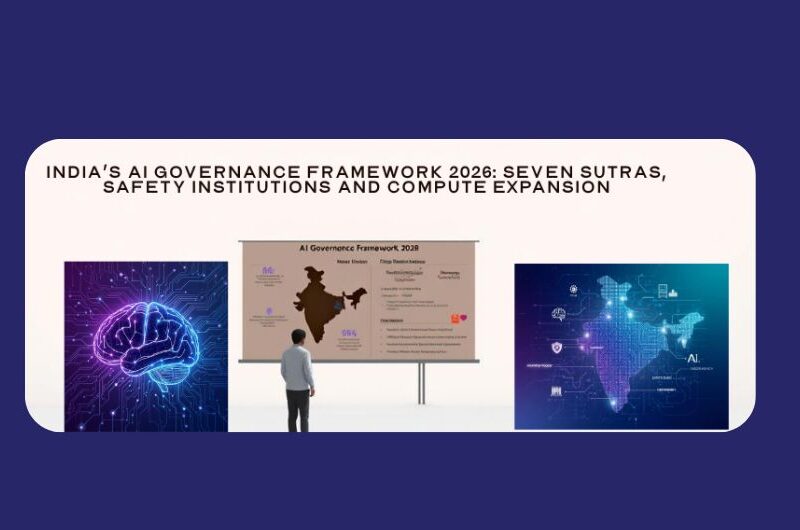
India’s AI Governance Framework 2026: Seven Sutras, Safety Institutions and Compute Expansion
1) India AI Governance Guidelines were released at AI Impact Summit 2026 and adopt a principle-based “techno-legal” framework built around seven Sutras for safe, trusted and inclusive AI innovation.
2) Ministry of Electronics and Information Technology (MeitY) formed the drafting committee in July 2025 to review laws, global developments, research, and public feedback.
3) The framework is presented in four parts: (1) seven Sutras, (2) key issues and recommendations, (3) action plan, and (4) practical guidelines for industry and regulators.
4) Guidelines recommend new national institutions: AI Governance Group (AIGG), Technology & Policy Expert Committee (TPEC), and IndiaAI Safety Institute for standards, testing, and guidance.
5) IndiaAI Mission has onboarded 38,000+ Graphics Processing Units (GPUs) via a subsidised national compute facility, with a stated target of 100,000 GPUs through the IndiaAI Compute Portal.
6) AIKosh hosts 9,500+ datasets and 273 sectoral models, supporting indigenous model development and providing ready resources for sector-specific AI deployment.
7) National Supercomputing Mission has operationalised 40+ petaflop systems, including AIRAWAT and PARAM Siddhi-AI, strengthening high-end compute capacity for AI.
8) Capacity initiatives support 500 PhDs, 5,000 postgraduates, and 8,000 undergraduates; 570 AI Data Labs and 27 IndiaAI labs across states expand grassroots innovation.
9) National Education Policy 2020 integrates AI-linked curriculum; additionally, 174 Industrial Training Institutes (ITIs) are approved across 27 States/Union Territories for skilling.
10) YUVA AI for ALL is a free foundational course launched for mass AI literacy, aiming to spread basic AI understanding beyond specialists to citizens and small businesses.
11) Seven Sutras include: Trust is the Foundation, People First, Innovation over Restraint, Fairness and Equity, Accountability, Understandable by Design, Safety–Resilience–Sustainability.
12) The guidelines position “innovation over restraint” as a core approach, prioritising AI adoption as a driver of inclusive growth, competitiveness, and Viksit Bharat 2047.
13) The risk-mitigation pillar references existing agencies: Indian Computer Emergency Response Team (CERT-In), Indian Cyber Crime Coordination Centre (I4C), and National Critical Information Infrastructure Protection Centre (NCIIPC).
14) Policy foundations referenced include Information Technology Act 2000, Information Technology Rules 2021 and Information Technology Amendment Rules 2026, Digital Personal Data Protection Act 2023, and 2026 IT rules addressing AI-generated and deepfake harms.
15) Action plan timelines: short-term sets up AIGG/TPEC, master circular, risk frameworks and incident database groundwork; medium-term publishes standards and sandboxes; long-term updates laws and expands global standards engagement.
Must Know Terms :
1) AI Governance Group: A proposed national body to steer AI governance in India. It is meant to coordinate policy direction, oversee implementation of the guidelines, and ensure agencies follow common risk and compliance expectations. It can act as a single window for government-wide alignment on AI safety, standards, accountability, and regulatory coordination across sectors.
2) IndiaAI Safety Institute: A proposed institution focused on practical AI safety work. It is meant to support standards, model testing, evaluation methods, and safety guidance for developers and users. The idea is to create a national capability for red-teaming, benchmarking, and risk assessment so that AI systems used at scale can be checked for reliability, bias, and security risks.
3) AIKosh: A national AI resource platform hosting 9,500+ datasets and 273 sectoral models. It supports Indian model development by providing ready data and model assets for domains like health, agriculture, education, and governance. It reduces duplication, speeds up prototyping, and helps teams build sector-focused AI solutions with local datasets and context.
4) IndiaAI Compute Portal: A national platform to provide subsidised compute access for AI development. The IndiaAI Mission has onboarded 38,000+ GPUs through a national compute facility, with a stated target of 100,000 GPUs via this portal. It aims to make high-performance compute affordable for startups, researchers, and public projects needing large-scale training and inference.
5) Seven Sutras Framework: A principle set used to guide safe and trusted AI. The seven sutras listed are: Trust is the Foundation, People First, Innovation over Restraint, Fairness and Equity, Accountability, Understandable by Design, and Safety–Resilience–Sustainability. These act as decision rules for design, deployment, monitoring, and governance across sectors.
6) Incident Database Framework: A proposed system to record, classify, and analyse AI-related incidents such as misuse, harmful outputs, security failures, deepfake harms, or operational breakdowns. It is planned as groundwork in the short-term action plan, so patterns can be tracked and risk controls updated. It supports faster response, learning loops, and evidence-based regulation over time.
MCQ :
1. India AI Governance Guidelines were released at:
A) Digital India Week 2026
B) AI Impact Summit 2026
C) Global Tech Forum 2026
D) IndiaAI Conclave 2026
2. The drafting committee for the guidelines was formed in:
A) July 2024
B) July 2025
C) January 2026
D) March 2026
3. The framework is presented in how many parts?
A) 3
B) 4
C) 5
D) 6
4. Which of the following is NOT listed as a proposed new national institution?
A) AI Governance Group (AIGG)
B) Technology & Policy Expert Committee (TPEC)
C) IndiaAI Safety Institute
D) National AI Ethics Tribunal
5. IndiaAI Mission has onboarded how many GPUs through a subsidised national compute facility?
A) 18,000+
B) 28,000+
C) 38,000+
D) 48,000+
6. The stated target through the IndiaAI Compute Portal is:
A) 50,000 GPUs
B) 75,000 GPUs
C) 90,000 GPUs
D) 100,000 GPUs
7. AIKosh hosts more than:
A) 5,500 datasets and 173 models
B) 7,500 datasets and 200 models
C) 9,500 datasets and 273 models
D) 12,500 datasets and 300 models
8. National Supercomputing Mission has operationalised:
A) 20+ petaflop systems
B) 30+ petaflop systems
C) 40+ petaflop systems
D) 60+ petaflop systems
9. Which pair is specifically mentioned under National Supercomputing Mission capability for AI?
A) PARAM 8000 and PARAM Yuva
B) AIRAWAT and PARAM Siddhi-AI
C) Pratyush and Mihir
D) EKA and TeraFlop-1
10. Capacity initiatives support how many PhDs?
A) 250
B) 400
C) 500
D) 700
11. The number of AI Data Labs mentioned is:
A) 270
B) 370
C) 470
D) 570
12. The number of IndiaAI labs mentioned is:
A) 17
B) 27
C) 37
D) 47
13. 174 Industrial Training Institutes are approved across:
A) 20 States/UTs
B) 24 States/UTs
C) 27 States/UTs
D) 30 States/UTs
14. Which of the following is included among the Seven Sutras?
A) Regulation over Innovation
B) People First
C) Secrecy by Design
D) Zero-Risk Guarantee
15. Risk-mitigation pillar references which agency for critical information infrastructure protection?
A) CERT-In
B) I4C
C) NCIIPC
D) NCRB


0 comment