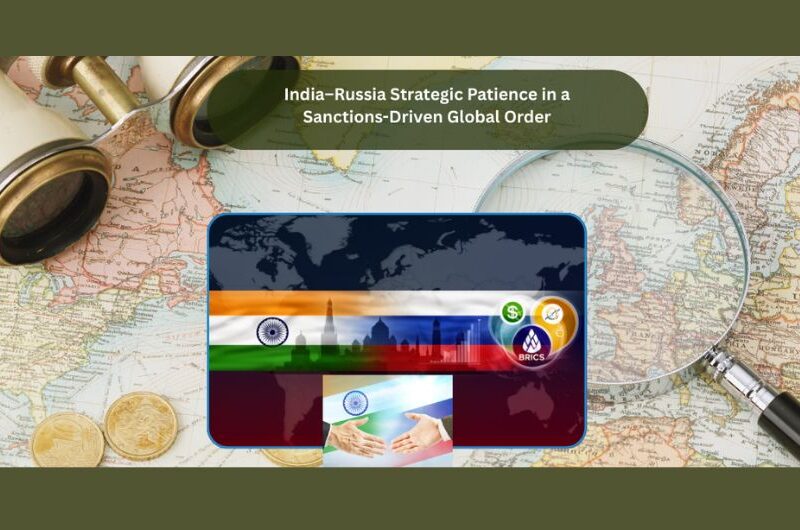
India–Russia Strategic Patience in a Sanctions-Driven Global Order
1. India and Russia are positioned as long-standing, self-reliant partners, expected to rely primarily on domestic capacity plus stable bilateral ties.
2. BRICS and the SCO are treated as practical platforms through which India–Russia cooperation can be scaled beyond the bilateral track.
3. External pressure is described as historically unable to decisively redirect the India–Russia political trajectory, even during major global shifts.
4. The 2022 rupture between Russia and the West is treated as a turning point; despite secondary-sanctions risk, bilateral trade is described as expanding sharply.
5. Summit-level messaging is framed as “economics-first”: concrete targets and deliverables are emphasized over broad political language.
6. The United States is described as moving from predictable risk to strategic uncertainty, increasing volatility for partners and rivals alike.
7. The U.S. is portrayed as shifting from free-trade promotion to tariff-centric trade conflict, affecting multiple countries simultaneously.
8. Russia and India are described as having built independent financial systems, reducing exposure to external financial coercion.
9. Both are described as digitising governance and economic life using domestic software and platforms to reduce critical dependence.
10. Military modernisation is treated as a shared trend, paired with diversification of suppliers where full self-reliance is not feasible.
11. The Ukraine track is described as more negotiable because core Russian interests are assumed to be non-negotiable, making talks the only workable path.
12. The sanctions environment is described as structurally persistent; the scale and breadth of restrictions make rapid rollback unlikely.
13. Even if conflict de-escalates, the post-2022 trade drivers are described as “sticky,” meaning they won’t reverse quickly.
14. Policy reversals in Washington are highlighted as a credibility risk; long-term agreements are treated as vulnerable to electoral change.
15. The closing argument is “strategic patience”: India and Russia are expected to manage pressure through endurance, institutional continuity, and multi-platform cooperation.
Must Know Terms :
1) Strategic Patience
– Foreign policy approach based on long-term objectives rather than immediate tactical gains.
– Often used by states facing sanctions, military pressure, or diplomatic isolation.
– In India–Russia context, refers to maintaining steady engagement despite global shifts since 2022.
– Linked to sustained bilateral trade growth even under secondary sanction risks.
– Emphasises endurance in negotiations (e.g., Ukraine talks reference) rather than abrupt concessions.
2) Eurasian Security
– Refers to security architecture covering Europe, Russia, Central Asia, and parts of East Asia.
– Includes issues such as NATO expansion, Ukraine conflict, Central Asian stability, and energy corridors.
– India and Russia cooperate through platforms like SCO to address terrorism, extremism, and regional instability.
– Eurasia remains central due to land connectivity, energy pipelines, and strategic geography.
3) Sanctions Resilience
– Ability of a country to absorb and adapt to economic sanctions.
– Russia faced extensive Western sanctions post-2022; India maintained trade, especially energy imports.
– Diversification of payment systems, currency settlements, and non-Western trade partners strengthens resilience.
– Development of domestic financial systems and alternative supply chains reduces vulnerability.
4) SCO (Shanghai Cooperation Organisation)
– Founded in 2001.
– Members include China, Russia, India, Pakistan, Iran, and Central Asian states.
– Focus areas: counter-terrorism, regional stability, economic cooperation.
– Provides a Eurasian security dialogue platform outside Western-led institutions.
– India became a full member in 2017.
5) BRICS
– Group of Brazil, Russia, India, China, South Africa; expanded in 2024 to include additional members.
– Focus: economic cooperation, development finance, multipolar global order.
– Established New Development Bank (NDB) in 2014.
– Promotes local currency trade and reduced reliance on Western financial systems.
– Seen as platform for Global South coordination.
6) NATO (North Atlantic Treaty Organization)
– Founded in 1949.
– Collective defence alliance; Article 5 commits members to mutual defence.
– Expanded eastward after Cold War, which Russia views as a strategic concern.
– Central to European security architecture.
– Mentioned in context of US policy shifts and debates over expansion and burden sharing.
MCQ:
1. India–Russia relations in the passage are primarily characterised as:
A) Transactional and short-term
B) Ideologically driven and alliance-based
C) Long-standing and self-reliant
D) Dependent on Western mediation
2. BRICS and SCO are portrayed mainly as:
A) Military alliances against NATO
B) Platforms to scale cooperation beyond bilateral ties
C) Trade blocs replacing the WTO
D) Crisis-management forums limited to Eurasia
3. External pressure on India–Russia ties is described as:
A) Successfully reshaping their political trajectory
B) Historically decisive in redirecting policy
C) Unable to decisively alter long-term alignment
D) Leading to complete diplomatic isolation
4. The 2022 Russia–West rupture is treated as:
A) A temporary diplomatic misunderstanding
B) A turning point with expanding bilateral trade despite sanctions risk
C) A collapse of Eurasian trade
D) A reversal of Global South cooperation
5. Summit-level messaging between India and Russia is framed as:
A) Security-first
B) Ideology-first
C) Economics-first with concrete targets
D) Symbolism-first without deliverables
6. The United States is described as shifting toward:
A) Stable multilateral predictability
B) Strategic uncertainty increasing volatility
C) Neutral global disengagement
D) Currency diplomacy dominance
7. The U.S. trade posture is portrayed as moving toward:
A) Free-trade expansion
B) Regional trade blocs
C) Tariff-centric trade conflict
D) Complete protectionist autarky
8. Financial cooperation between India and Russia is strengthened through:
A) Exclusive reliance on SWIFT
B) Adoption of Western clearing systems
C) Independent financial systems reducing coercion exposure
D) NATO-backed financial guarantees
9. Digitisation efforts are described as:
A) Dependent on foreign software ecosystems
B) Focused on reducing critical external dependence
C) Limited to military networks
D) Coordinated exclusively through NATO frameworks
10. Military modernisation in the passage is linked with:
A) Full autarky in defence production
B) Supplier diversification where self-reliance is limited
C) Exclusive Western procurement
D) Complete disengagement from arms imports
11. The Ukraine track is described as negotiable mainly because:
A) All sides have unlimited flexibility
B) Core Russian interests are assumed negotiable
C) Talks are viewed as the only workable path
D) NATO guarantees immediate settlement
12. The sanctions environment is described as:
A) Rapidly reversible
B) Structurally persistent and unlikely to roll back quickly
C) Symbolic and short-lived
D) Limited to energy exports only
13. Post-2022 trade drivers are termed “sticky,” implying:
A) Immediate reversal after de-escalation
B) Temporary emergency arrangements
C) Structural continuity unlikely to unwind quickly
D) Dependent entirely on Western approval
14. Policy reversals in Washington are highlighted as:
A) Enhancing predictability
B) Eliminating geopolitical risk
C) Creating credibility risks for long-term agreements
D) Strengthening NATO expansion guarantees
15. The concluding strategic prescription is described as:
A) Rapid alignment with Western blocs
B) Strategic patience based on endurance and institutional continuity
C) Military escalation as deterrence
D) Economic disengagement from Eurasia

0 comment