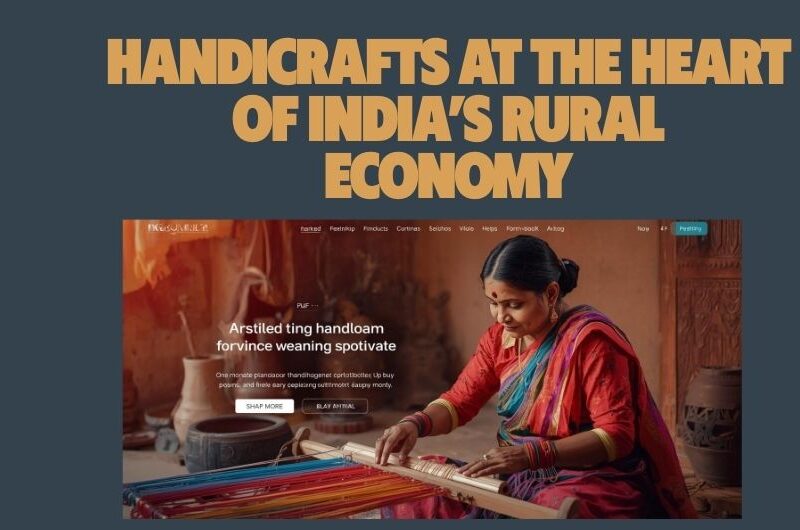
Handicrafts at the Heart of India’s Rural Economy
Handicrafts and Rural Livelihoods
India’s handicraft sector functions as a large, decentralized livelihood system rooted in rural and semi-urban areas. It supports artisan households through home-based or small-workshop production models that require relatively low capital but generate meaningful value addition. Beyond income, handicrafts sustain community skills transmitted across generations and reinforce cultural continuity through region-specific techniques, motifs, and materials. The sector’s breadth is reflected in hundreds of formally classified craft categories and a wide range of geographically distinctive products with recognized identity value.
What Makes a Product a Handicraft
Handicrafts are predominantly hand-made goods, even when tools or limited machinery assist certain steps. Their distinctiveness arises from visual appeal, aesthetic and artistic character, and cultural attachment, which differentiates them from mechanized products of similar utility. The sector is labour-intensive and widely dispersed, with production often organized around informal networks, local supply chains, and seasonal availability of raw materials. This structure allows households—especially those tied to agriculture—to supplement incomes during lean periods while maintaining flexible work arrangements within their local context.
Workforce Profile and Inclusion
The artisan workforce is large and includes substantial participation from women and social groups that have historically relied on informal, locally anchored occupations. Women form a major share of weavers and artisans, indicating the sector’s role in expanding economic participation within households and communities. Craft work also draws participation from communities across social categories, making it an avenue of livelihood diversification and inclusion. Identification and registration initiatives strengthen visibility of artisans, improve access to formal benefits, and create a basis for targeted support, training, and market linkage interventions.
Exports, Markets, and Demand Trends
Handicrafts contribute to external demand alongside the broader textiles and apparel ecosystem, with exports spanning multiple categories such as woodwares, art metal wares, handprinted textiles, embroidered goods, and imitation jewellery. Market concentration remains significant in major importing countries, while a substantial share also goes to diversified global destinations. Demand is increasingly shaped by preferences for authentic, sustainable, and handmade products, creating space for India to expand value realization through design innovation, quality assurance, branding, and reliable supply fulfillment. Strengthening consistency in finishing, packaging, and compliance can improve unit value while sustaining artisanal character.
Institutional Support and Sector Development
Public interventions focus on cluster development, skill upgradation, tool support, marketing platforms, and social security coverage. Cluster-based models aim to bring scattered artisans into collective frameworks supported by common facilities, modern infrastructure, and structured training to improve productivity and competitiveness. Skill programmes emphasize design and technology development, apprenticeship-style transmission of traditional knowledge, structured upgradation aligned with recognized qualification frameworks, and distribution of improved toolkits to enhance output quality and efficiency. Marketing and exhibition support provides platforms for visibility, buyer linkages, and discovery of new demand segments, complementing local retail channels and emerging digital avenues.
Clusters, Collectives, and Enterprise Pathways
A cluster approach enables artisans and small enterprises to achieve economies of scale without losing craft specificity. Common facility centres, raw material banks, design support, and professional program management can reduce transaction costs and improve market readiness. Collective structures such as producer companies and artisan groups improve bargaining power, help standardize processes where appropriate, and facilitate access to finance and formal schemes. The broader objective is to shift artisans from vulnerability to resilience by building enterprise capabilities while safeguarding heritage and region-specific craft identities.
Policy Enablement and Market Competitiveness
Reforms affecting taxation, labour welfare, and export competitiveness influence the sector’s ability to scale. Rationalized tax treatment for selected craft items can reduce cost pressures, while welfare-oriented frameworks can improve dignity of work and stability for craft workers. Export support instruments and promotional missions aim to reduce embedded costs, strengthen competitiveness, and expand international presence. At the same time, the sector’s long-term gains depend on combining authenticity with modern market expectations—quality consistency, timely delivery, contemporary design adaptation, and credible branding.
Conclusion
Handicrafts constitute a high-impact rural economy segment that blends livelihood creation with cultural stewardship. With rising global interest in handmade products, the sector’s growth potential is strong if support focuses on skills, infrastructure, clusters, market access, and social protection. Strengthening value chains, enhancing product innovation while preserving identity, and improving formal inclusion of artisans can raise incomes and ensure sustained expansion. The sector’s future competitiveness will be shaped by its ability to scale responsibly—protecting heritage, improving productivity, and integrating with wider domestic and global markets.
Multiple Choice Questions
- Which feature best distinguishes handicrafts from mechanically produced goods?
- High capital investment
- Predominant use of machines
- Hand-based production with cultural and aesthetic value
- Standardized mass production
- India’s handicraft sector is characterized mainly by:
- Capital-intensive factory systems
- Labour-intensive and decentralized production
- Complete dependence on urban markets
- Exclusive export orientation
- How many GI-tagged handicraft products are associated with India?
- About 150
- About 220
- About 318
- About 450
- National Handicrafts Week is observed annually during:
- January 1–7
- August 15–21
- December 8–14
- October 2–8
- The Shilp Guru Award is best described as:
- A regional marketing incentive
- A training certification
- The highest honour in the handicrafts sector
- An export-linked subsidy
- Which group constitutes the largest share of artisans in the handicrafts sector?
- Urban industrial workers
- Women artisans
- Foreign skilled workers
- Corporate designers
- Approximately how many handloom and handicraft artisans are estimated to be engaged in India?
- 32 lakh
- 45 lakh
- 64.66 lakh
- 90 lakh
- The handicrafts sector supports rural livelihoods mainly by:
- Replacing agricultural activity entirely
- Providing seasonal and supplemental income
- Promoting large-scale mechanization
- Eliminating household-based work
- The Pehchan Artisan Identification programme primarily aims to:
- Promote exports directly
- Register artisans for taxation
- Formalize artisans and link them to welfare benefits
- Replace traditional crafts
- In 2024–25, handicraft exports excluding hand-knotted carpets reached approximately:
- ₹18,000 crore
- ₹25,000 crore
- ₹33,122 crore
- ₹45,000 crore
- Which country accounts for the largest share of India’s handicraft exports?
- United Kingdom
- Germany
- United States
- Japan
- The National Handicraft Development Programme primarily focuses on:
- Import substitution only
- End-to-end support for artisans and clusters
- Automation of craft production
- Export licensing reforms
- Which initiative emphasizes transfer of traditional skills from master artisans to trainees?
- Comprehensive Skill Upgradation Program
- Improved Toolkit Distribution Program
- Guru Shishya Hastshilp Prashikshan Program
- Design and Technology Development Workshop
- The Comprehensive Handicrafts Cluster Development Scheme aims to:
- Centralize production in metro cities
- Develop world-class infrastructure in craft clusters
- Reduce the number of artisans
- Eliminate SMEs from handicrafts
- The One District One Product initiative supports handicrafts mainly by:
- Promoting uniform national designs
- Encouraging import of raw materials
- Highlighting and marketing region-specific craft products
- Shifting production to industrial estates



0 comment