GST Rate Rationalisation and Sectoral Relief Measures
1. The 56th GST (Goods and Services Tax) Council meeting on 3 September 2025 introduced a simplified tax structure, reducing rates across trade sectors to lower costs, improve compliance, and strengthen business competitiveness.
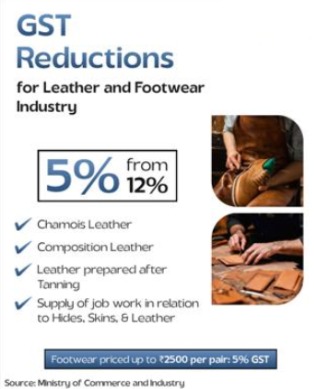
2. Leather materials prepared after tanning, composition leather, and chamois leather saw GST fall from 12% to 5%, while footwear priced up to ₹2500 per pair also moved lower.
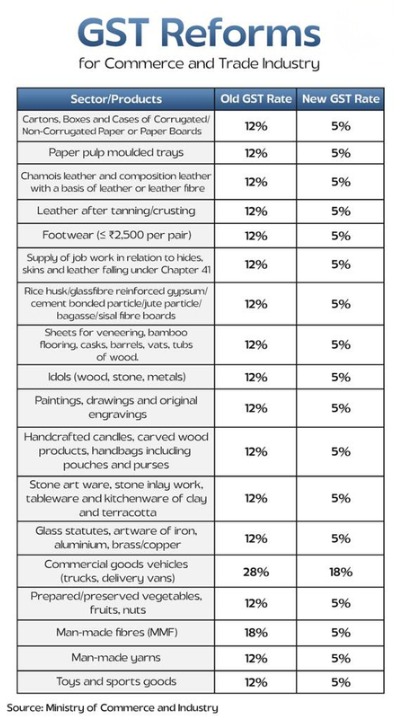
3. Job work related to hides, skins, and leather under Chapter 41 now attracts 5% GST instead of 12%, reducing production costs and improving operating margins for MSMEs (Micro, Small and Medium Enterprises).
4. Packing paper, cartons, boxes, and paper-pulp moulded trays now fall under 5% GST, reducing packaging expenses, supporting food processing units, and improving affordability in shipments for online commerce.
5. GST on trucks and delivery vans declined from 28% to 18%, lowering freight costs, improving last-mile logistics, and strengthening supply-chain efficiency for retail, exports, and warehousing across India.
6. Agro-based boards such as rice husk, bagasse, jute particle, sisal fibre, and gypsum boards moved from 12% to 5% GST, encouraging eco-friendly manufacturing alternatives for wood sector MSMEs.
7. Handicraft items including idols, paintings, engravings, handcrafted candles, clay tableware, handbags, and metal artware now attract 5% GST instead of 12%, improving artisan affordability and export competitiveness.
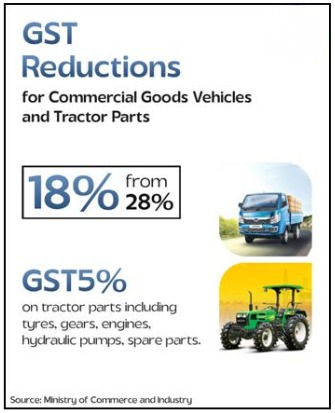
8. Commercial goods vehicles now face 18% GST instead of 28%, reducing capital costs for operators and helping cheaper transport of agricultural goods, cement, steel, and e-commerce deliveries nationwide.
9. Components used in tractor manufacturing, including tyres and gears, are now taxed at 5%, supporting ancillary industries producing engines, hydraulic pumps, spare parts, and export-oriented manufacturing growth globally.
10. Prepared and preserved fruits, vegetables, and nuts now attract 5% GST instead of 12%, supporting food processing, cold storage expansion, reduced wastage, and improved farmer returns across supply chains.
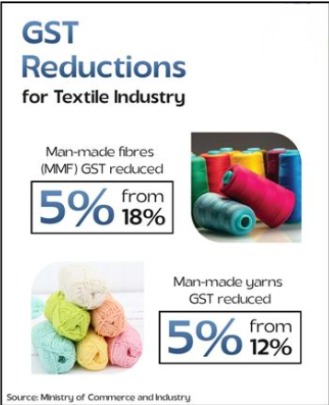
11. Man-made fibres now attract 5% GST instead of 18%, while man-made yarns fell from 12% to 5%, reducing distortions and improving textile competitiveness across the value chain significantly.
12. Rate alignment across fibre, yarn, and fabric addresses the inverted duty structure, eases working-capital pressure on manufacturers, and makes synthetic garments more price-competitive in international markets for exporters.
13. GST on toys and sports goods dropped from 12% to 5%, making products cheaper, supporting domestic MSME manufacturers, and strengthening local production against low-cost imported competition in India.
14. The reforms reduce compliance burdens by compressing taxation into fewer slabs, improving operational simplicity for smaller businesses and potentially increasing demand for goods produced at MSME level nationwide.
15. Lower GST across leather, textiles, food processing, packaging, logistics, handicrafts, and toys is designed to improve affordability, export competitiveness, sustainable manufacturing, and broader commercial efficiency across the economy.
Must Know Terms :
1. Chamois: Chamois is a soft, absorbent leather made mainly from sheep or lamb skin, processed with oils after tanning. It is valued for flexibility, polishing use, and water absorption. In the revised GST structure, chamois leather was placed in the lower 5 percent slab. This change reduces tax burden on leather goods and supports processing units engaged in specialty leather production.
2. Bagasse: Bagasse is the fibrous residue left after crushing sugarcane to extract juice. It is widely used for making boards, paper, packaging material, and bio-based products. Agro-based boards made from bagasse were shifted to a 5 percent GST slab. This supports low-cost industrial use of agricultural residue, promotes waste utilization, and encourages alternatives to timber-based raw materials in manufacturing sectors.
3. Sisal: Sisal is a hard natural fibre obtained from the leaves of the Agave plant. It is used in ropes, mats, carpets, boards, and composite materials because of strength and durability. Sisal fibre boards were included in the reduced 5 percent GST category. This benefits eco-friendly manufacturing, lowers production cost for fibre-based board industries, and supports greater use of biodegradable raw materials.
4. Gypsum: Gypsum is a soft sulfate mineral containing calcium sulfate dihydrate, widely used in plaster, wallboards, cement, and construction materials. Gypsum boards are important in interior building work because they are light, fire-resistant, and easy to install. Agro-based and gypsum boards moved to the 5 percent GST slab, reducing cost pressure on construction-linked manufacturing units and encouraging wider commercial use.
5. Ancillary: Ancillary refers to supporting industries that produce parts, tools, components, or services used by larger manufacturing units. In tractor manufacturing, ancillary units supply tyres, gears, pumps, engines, and spare parts. Lower GST on such components helps ancillary industries by reducing input taxation, improving production economics, and strengthening industrial linkages between small component makers and major equipment manufacturers across the supply chain.
6. Distortions: Distortions in taxation arise when different stages of production face uneven tax rates, creating cost imbalances and inefficiency. In the textile sector, higher tax on man-made fibres and yarn than on finished products caused such distortions. Reducing GST on fibres and yarns to 5 percent improves rate alignment, eases working-capital pressure, and makes synthetic textile production more commercially efficient and competitive.
Key Takeaways
a) GST on leather, footwear, and related job work reduced from 12% to 5%.
b) On packaging paper GST cut to 5%, and down from 28% to 18% on Commercial Goods Vehicles.
c) Textiles see major correction with man-made fibres cut from 18% to 5%, yarn from 12% to 5%.
d) On Toys and sports goods, GST reduced from 12% to 5%, making them more affordable.
e) Processed fruits, vegetables, and nuts now taxed at 5%, down from 12%.
MCQ :
1. The 56th GST Council meeting introduced the revised tax structure on:
A) 3 September 2024
B) 3 September 2025
C) 1 July 2025
D) 15 August 2025
2. GST on chamois leather was reduced from 12 percent to:
A) 18 percent
B) 5 percent
C) 8 percent
D) 10 percent
3. Job work related to hides, skins, and leather under Chapter 41 now attracts:
A) 5 percent GST
B) 12 percent GST
C) 18 percent GST
D) 28 percent GST
4. Packing paper, cartons, boxes, and paper-pulp moulded trays now fall under:
A) 18 percent GST
B) 12 percent GST
C) 5 percent GST
D) Nil GST
5. GST on trucks and delivery vans declined from 28 percent to:
A) 22 percent
B) 12 percent
C) 20 percent
D) 18 percent
6. Which among the following was included in the agro-based boards shifted to the 5 percent GST slab?
A) Granite slab
B) Bagasse board
C) Plastic board
D) Steel sheet
7. Handicraft items such as idols, paintings, engravings, and handcrafted candles now attract:
A) 5 percent GST
B) 18 percent GST
C) 28 percent GST
D) 10 percent GST
8. Commercial goods vehicles now face which GST rate?
A) 12 percent
B) 15 percent
C) 18 percent
D) 28 percent
9. Components used in tractor manufacturing, including tyres and gears, are now taxed at:
A) 28 percent
B) 12 percent
C) 5 percent
D) 18 percent
10. Prepared and preserved fruits, vegetables, and nuts were shifted from 12 percent GST to:
A) 10 percent
B) 8 percent
C) 18 percent
D) 5 percent
11. Man-made fibres now attract:
A) 5 percent GST
B) 12 percent GST
C) 18 percent GST
D) 28 percent GST
12. Rate alignment across fibre, yarn, and fabric was aimed at addressing:
A) Freight equalisation
B) Export subsidy
C) Inverted duty structure
D) Agricultural inflation
13. GST on toys and sports goods was reduced to:
A) 18 percent
B) 10 percent
C) 12 percent
D) 5 percent
14. Bagasse is best described as:
A) A mineral used in cement
B) A fibrous residue left after crushing sugarcane
C) A synthetic fibre used in garments
D) A processed leather variety
15. In the textile sector, distortions arose because:
A) Finished products were taxed more than raw cotton
B) Import duty was removed on machinery
C) Fibres and yarn faced higher tax rates than finished products
D) Textile exports were fully exempt from tax




0 comment