Forecasting India’s Weather Shield
1. Multi-Hazard Early Warning Decision Support System (MHEW-DSS) was officially launched in January 2024 as a real-time digital forecasting platform developed in-house by the India Meteorological Department.
2. The system was developed under Mission Mausam and marks a shift from fragmented forecasting processes to an integrated and automated forecasting and warning generation framework.
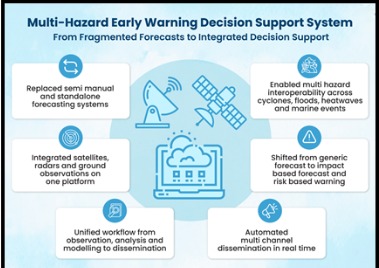
3. MHEW-DSS uses Geographic Information System maps, satellite inputs, radar data, and multiple observational datasets to support real-time weather analysis and warning dissemination.
4. Impact-based and location-specific warnings generated through the system now reach nearly 80 percent of the population across India and neighbouring regions.
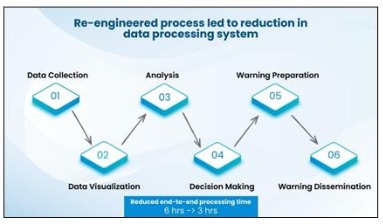
5. Real-time forecasting and impact-based warnings under MHEW-DSS reduced forecast preparation time by 50 percent and improved forecast accuracy by 30 percent.
6. Forecast lead time under the system increased from 5 days to 7 days, giving authorities and communities more time for preparedness and response.
7. The time required to prepare forecasts declined by about 3 hours from the earlier 6-hour cycle after the forecasting workflow was re-engineered.
8. More than 90 percent of weather data collection, quality checks, and integration are now automated under the MHEW-DSS platform.
9. Over 95 percent of numerical weather prediction model inputs are now used in forecasting through the system, improving multi-hazard risk assessment.
10. Improved cyclone forecasting under the system reduced evacuation costs to one third between 1999 and 2024 due to lower cyclone landfall point forecast error in 3 to 5-day forecasts.
11. Accurate forecasts during Cyclone Biparjoy and Cyclone Dana enabled timely evacuation and resulted in zero casualties in Gujarat and Odisha.
12. The system generated around 250 crore rupees in cost savings and removed dependence on foreign vendors, strengthening technological self-reliance in forecasting operations.
13. Mausamgram, launched in January 2024, provides hyper-local forecasts for more than 1.5 lakh pin codes, 5,700 blocks, and over 6.2 lakh villages.
14. More than 200 organisations, including NITI Aayog and National Disaster Management Authority, use the India Meteorological Department’s application for forecasting and warning support.
15. The system received the National Award for e-Governance 2025, the Digital Transformation Summit 2026 Award of Excellence, and The Economic Times GovTech Award 2026.
Must Know Terms :
1.MHEW-DSS
Multi-Hazard Early Warning Decision Support System is the digital forecasting platform launched in January 2024 by the India Meteorological Department under Mission Mausam. It integrates forecasting, warning generation, and dissemination on one platform. The system reduced forecast preparation time by 50 percent, improved accuracy by 30 percent, increased forecast lead time to 7 days, and now reaches nearly 80 percent of the population.
2.Mission Mausam
Mission Mausam is the flagship initiative approved by the Union Cabinet in September 2024 to strengthen India’s weather forecasting and early warning capabilities. It supports better observation networks, modelling, and data assimilation. Under this framework, MHEW-DSS was developed and operationalised. The mission focuses on improving forecast accuracy, spatial resolution, and lead time for cyclones, heatwaves, heavy rainfall, and other extreme events.
3.Mausamgram
Mausamgram is a web-based hyper-local weather forecasting portal launched in January 2024 by the India Meteorological Department under the Ministry of Earth Sciences. It provides location-specific forecasts for more than 1.5 lakh pin codes, 5,700 blocks, and over 6.2 lakh villages. It delivers hourly forecasts up to 36 hours, 3-hourly forecasts up to 5 days, and 6-hourly forecasts up to 10 days.
4.WAFES
Weather Analysis and Forecast Enabling System is the core analytical engine within the MHEW-DSS platform. It helps forecasters analyse large volumes of observational and model data, generate charts, and visualise weather conditions through Geographic Information System-based maps. WAFES replaced the earlier manual forecasting workflow and allows real-time comparison of observations with model outputs, improving warning preparation, forecast clarity, and decision support.
5.CAP
Common Alerting Protocol is one of the dissemination channels used in the MHEW-DSS system for sharing warnings with authorities and the public. It works alongside SMS, emails, Application Programming Interfaces, the Mausam mobile app, and graphical bulletins. Its importance lies in enabling fast, standardised, and machine-readable alert transmission across agencies, platforms, and end users during severe weather and multi-hazard situations.
6.RSMC
Regional Specialized Meteorological Centre is the international role performed by the India Meteorological Department in supporting weather and cyclone services across the North Indian Ocean region. Through this framework, forecasting and advisories are shared with countries such as Bangladesh, Maldives, Myanmar, Oman, Pakistan, Sri Lanka, Thailand, United Arab Emirates, and Yemen. It strengthens India’s regional leadership in early warning cooperation and data support.
Key Takeaways
a) Multi-Hazard Early Warning Decision Support System (MHEW-DSS) enables a full digital shift from fragmented forecasting to an integrated, automated forecasting.
b) Impact-based, location-specific warnings now reach nearly 80% of the population across India and neighbouring regions.
c) Real-time forecasting and impact-based warnings have reduced forecast preparation time by 50% and improved forecast accuracy by 30%.
d) The implementation of MHEW-DSS has reduced evacuation costs to one third from 1999 to 2024 due to a reduction in cyclone landfall point forecast error in the 3-5 days ahead forecast issued by IMD.
MCQ :
1. Multi-Hazard Early Warning Decision Support System (MHEW-DSS) was officially launched in:
A) January 2024
B) September 2024
C) January 2025
D) April 2026
2. MHEW-DSS was developed in-house by the:
A) National Disaster Management Authority
B) India Meteorological Department
C) Ministry of Panchayati Raj
D) National Institute of Ocean Technology
3. The system was developed under:
A) Mission Shakti
B) Mission LiFE
C) Mission Mausam
D) Mission Karmayogi
4. Warnings generated through the system now reach nearly what share of the population across India and neighbouring regions?
A) 60 percent
B) 70 percent
C) 80 percent
D) 90 percent
5. Real-time forecasting and impact-based warnings under MHEW-DSS improved forecast accuracy by:
A) 20 percent
B) 30 percent
C) 40 percent
D) 50 percent
6. Forecast lead time under the system increased from 5 days to:
A) 6 days
B) 7 days
C) 8 days
D) 10 days
7. The time required to prepare forecasts declined by about:
A) 1 hour
B) 2 hours
C) 3 hours
D) 4 hours
8. More than what share of weather data collection, quality checks, and integration is now automated under MHEW-DSS?
A) 70 percent
B) 80 percent
C) 90 percent
D) 95 percent
9. Over what share of numerical weather prediction model inputs are now used in forecasting through the system?
A) 85 percent
B) 90 percent
C) 95 percent
D) 98 percent
10. Improved cyclone forecasting under the system reduced evacuation costs to what proportion between 1999 and 2024?
A) One half
B) One third
C) One fourth
D) One fifth
11. Accurate forecasts during which cyclones enabled timely evacuation and resulted in zero casualties in Gujarat and Odisha?
A) Tauktae and Yaas
B) Biparjoy and Dana
C) Fani and Michaung
D) Mocha and Remal
12. The system generated around how much in cost savings?
A) ₹150 crore
B) ₹200 crore
C) ₹250 crore
D) ₹300 crore
13. Mausamgram provides hyper-local forecasts for more than how many pin codes?
A) 1 lakh
B) 1.2 lakh
C) 1.5 lakh
D) 2 lakh
14. More than how many organisations use the India Meteorological Department’s application for forecasting and warning support?
A) 100
B) 150
C) 200
D) 250
15. Which of the following is one of the recognitions received by the system?
A) National Award for e-Governance 2025
B) Padma Shri for Innovation 2026
C) National Technology Mission Medal 2026
D) Prime Minister’s Innovation Shield 2026




0 comment