Digital Public Infrastructure in India
1. India has built population scale digital public infrastructure for over 1.4 billion people through open, interoperable systems linking identity, payments and data exchange to governance, welfare delivery and inclusion.
2. The JAM trinity combined Jan Dhan accounts, Aadhaar enrolment and mobile connectivity, creating the foundational digital rails that enabled direct benefit transfers, reduced leakages and strengthened service delivery.
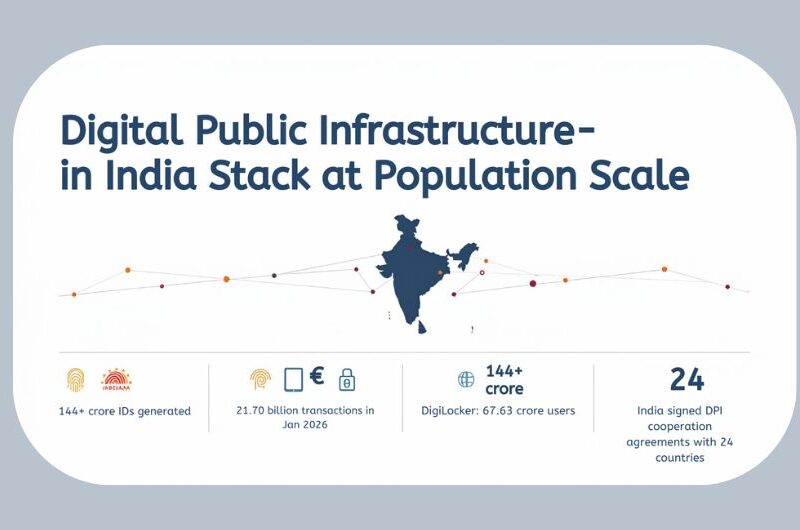
3. As of March 2026, more than 144 crore Aadhaar numbers had been generated, while 2024-25 recorded over 2,707 crore authentication transactions, making identity verification portable, rapid and reliable.
4. Pradhan Mantri Jan Dhan Yojana expanded from 14.72 crore accounts in 2015 to 57.71 crore by March 2026, with deposits rising to ₹2.94 lakh crore nationally.
5. Connectivity deepened digital reach, with 85.5 percent of households owning a smartphone, 125.87 crore wireless subscribers, and 5G available in 99.9 percent districts by December 2025.
6. Unified Payments Interface processed 21.70 billion transactions worth over ₹28.33 lakh crore in January 2026, with 691 banks live, making it India’s dominant retail payments rail.
7. Public Financial Management System strengthened direct benefit transfer architecture, helping save more than ₹4.31 lakh crore between 2015 and March 2024, while cumulative DBT transfers crossed ₹49.09 lakh crore.
8. Open Network for Digital Commerce expanded digital commerce access beyond closed platforms, with over 1.16 lakh retail sellers live across more than 630 cities and towns by December 2025.
9. Government eMarketplace transformed public procurement, processing nearly 3.27 crore orders worth over ₹16.41 lakh crore by November 2025, while enabling broad participation from sellers, service providers, and enterprises.
10. DigiLocker emerged as a large scale digital document wallet, reaching 67.63 crore users by 5 March 2026 and issuing over 950 crore authenticated documents for citizen use.
11. UMANG became a major citizen service platform, recording 10.25 crore user registrations and 723.36 crore transactions by 5 March 2026, while offering more than 2,400 government services.
12. CoWIN became the digital backbone of India’s vaccination programme, managing over 220 crore doses and demonstrating transparent, real time coordination across public and private health systems.
13. eSanjeevani mainstreamed telemedicine in public healthcare, serving 45.42 crore patients and onboarding 2.3 lakh healthcare providers by 5 March 2026, especially improving specialist access in underserved regions.
14. India signed agreements with 24 countries on India Stack and digital public infrastructure by February 2026, while UPI went live in eight countries, expanding global digital cooperation.
15. During its G20 Presidency, India positioned digital public infrastructure as a development accelerator, launched the Global DPI Repository, and reinforced its role as a global reference point.
Must Know Terms :
1. Interoperability
Interoperability allowed India’s digital platforms to function across shared public rails instead of isolated systems. It connected identity, payments, documents and service delivery through common standards. This made Aadhaar authentication usable in banking, welfare and governance, enabled UPI across banks, and supported document exchange through DigiLocker and service access through UMANG. It became the operational logic of India Stack.
2.PFMS
PFMS stands for Public Financial Management System. It is a web based platform for tracking government fund flow, payments, accounting and reporting. It was mandated for Direct Benefit Transfer in December 2014. Between 2015 and March 2024, savings exceeded ₹4.31 lakh crore through removal of fake and duplicate beneficiaries. By January 2026, cumulative DBT transfers through this system crossed ₹49.09 lakh crore.
3.ONDC
ONDC stands for Open Network for Digital Commerce. It was launched in 2022 to create an open digital commerce network instead of one closed marketplace. It links buyers and sellers through interoperable platforms. By December 2025, more than 1.16 lakh retail sellers were live on the network. Its operations had spread across more than 630 cities and towns, expanding digital market access for smaller businesses.
4.MOSIP
MOSIP stands for Modular Open Source Identity Platform. It is an India developed open source framework for countries building sovereign digital identity systems. It offers configurable identity architecture instead of a locked proprietary model. It supports national registration, authentication and identity management functions. More than 25 countries are adopting or exploring MOSIP for their identity programmes, making it a major export of India’s digital governance capability.
5.APISetu
API Setu is India’s Open API Platform initiated by the Ministry of Electronics and Information Technology in March 2020. It enables secure and standardised sharing of government data and services through application programming interfaces. By March 2026, the platform hosted 8,036 APIs. It had 6,592 consumers, 2,559 publishers and 10,530 organisations onboard, strengthening interoperability across public and private digital ecosystems.
6.UMANG
UMANG stands for Unified Mobile Application for New age Governance. It was launched in 2017 as a single window platform for central, state and local government services through mobile and web access. It includes pension, scholarship, utility, passport, licence, Aadhaar and EPFO related services. By 5 March 2026, it recorded 10.25 crore registrations, 723.36 crore transactions and offered more than 2,400 services.
Key Takeaways
• India has signed DPI cooperation agreements with 24 countries.
• UPI is now operational in 8 countries enabling cross border payments.
• India Stack Global facilitates DPI adoption by partner nations.
• India contributed highest solutions to the Global DPI Repository.
MCQ
1. India’s digital public infrastructure is fundamentally built on linking which three core layers?
A) Identity, payments and data exchange
B) Roads, ports and airports
C) Agriculture, trade and taxation
D) Courts, police and defence
2. The JAM trinity consists of:
A) Jan Suraksha, Aadhaar and Mobile banking
B) Jan Dhan, Aadhaar and Mobile connectivity
C) Judicial access, Aadhaar and Markets
D) Jan Dhan, API Setu and Mobile wallets
3. As of March 2026, the number of Aadhaar numbers generated had crossed:
A) 124 crore
B) 134 crore
C) 144 crore
D) 154 crore
4. During 2024–25, Aadhaar authentication transactions were recorded at more than:
A) 1,707 crore
B) 2,107 crore
C) 2,407 crore
D) 2,707 crore
5. Pradhan Mantri Jan Dhan Yojana accounts increased from 14.72 crore in 2015 to:
A) 47.71 crore
B) 52.71 crore
C) 57.71 crore
D) 62.71 crore
6. By March 2026, deposits in Jan Dhan accounts had risen to:
A) ₹1.94 lakh crore
B) ₹2.94 lakh crore
C) ₹3.94 lakh crore
D) ₹4.94 lakh crore
7. By December 2025, smartphone ownership had reached at least one device in:
A) 75.5 percent of households
B) 80.5 percent of households
C) 85.5 percent of households
D) 90.5 percent of households
8. UPI processed how many transactions in January 2026?
A) 19.70 billion
B) 20.70 billion
C) 21.70 billion
D) 22.70 billion
9. The value of UPI transactions in January 2026 was:
A) over ₹18.33 lakh crore
B) over ₹22.33 lakh crore
C) over ₹25.33 lakh crore
D) over ₹28.33 lakh crore
10. Public Financial Management System helped generate savings of more than how much between 2015 and March 2024?
A) ₹2.31 lakh crore
B) ₹3.31 lakh crore
C) ₹4.31 lakh crore
D) ₹5.31 lakh crore
11. By December 2025, ONDC had more than how many retail sellers live on the network?
A) 1.16 lakh
B) 2.16 lakh
C) 3.16 lakh
D) 4.16 lakh
12. As of 5 March 2026, DigiLocker had reached:
A) 57.63 crore users
B) 62.63 crore users
C) 67.63 crore users
D) 72.63 crore users
13. UMANG had recorded how many transactions by 5 March 2026?
A) 523.36 crore
B) 623.36 crore
C) 723.36 crore
D) 823.36 crore
14. India had signed agreements with how many countries on India Stack and digital public infrastructure by February 2026?
A) 18
B) 20
C) 22
D) 24
15. More than how many countries are adopting or exploring MOSIP for identity programmes?
A) 15
B) 20
C) 25
D) 30



0 comment