Best UPSC and MPPSC IAS Coaching Classes in Gwalior

Sanchar Saathi: Citizen-Centric Framework for Telecom Security

Sanchar Saathi: Citizen-Centric Framework for Telecom Security     Sanchar Saathi Mobile Application: Strengthening Telecom Security   The Sanchar Saathi mobile application was introduced in January 2025 to enhance transparency, safety, and citizen control within India’s expanding telecom ecosystem. With mobile phones central to banking, governance, education, healthcare, and digital services, the platform addresses growing risks related to identity misuse, device theft, and telecom-enabled fraud.   Rationale and Context   India’s telecom network serves over a billion subscribers and functions as critical digital infrastructure. Rising incidents of cyber fraud, forged identities, and deceptive communications created the need for a citizen-facing preventive mechanism. Sanchar Saathi responds by enabling users to verify, report, and protect their telecom identities directly.   Core Design Principles   The application follows a voluntary, consent-driven model. It activates only after user registration and allows full control over activation, deactivation, or deletion. Privacy protection is embedded by design, ensuring security enhancement without compromising personal data autonomy.   Measurable Outcomes   Since launch, the platform has recorded widespread adoption and tangible results. Millions of mobile devices reported as lost or stolen have been blocked, unauthorised connections disconnected, and fraudulent identifiers removed. These interventions have significantly reduced misuse of telecom resources and associated financial risks.   Financial Fraud Risk Indicator   An important component is the Financial Fraud Risk Indicator, which categorises mobile numbers based on their likelihood of financial misuse. This risk-based classification assists financial institutions and digital payment platforms in applying enhanced safeguards for high-risk numbers.   Citizen-Centric Functionalities   The application integrates multiple services on a single interface. Users can report suspicious calls, messages, or online communications, track and block lost devices, verify handset authenticity, identify unauthorised connections issued in their name, and report international calls disguised as domestic numbers.   Public Participation and Transparency   Citizen reporting plays a central role in enforcement actions against fraudulent telecom activities. Public dashboards display actions taken, reinforcing transparency, accountability, and trust in the system.   Legal and Privacy Safeguards   The platform operates within India’s cyber and data protection framework. It collects only essential information required for service delivery, avoids commercial profiling, and restricts data sharing strictly to lawful requirements, ensuring protection against unauthorised access or misuse.   Conclusion   Sanchar Saathi represents a comprehensive approach to telecom security by combining technology, legal safeguards, and citizen participation. It strengthens trust in digital communications while reducing fraud, identity misuse, and device-related crimes across the country.     MCQ: 1.The primary objective of the Sanchar Saathi mobile application is to: A. Expand mobile network coverage in rural regions B. Strengthen telecom security and protect digital identity C. Regulate mobile handset prices D. Promote domestic smartphone manufacturing 2.The Sanchar Saathi application was introduced in: A. 2023 B. 2024 C. 2025 D. 2026 3.The operational model of the Sanchar Saathi application is best described as: A. Mandatory and centrally controlled B. Subscription-based commercial service C. Voluntary and consent-driven D. Automated background monitoring system 4.Which of the following best explains the need for Sanchar Saathi? A. Declining telecom penetration B. Rising cyber fraud and identity misuse C. Shortage of telecom infrastructure D. Increasing handset imports 5.Activation of the Sanchar Saathi application occurs: A. Automatically on device startup B. After verification by service providers C. Only after user registration and consent D. Through police authorisation 6.One major outcome of Sanchar Saathi has been: A. Reduction in international roaming charges B. Blocking of lost or stolen mobile devices C. Expansion of broadband services D. Increase in handset resale value 7.The Financial Fraud Risk Indicator primarily: A. Calculates telecom revenue loss B. Predicts handset lifespan C. Classifies mobile numbers based on fraud risk D. Tracks user spending behaviour 8.The Financial Fraud Risk Indicator assists mainly: A. Device manufacturers B. Telecom equipment vendors C. Financial institutions and payment platforms D. Internet service resellers 9.Which activity can users perform through Sanchar Saathi? A. Upgrade mobile operating systems B. Report suspicious calls and messages C. Purchase insurance for devices D. Change telecom tariff plans 10.The application helps users identify: A. Network congestion zones B. Unauthorised mobile connections in their name C. International data tariffs D. Signal strength variations 11.Reporting international calls disguised as domestic numbers helps address: A. Spectrum allocation issues B. Illegal telecom setups C. Mobile manufacturing defects D. Data speed limitations 12.Citizen participation in Sanchar Saathi mainly supports: A. Market competition B. Enforcement against fraudulent telecom activity C. Reduction of handset prices D. Network infrastructure expansion 13.Transparency in Sanchar Saathi is ensured through: A. Automated alerts only B. Periodic media briefings C. Public dashboards displaying actions taken D. Confidential internal audits 14.The data collection approach of Sanchar Saathi is characterised by: A. Extensive profiling for analytics B. Collection of maximum user data C. Minimal data collection for legitimate purposes D. Commercial sharing of user information 15.The broader significance of Sanchar Saathi lies in its ability to: A. Replace telecom service providers B. Centralise all digital services C. Strengthen trust in digital communications D. Promote smartphone exports  

More Details
DHRUV64: India’s First 1.0 GHz, 64-bit dual-core Microprocessor

DHRUV64: India’s First 1.0 GHz, 64-bit dual-core Microprocessor         Overview of DHRUV64 Microprocessor   India has achieved an important milestone in its semiconductor journey with the development of DHRUV64, the country’s first fully indigenous 1.0 GHz, 64-bit dual-core microprocessor. Developed by the Centre for Development of Advanced Computing under the Microprocessor Development Programme, DHRUV64 provides India with a reliable domestic processor platform capable of supporting both strategic and commercial requirements. It marks a clear advancement toward technological self-reliance in advanced chip design.     Technical Characteristics and Use Cases   DHRUV64 is built on modern processor architecture that offers higher efficiency, improved multitasking capability and enhanced operational reliability. Its design enables smooth integration with a wide range of external hardware systems. This flexibility makes it suitable for deployment in telecommunications infrastructure, automotive electronics, industrial automation, consumer devices and Internet-of-Things applications, aligning domestic processor capability with contemporary global technology standards.     Strategic Importance for India   The development of DHRUV64 strengthens India’s indigenous semiconductor ecosystem and supports national digital infrastructure security. India accounts for a significant share of global microprocessor consumption, and the availability of a domestically designed processor reduces long-term dependence on external suppliers. DHRUV64 builds upon earlier indigenous processor initiatives such as SHAKTI, AJIT, VIKRAM and THEJAS, collectively forming the foundation of a self-sustaining national processor ecosystem.     Contribution to Research and Innovation   DHRUV64 provides startups, academic institutions and industry with a cost-effective platform to design, test and scale computing systems using indigenous technology. It enables experimentation with new system architectures without reliance on foreign intellectual property. This supports innovation, strengthens research capabilities and helps expand the pipeline of skilled semiconductor professionals within the country.     Role of Open Architecture and RISC-V   The processor has been developed within the Digital India RISC-V framework, which promotes open instruction-set architecture. RISC-V eliminates licensing costs and encourages collaborative development through shared standards and tools. This approach supports the creation of a comprehensive portfolio of indigenous processors and facilitates cooperation across research organisations, startups and industry, accelerating ecosystem growth.     Institutional and Programme Support   India’s progress in processor development is backed by coordinated institutional support and national programmes focused on policy guidance, funding and long-term planning. These initiatives strengthen chip design capability, provide access to fabrication infrastructure, encourage large-scale investment and build human resource capacity. Together, they integrate research, innovation and industry participation into a sustainable semiconductor ecosystem.     Overall Significance   The rollout of DHRUV64 demonstrates India’s growing ability to design, develop and prototype advanced microprocessors using domestic expertise and resources. The transition from earlier processor designs to DHRUV64, along with the development of future processors, reflects a structured and confident pathway toward technological self-reliance. By combining open architecture, institutional backing and a strong talent base, India is steadily strengthening its position in advanced semiconductor technologies.   MCQ: DHRUV64 is best described as which one of the following? (a) A domestically assembled foreign-designed processor (b) A fully indigenous 1.0 GHz, 64-bit dual-core microprocessor (c) A graphics processing unit for consumer electronics (d) A prototype chip limited to academic research only   DHRUV64 was developed under which institutional arrangement? (a) A private industry consortium (b) A joint foreign–Indian venture (c) A defence-only classified programme (d) A national programme led by a public research organisation   Which organisation played a central role in the design and development of DHRUV64? (a) Semiconductor Lab, Mohali (b) Indian Space Research Organisation (c) Centre for Development of Advanced Computing (d) National Informatics Centre   The primary objective behind developing DHRUV64 is to: (a) Compete in low-cost consumer chip markets (b) Achieve technological self-reliance in advanced processor design (c) Replace all imported electronics immediately (d) Focus exclusively on space missions   Which of the following sectors can directly benefit from the deployment of DHRUV64? (a) Only defence manufacturing (b) Telecommunications, automotive and industrial systems (c) Agriculture extension services alone (d) Banking and insurance software platforms only   One key architectural advantage of DHRUV64 is its ability to: (a) Eliminate the need for external hardware interfaces (b) Operate without an operating system (c) Integrate smoothly with diverse hardware systems (d) Replace high-end supercomputers   The strategic significance of DHRUV64 mainly lies in: (a) Increasing software exports (b) Reducing dependence on imported microprocessors (c) Expanding consumer electronics imports (d) Replacing traditional manufacturing industries   DHRUV64 builds upon earlier indigenous processor initiatives such as: (a) PARAM, VEGA and AGNI (b) SHAKTI, AJIT, VIKRAM and THEJAS (c) BHARAT, ARJUN and NAG (d) GAGAN, IRNSS and NAVIC   Which group is most directly enabled by DHRUV64 for low-cost experimentation and innovation? (a) Only large multinational corporations (b) Foreign semiconductor manufacturers (c) Startups, academia and domestic industry (d) Financial institutions and service providers   The development of DHRUV64 particularly strengthens which aspect of the national ecosystem? (a) Chip-design skills and research capacity (b) Textile and garment manufacturing (c) Mining and raw material extraction (d) Traditional handicraft industries   DHRUV64 has been developed within a framework that promotes which type of architecture? (a) Proprietary closed-source instruction sets (b) Licensed architectures with high royalty costs (c) Open instruction-set architecture (d) Military-restricted architectures only   A major advantage of using open architecture for processor development is: (a) Complete elimination of fabrication costs (b) Freedom from licensing fees and wider collaboration (c) Automatic dominance in global chip markets (d) Guaranteed commercial success   Institutional and programme support for DHRUV64 primarily contributes to: (a) Short-term import substitution only (b) Integration of research, industry and skill development (c) Expansion of non-electronic sectors (d) Reduction of higher education enrolment   The progression from earlier processors to DHRUV64 indicates: (a) Fragmented and uncoordinated development efforts (b) Dependence on external technology providers (c) A structured and long-term technological roadmap (d) Focus on experimental prototypes without deployment   Overall, DHRUV64 reflects India’s growing capability to: (a) Manufacture consumer gadgets at scale (b) Design, develop and prototype advanced microprocessors domestically (c) Eliminate the need for global semiconductor cooperation (d) Shift entirely away from digital

More Details

India’s Solar Momentum

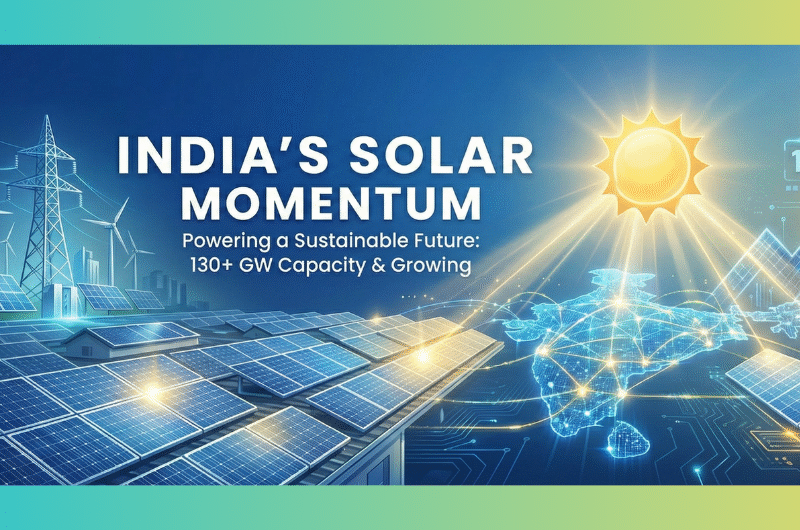
India’s Solar Momentum     India’s rapid solar expansion has positioned the country as a global clean-energy leader. Solar capacity has grown from 3 GW (2014) to 129 GW (2025), helping push non-fossil power beyond 50% of India’s total installed electricity capacity. Large-scale deployment, strong policy architecture, and international cooperation continue to drive this transformation.   India’s Solar Growth Story Solar capacity reached 129 GW in 2025, contributing significantly to India’s total 259 GW non-fossil capacity. Rooftop solar adoption under PM Surya Ghar has crossed 9 lakh households, adding 7 GW and releasing subsidies worth ₹13,464.6 crore. India has set up 55 solar parks with nearly 40 GW sanctioned across 13 states. Solar installations have expanded more than 40-fold in a decade, making solar the largest contributor to India’s renewable mix.   Global Standing According to IRENA 2025 data, India ranks: 3rd in solar energy 4th in wind energy 4th in overall renewable energy capacity India’s leadership has reinforced its influence in global clean-energy markets and value chains.   Policy Framework: Panchamrit Roadmap India’s commitments from COP26 (Glasgow, 2021) guide the current energy transition: 500 GW non-fossil capacity by 2030 50% electricity capacity from non-fossil sources by 2030 Reduce emissions by 1 billion tonnes by 2030 45% reduction in carbon intensity by 2030 Net-zero emissions by 2070 These targets anchor India’s renewable energy strategy and investment priorities.   Key Government Initiatives Driving Solar Expansion PM Surya Ghar Launched in Feb 2024 with an outlay of ₹75,021 crore. Aims for 1 crore rooftop-solar households providing up to 300 units of free electricity monthly. Strong progress with nearly 24 lakh installations already completed. National Solar Mission (2010) Flagship programme enabling exponential growth in solar deployment. Current portfolio includes: 72 GW ground-mounted plants 42 GW rooftop solar 32 GW hybrid projects 45 GW off-grid systems PLI Scheme for High-Efficiency Solar PV Modules Total outlay: ₹24,000 crore. Targets Giga-scale domestic manufacturing. Has attracted ₹52,900 crore investment and generated 44,400 jobs (as of Sep 2025). Encourages local value-addition and technological upgrading. PM-KUSUM Scheme Promotes solarisation in agriculture. Achievements (as of Oct 2025): 9 lakh+ standalone pumps 10,535 solarized grid-connected pumps 74 lakh+ Feeder-Level Solarization pumps Extended till March 2026, with higher subsidies for farmers in remote areas. Solar Parks and Ultra-Mega Projects 55 approved parks, nearly 40 GW 14,922 MW already installed; remainder under development. Scheme extended till March 2029.   India’s Leadership in Global Solar Diplomacy International Solar Alliance (ISA) India co-founded ISA with France; HQ in Gurugram. ISA’s 8th Assembly (New Delhi, 2025) hosted 550+ delegates from 125+ countries. Focus areas include: Catalytic Finance Hub Global Capability & Digitisation Centre Regional & Country Engagement Technology Roadmap & Policy Promotes solar deployment, finance access, and inclusive energy transition. OSOWOG (One Sun, One World, One Grid) Vision for a global interconnected renewable energy grid. Enables solar-rich regions to supply clean power across borders. Global Recognition The International Energy Agency calls India “a major driving force in global energy trends.” G20 New Delhi Leaders’ Declaration recognised India’s LiFE vision and climate leadership.   Overall Significance India’s solar momentum reflects a successful blend of policy direction, technology adoption, manufacturing expansion, and international cooperation. Solar energy now anchors India’s long-term strategy for: Energy security Low-carbon economic growth Domestic manufacturing strength Climate resilience Inclusive development (farmers, women, villages, small islands) India’s progress demonstrates how renewable energy can become both a national development tool and a global climate solution.         India’s Solar Momentum – Summary for Learners   India’s solar expansion has transformed the national energy landscape. Installed solar capacity has risen from 3 GW in 2014 to 129 GW in 2025, pushing non-fossil capacity beyond 50% of India’s total electricity base. Strong policy support, domestic manufacturing, rooftop schemes, agricultural solarisation, and global solar cooperation together drive this clean-energy shift.   India’s solar capacity touched 129 GW in 2025, significantly contributing to the 259 GW non-fossil capacity, which now accounts for more than half of India’s total installed electricity capacity.   Under PM Surya Ghar, 23.9 lakh households have adopted rooftop solar, contributing 7 GW of capacity and receiving ₹13,464.6 crore in subsidies, demonstrating rapid residential-level clean-energy deployment.   India has approved 55 solar parks across 13 states with nearly 40 GW sanctioned capacity, providing shared infrastructure for large-scale solar power generation.   Over the last decade, solar capacity has grown more than 40-fold, making solar the largest contributor among all renewable energy sources in India.   India ranks 3rd globally in solar energy capacity, 4th in wind energy, and 4th in total renewable energy capacity according to IRENA’s 2025 statistics.   The Panchamrit commitments guide India’s energy transition: 500 GW non-fossil capacity by 2030, 50% installed capacity from non-fossil sources, and net-zero emissions by 2070.   The National Solar Mission has facilitated exponential growth in solar power through ground-mounted plants (98.72 GW), rooftop systems (22.42 GW), hybrid projects (3.32 GW), and off-grid systems (5.45 GW).   The PLI Scheme for high-efficiency solar PV modules, with an outlay of ₹24,000 crore, has attracted ₹52,900 crore investment and created more than 44,000 jobs.   PM-KUSUM has enabled agricultural solarisation, installing over 9 lakh standalone solar pumps and solarising thousands of grid-connected pumps, benefiting farmers across remote regions.   Solar park development has already installed 14,922 MW of operational capacity, with the remainder under implementation and the scheme extended till March 2029.   India leads global solar diplomacy through the International Solar Alliance (ISA), hosting its 8th Assembly with delegates from 125+ countries and advancing global solar adoption.   The OSOWOG vision aims to interconnect global renewable energy grids, allowing solar-rich regions to supply clean power across borders.   India’s climate leadership has been acknowledged by the G20 and IEA, recognising its pivotal role in shaping global energy trends and promoting sustainable lifestyles.   Rapid solar growth strengthens India’s energy security, reduces import dependence, and promotes indigenous manufacturing capability.   Solar energy serves as a catalyst for sustainable economic growth, inclusive development, job creation, and long-term climate resilience.

More Details

Electronics Development Fund

Electronics Development Fund   The Electronics Development Fund (EDF) is a flagship initiative launched by the Government of India on 15 February 2016 to strengthen India’s innovation ecosystem in electronics, nano-electronics, IT and emerging technologies. It was created under MeitY as a Fund of Funds to support early-stage startups through professionally managed venture and angel funds. EDF has become a key pillar of India’s Electronics System Design and Manufacturing (ESDM) strategy.   India’s electronics sector has grown rapidly in recent years due to policy reforms, industrial expansion and rising domestic demand. The EDF was conceptualised to accelerate this momentum by increasing risk-capital availability for high-technology entrepreneurs. By nurturing innovation at the seed and growth stage, EDF aims to reduce import dependence and enhance India’s capabilities in indigenous design and IP generation.   EDF invests in “Daughter Funds” such as Category I and II SEBI-registered Alternative Investment Funds (AIFs). These funds then provide capital to startups working on frontier technologies. This indirect investment model allows EDF to leverage professional fund management, attract private investors and expand overall investment in the sector.   The Ministry of Electronics and Information Technology (MeitY) is the anchor investor, while Canara Bank acts as Trustee and Sponsor. The Investment Manager is Canbank Venture Capital Funds Ltd. (CVCFL), responsible for evaluating Daughter Funds, conducting due diligence and ensuring alignment with EDF objectives.   The strategic goals of EDF include promoting innovation, creating a national pool of intellectual property, enhancing India’s ESDM design capabilities and supporting technology development driven by domestic needs. EDF also encourages acquisition of critical foreign technologies to reduce high-volume imports, strengthening national self-reliance.   EDF’s operational model is flexible. It participates in Daughter Funds on a non-exclusive basis, usually as a minority investor to stimulate greater private participation. It gives autonomy to fund managers to raise corpus, select investments and monitor portfolio companies. This ensures market-responsive decision-making.   As on 30 September 2025, EDF has invested ₹257.77 crore in eight Daughter Funds. These funds have further invested ₹1,335.77 crore across 128 startups nationwide. The supported ventures work in advanced domains such as IoT, robotics, drones, health technology, cyber security, AI and machine learning, contributing significantly to India’s tech innovation landscape.   The supported startups have created more than 23,600 high-technology jobs. A total of 368 Intellectual Properties (IPs) have been created or acquired, strengthening India’s innovation base. Daughter Funds have exited from 37 investments, and EDF has received cumulative returns of ₹173.88 crore, demonstrating financial viability alongside developmental impact.   Major Daughter Funds include Unicorn India Ventures, Aaruha Technology Fund, Endiya Seed Co-creation Fund, Karsemven Fund, pi Ventures, YourNest India VC Fund II, Ventureast Proactive Fund II and Exfinity Technology Fund. Their investments span early-stage product development, deep technology, and scalable digital solutions.   EDF contributes to national strategic capacity-building by supporting startups working on indigenous products relevant to defence, communication, healthcare and automation. Its efforts align with initiatives such as Make in India, Digital India and Atmanirbhar Bharat.   Overall, the Electronics Development Fund has emerged as a crucial enabler of India’s transition from an electronics-importing nation to a design-led manufacturing and innovation hub. With strong institutional design and measurable outcomes, EDF reinforces India’s long-term vision of technological self-reliance and global competitiveness.     MCQ: With reference to the Electronics Development Fund (EDF), consider the following statements: It was launched to strengthen innovation in electronics, nano-electronics and IT. It directly provides loans to startups developing new technologies. Which of the statements given above is/are correct? (a) I only (b) II only (c) Both I and II (d) Neither I nor II   EDF operates primarily as: (a) A direct lending agency under MeitY (b) A Fund of Funds investing in Daughter Funds (c) A public sector manufacturing enterprise (d) A sovereign wealth fund   The anchor investor of the Electronics Development Fund is: (a) NITI Aayog (b) Ministry of Electronics and IT (MeitY) (c) Reserve Bank of India (d) SIDBI   Under EDF, Daughter Funds must be registered as: (a) SEBI Category I or Category II AIFs (b) NBFC-MFIs (c) Public Trusts (d) FDI-approved financial entities   The trustee and settlor/sponsor of the EDF is: (a) State Bank of India (b) NABARD (c) Canara Bank (d) EXIM Bank   The investment manager for EDF is: (a) SIDBI Venture Capital Ltd. (b) Canbank Venture Capital Funds Ltd. (c) NITI Aayog Innovation Fund (d) Industrial Finance Corporation of India   One of the key goals of EDF is: (a) Increasing export subsidies for electronics (b) Building a strong national pool of intellectual property (c) Promoting agricultural mechanisation (d) Regulating foreign venture capital inflows   EDF generally maintains minority participation in Daughter Funds because: (a) It aims to encourage private co-investment (b) SEBI prohibits government majority ownership (c) Majority ownership reduces tax benefits (d) It lacks the mandate to invest higher equity   Which of the following sectors have received EDF-supported startup funding? Robotics Drones Cyber Security Power Transmission Lines Select the correct answer: (a) 1 and 2 only (b) 1, 2 and 3 only (c) 2, 3 and 4 only (d) 1, 2, 3 and 4   As per the report, total EDF investment in Daughter Funds is approximately: (a) ₹100 crore (b) ₹257.77 crore (c) ₹500 crore (d) ₹1,335 crore   The total number of startups funded through Daughter Funds under EDF is: (a) 37 (b) 128 (c) 256 (d) 368   The cumulative number of Intellectual Properties created or acquired by EDF-supported startups is: (a) 23 (b) 128 (c) 368 (d) 1,335   Which of the following is NOT one of the Daughter Funds supported by EDF? (a) pi Ventures Fund-1 (b) Unicorn India Ventures (c) Endiya Seed Co-creation Fund (d) National Investment and Infrastructure Fund   The cumulative returns received by EDF from exits and partial exits are closest to: (a) ₹25 crore (b) ₹75 crore (c) ₹174 crore (d) ₹500 crore   Which of the following best describes EDF’s strategic vision? (a) Promote low-technology mass manufacturing in India (b) Strengthen

More Details

 INDIA’S SOLAR ENERGY REVOLUTION AND CLEAN POWER TRANSITION

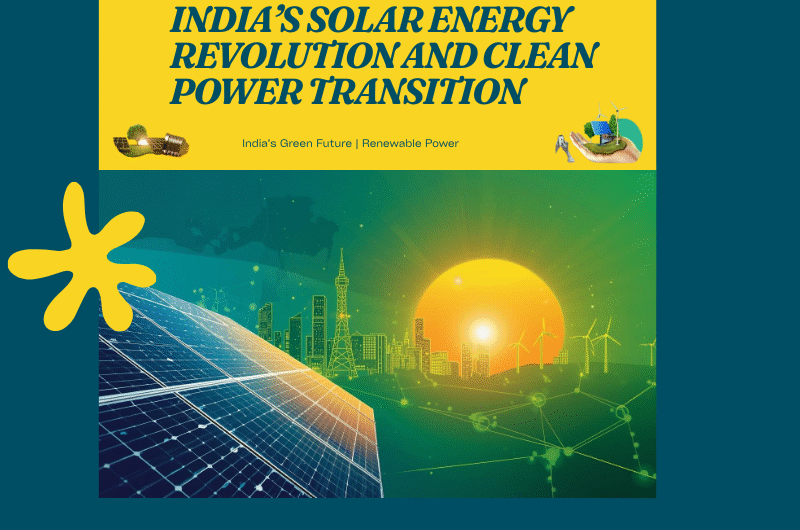
INDIA’S SOLAR ENERGY REVOLUTION AND CLEAN POWER TRANSITION   India’s solar transformation is one of the most rapid energy transitions witnessed in the world. From merely 3 GW in 2014, installed solar capacity has grown to about 129 GW by 2025, marking more than a forty-fold increase. Solar energy has now become the largest contributor to India’s renewable power sector, overtaking wind and hydropower in total installations.   India has also crossed a historic milestone by sourcing over half of its electricity capacity from non-fossil fuel sources. Out of nearly 500 GW total installed capacity, more than 259 GW now comes from solar, wind, hydro, nuclear and biomass, indicating a major structural shift away from fossil fuel dominance in electricity generation.   The direction of India’s clean energy expansion is guided by the Panchamrit commitments announced at COP26 in 2021. These include achieving 500 GW of non-fossil capacity, ensuring 50% electricity from clean sources by 2030, reducing carbon emissions by one billion tonnes, lowering emission intensity by 45%, and achieving Net Zero by 2070.   Household-level solar adoption has accelerated through the PM Surya Ghar Muft Bijli Yojana launched in February 2024. The scheme targets one crore households and offers up to 300 free electricity units monthly, reducing energy costs while promoting decentralised power generation.   Agriculture is being integrated into the solar revolution through the PM-KUSUM scheme. Solar-powered pumps and grid-connected systems are helping farmers cut diesel use, lower irrigation costs and generate income by selling surplus electricity to power utilities.   To build industrial strength, the Production Linked Incentive scheme encourages domestic manufacturing of solar panels and components. This supports employment generation, industrial growth and reduction of import dependence, strengthening India’s energy security.   India has emerged as a leader in international solar cooperation through the International Solar Alliance headquartered in Gurugram. With more than 125 participating countries, the alliance supports finance mobilisation, technology transfer and capacity building for solar projects worldwide.   The One Sun, One World, One Grid vision promotes international grid connectivity, enabling countries to share solar power across borders. The idea presents a long-term solution for global energy sustainability and climate security.   Globally, India ranks among the top nations in renewable deployment, currently placed third in solar power capacity and fourth in overall renewable energy capacity. This reflects growing international recognition of India’s clean energy leadership.   Overall, India’s solar momentum represents a strategic combination of strong policies, technological adoption, domestic manufacturing and global diplomacy, establishing solar power as a backbone of sustainable development and climate action. MCQ: 1. With reference to India’s solar energy growth, consider the following statements: 1. India’s solar capacity increased more than forty times between 2014 and 2025. 2. Solar energy is now the largest contributor among renewable sources in India. 3. Hydropower contributes more than solar to the renewable mix at present. Which of the statements given above is/are correct? (a) 1 and 2 only (b) 2 and 3 only (c) 1 only (d) 1, 2 and 3 2. India crossed a major energy milestone when: (a) Nuclear energy overtook coal (b) Non-fossil power exceeded 50% of installed capacity (c) Renewable energy exports began (d) Solar energy became cheaper than hydropower 3. India’s total installed electricity capacity is closest to: (a) 300 GW (b) 400 GW (c) 500 GW (d) 600 GW 4. Non-fossil energy in India currently includes: (a) Only solar and wind (b) Solar, wind and biomass only (c) Solar, wind, hydro, nuclear and biomass (d) Only solar and nuclear 5. The Panchamrit commitments were announced at: (a) Rio+20 (b) COP21 (c) COP26 (d) COP28 6. Which of the following is NOT part of the Panchamrit framework? (a) 500 GW non-fossil capacity by 2030 (b) Carbon neutrality by 2050 (c) Net Zero emissions by 2070 (d) 45% reduction in emission intensity 7. The target of reducing total projected carbon emissions by 1 billion tonnes is to be achieved by: (a) 2025 (b) 2030 (c) 2040 (d) 2070 8. The PM Surya Ghar Muft Bijli Yojana mainly focuses on: (a) Solar farms in deserts (b) Rooftop solar for households (c) Wind-solar hybrid plants (d) Solar manufacturing parks 9. Under PM Surya Ghar Yojana, the maximum free electricity offered per month is: (a) 100 units (b) 200 units (c) 300 units (d) 400 units 10. PM-KUSUM scheme mainly integrates solar energy with: (a) Industry (b) Urban housing (c) Agriculture (d) Transport 11. A key benefit of PM-KUSUM for farmers is: (a) Free fertilizers (b) Income by selling surplus power (c) Free tractors (d) Export subsidy 12. The Production Linked Incentive scheme in the solar sector aims to: (a) Promote solar exports (b) Strengthen domestic manufacturing (c) Eliminate private investment (d) Focus only on research institutes 13. The official headquarters of the International Solar Alliance is located at: (a) New Delhi (b) Mumbai (c) Gurugram (d) Jaipur 14. India’s current global position in solar power capacity is: (a) First (b) Second (c) Third (d) Fourth 15. The concept of “One Sun, One World, One Grid” emphasises: (a) Solar panel standardisation (b) Cross-border renewable electricity sharing (c) Solar pricing regulation (d) Nuclear-solar integration

More Details

GSAT-7R Satellite: A New Era in India’s Naval Communication Power

GSAT-7R Satellite: A New Era in India’s Naval Communication Power Introduction GSAT-7R is India’s latest and most advanced communication satellite dedicated to the Indian Navy. Launched by the Indian Space Research Organisation (ISRO), it significantly strengthens maritime communication and operational capabilities across the vast Indian Ocean Region. This satellite marks a major milestone in India’s mission to build a secure, indigenous, and technologically superior defence infrastructure. By enhancing encrypted communication support for ships, submarines, aircraft, and naval bases, GSAT-7R elevates India into a new era of maritime security and strategic readiness.   Development and Launch GSAT-7R is a successor to earlier communication satellites in the GSAT-7 series that serve India’s defence forces. Weighing around 4400 kilograms, it is one of the heaviest military communication satellites ever launched by India. The satellite was placed into Geosynchronous Transfer Orbit using the LVM-3 heavy-lift launcher, ISRO’s most powerful rocket. With an estimated operational life of about 12 to 15 years, GSAT-7R will ensure long-term support to naval operations. The mission highlights India’s growing technological capabilities in space-based defence assets and reflects the progress under the Aatmanirbhar Bharat initiative.   Technical Capabilities GSAT-7R is equipped with advanced multi-band communication systems that support reliable and secure exchange of voice, data, and real-time video. The satellite connects ships to submarines, aircraft to naval headquarters, and different command-and-control centres to each other without disruption. It enhances network-centric warfare capabilities by providing battlefield awareness and faster response chains. A remarkable feature of GSAT-7R is the extensive use of indigenously developed components and improved propulsion and antenna systems. The satellite ensures encrypted, interference-free communication for defence forces even in hostile conditions. By supporting modern maritime operations like anti-submarine warfare, surveillance missions, and maritime reconnaissance, GSAT-7R becomes a core pillar of naval digital transformation.   Strategic Importance The Indian Ocean Region holds immense strategic value for India’s economic security and geopolitical influence. Nearly all energy and trade routes pass through this region. Keeping them secure from foreign aggression, piracy, terrorism, or underwater threats requires fast communication and perfect coordination among naval assets. GSAT-7R meets this exact requirement by ensuring continuous and confidential connectivity over long distances, whether ships are operating close to the coast or deep in the ocean. As global powers increase maritime presence in the Indian Ocean, India’s enhanced space-based communication strengthens its surveillance, deterrence, and power projection capability. Faster decision-making and stronger command structures will directly contribute to national security and stability in the wider Indo-Pacific region.   GSAT-7 Satellite Series for the Armed Forces India is steadily expanding a dedicated defence satellite network. GSAT-7 (Rukmini), launched in 2013, was the first military satellite exclusively for the Indian Navy. GSAT-7A was launched for the Indian Air Force and Army to support UAV and air-ground communication. GSAT-7R, as the newest addition, takes the Indian Navy’s communication power to the next level with upgraded payloads and enhanced coverage.   Strengthening Defence and Self-Reliance GSAT-7R showcases India’s emergence as a modern defence power capable of independently developing space-based strategic systems. It reduces reliance on external technologies and supports the vision of a secure, resilient, and technologically advanced naval force. The satellite also empowers the Defence Space Agency and future missions that may integrate space, cyber, and artificial intelligence-driven warfare systems.   Conclusion GSAT-7R is not just a satellite launch; it is a strategic investment that reinforces India’s maritime superiority for the next decade and beyond. With secure communication and real-time monitoring across the Indian Ocean, the Indian Navy will operate with greater efficiency, intelligence, and authority. GSAT-7R symbolizes India’s confidence, capability, and commitment to protecting national interests in an increasingly contested maritime environment. MCQ 1. GSAT-7R is primarily designed to enhance communication capabilities of: (a) Indian Air Force (b) Indian Navy (c) Indian Army (d) DRDO 2. GSAT-7R was launched using which ISRO launch vehicle? (a) PSLV (b) GSLV Mk-II (c) LVM-3 (d) SSLV 3. The approximate weight of GSAT-7R is: (a) 1200 kg (b) 2200 kg (c) 3400 kg (d) 4400 kg 4. The operational life of GSAT-7R is estimated to be: (a) 5–7 years (b) 8–10 years (c) 12–15 years (d) 20 years 5. GSAT-7R strengthens India’s position in which region? (a) Arctic region (b) Pacific region (c) Indian Ocean Region (d) Atlantic region 6. Which earlier satellite series does GSAT-7R succeed? (a) INSAT-3D (b) GSAT-6 (c) GSAT-7 series (d) Cartosat series 7. GSAT-7R supports which type of defence communication? (a) Only voice communication (b) Only video communication (c) Multi-band encrypted communication (d) Only radar-based communication 8. One of the major strategic benefits of GSAT-7R is: (a) Enhancing agricultural productivity (b) Facilitating underwater and naval operations (c) Weather forecasting (d) Railway signalling 9. The first exclusive military satellite for the Indian Navy was: (a) GSAT-7A (b) GSAT-7R (c) GSAT-7 (Rukmini) (d) RISAT-2 10. GSAT-7A was launched primarily for: (a) Navy operations (b) Space research (c) Indian Air Force and Army (d) ISRO internal testing 11. GSAT-7R contributes to which national initiative? (a) Digital India (b) Make in India (c) Aatmanirbhar Bharat (d) Skill India 12. Which of the following is a key technical feature of GSAT-7R? (a) Solar imaging capability (b) Encrypted, interference-free communication (c) Weather radar systems (d) Civilian broadcast channels 13. GSAT-7R helps improve which warfare capability? (a) Desert warfare (b) Biological warfare (c) Network-centric maritime warfare (d) Space tourism 14. Which organisation launched GSAT-7R? (a) DRDO (b) HAL (c) ISRO (d) BEL 15. GSAT-7R enhances the Navy’s: (a) Fishing capacity (b) Maritime surveillance and coordination (c) Tourism activities (d) Civil aviation monitoring  

More Details

Free IAS Guidance
Start Your Journey Today 🇮🇳

Fill out the form below, and we will be in touch shortly.