Best UPSC and MPPSC IAS Coaching Classes in Gwalior

Strategic Continuity Under Strain: India–United States Defence Dynamics in Trump 2.0

Strategic Continuity Under Strain: India–United States Defence Dynamics in Trump 2.0   1. India–United States ties during Trump 2.0’s first year remained fragile and were sustained more by institutional resilience built over three decades than by fresh political momentum after the Modi–Trump meeting on 13 February 2025. 2. A key source of friction was the imposition of United States tariffs, reportedly reaching up to 50% on several Indian exports, linked to India’s continued import of Russian oil along with wider bilateral trade disputes. 3. Repeated United States claims of mediation on India–Pakistan issues, along with sensitivities over immigration, agriculture, and reduced leader-level engagement, adversely affected Indian public sentiment and mutual trust. 4. Defence cooperation remained the most resilient pillar of the India–US Comprehensive Global Strategic Partnership and functioned as an island of continuity despite turbulence across other sectors. 5. Major defence cooperation expanded sharply during 2015–2020, continued despite CAATSA-related sanction risks, and later evolved toward advanced technology collaboration and defence-industrial cooperation. 6. The broader context included the postponed QUAD summit planned in India in 2025, growing Trump–Pakistan military proximity, 2025 United States National Security Strategy priorities, and renewal of the 10-year defence framework. 7. Major military exercises during 2025 included Tiger Triumph from 01–13 April, Yudh Abhyas from 01–14 September, and Malabar from 08–18 November, reflecting continued operational coordination. 8. Delivery of the final three Apache attack helicopters for the Indian Army was completed on 16 December 2025, in addition to the larger fleet already contracted for the Indian Air Force and Army. 9. Deliveries of GE F404 IN20 engines for the Light Combat Aircraft Tejas Mk1A resumed in 2025, and five out of the 99 contracted engines had been delivered by December 2025 after earlier delays. 10. In November 2025, Hindustan Aeronautics Limited signed an agreement with General Electric for 113 additional F404 engines, with deliveries scheduled for 2027–2032 to support 97 aircraft ordered by the Indian Air Force. 11. In mid-November 2025, the United States Defence Security Cooperation Agency notified Congress of a proposed 93 million United States dollar sale including Javelin anti-tank guided missiles and Excalibur precision artillery munitions for India. 12. Around 15 of the 24 MH-60R Seahawk helicopters contracted in 2020 had been delivered, full induction was expected by end-2026, and India signed a 946 million United States dollar five-year sustainment package in December 2025. 13. QUAD engagement continued in functional terms, with Foreign Ministers meeting in Washington DC in January and July 2025, while workshops and working groups advanced areas such as counterterrorism and critical minerals cooperation. 14. The framework for the US–India Major Defence Partnership was renewed in late October 2025 for another 10 years, with priority areas including maritime security, intelligence sharing, counterterrorism, and missile defence. 15. A major strategic risk remained the proposed Sanctioning Russia Act, under which tariffs could rise up to 500% on India, even as Russia-origin defence imports had already fallen below 50% during 2019–23.   Must Know Terms : 1) PVSM (Param Vishisht Seva Medal): This is one of India’s highest peacetime military decorations. It is awarded for “distinguished service of the most exceptional order.” It can be given to officers of the Army, Navy, Air Force, and other uniformed services. It ranks above AVSM and VSM in the peacetime distinguished service category. 2) UYSM (Uttam Yudh Seva Medal): This is a wartime distinguished service medal. It is awarded for exceptional service in an operational context during war or conflict. It ranks below Sarvottam Yudh Seva Medal (SYSM) but above Yudh Seva Medal (YSM). It recognises high-level operational leadership and planning in combat situations. 3) AVSM (Ati Vishisht Seva Medal): This is a peacetime military award for “distinguished service of an exceptional order.” It is lower in precedence than PVSM but higher than VSM. It is awarded to senior officers for outstanding service in command, staff, or leadership roles during peacetime. 4) SM (Sena Medal): Sena Medal is awarded for individual acts of exceptional devotion to duty or courage. It can be given in both peacetime and operational situations. When awarded for gallantry, it is specifically recognised as Sena Medal (Gallantry). It is primarily an Indian Army decoration. 5) VSM (Vishisht Seva Medal): This is a peacetime award for “distinguished service of a high order.” It ranks below AVSM. It is awarded to officers and personnel for meritorious service in command, administration, or technical roles contributing to military effectiveness. 6) BAR: A Bar is not a separate medal but an additional award of the same decoration. If an officer receives the same medal again, a Bar is added to the ribbon. It indicates repeat recognition for distinguished or gallant service under the same award category.   MCQ: 1. India–US defence cooperation is best described as: A) A partnership limited to trade and tariffs B) An “island of continuity” insulated from turbulence C) A stalled domain due to immigration disputes D) A QUAD-only arrangement without bilateral depth 2. The primary driver of the downturn in India–US sentiment in the first year of Trump 2.0, as described, was: A) Cancellation of Malabar exercise B) US tariffs linked to India’s Russian oil imports C) India’s withdrawal from QUAD D) India’s refusal to renew defence frameworks 3. The Modi–Trump meeting cited as the early high-optics moment occurred on: A) 13 February 2024 B) 13 February 2025 C) 20 January 2025 D) 16 December 2025 4. Which additional irritant harmed trust and public sentiment? A) US claim of mediation on India–Pakistan issues B) India’s rejection of missile defence cooperation C) India’s suspension of intelligence sharing D) US refusal to supply naval helicopters 5. The surge phase of major India–US defence cooperation is placed mainly in: A) 2005–2010 B) 2010–2015 C) 2015–2020 D) 2021–2025 6. CAATSA is relevant in this context primarily because it: A) Mandates QUAD naval exercises annually B) Enables sanctions linked to major Russian defence purchases C) Funds US exports of agricultural produce to India D) Regulates immigration quotas for skilled workers 7. Which set correctly matches the cited

More Details
National Security Budget 2026–27: Modernisation, Indigenous Procurement, and Veterans’ Support

National Security Budget 2026–27: Modernisation, Indigenous Procurement, and Veterans’ Support     1. FY 2026–27 defence allocation is ₹7.85 lakh crore, highest among ministries; 15.19% higher than FY 2025–26 BE, forming 14.67% of total expenditure, and prioritises modernisation, self-reliance, veterans’ welfare. 2. Defence budget rose from ₹2.53 lakh crore in 2013–14 to ₹7.85 lakh crore in 2026–27, adding about ₹5.32 lakh crore, roughly tripling in thirteen years, nominal rupee terms. 3. Defence outlay split: 27.95% capital; 20.17% revenue for sustenance and operational preparedness; 26.40% pay and allowances; 21.84% pensions; 3.64% civil organisations and attached offices, highlighting heavy personnel-linked spending. 4. Capital head for Defence Forces in FY 2026–27 is over ₹2.19 lakh crore, 21.84% above FY 2025–26 BE, accelerating platform upgrades and capability creation across services this year. 5. Within the ₹2.19 lakh crore capital head, ₹1.85 lakh crore is earmarked for capital acquisition, about 24% higher than FY 2025–26, enlarging new procurement headroom for big-ticket projects. 6. Planned acquisitions cover next-generation fighter aircraft, advanced weapons, ships, submarines, UAVs and drones, expanding precision strike, surveillance, sea denial and unmanned force multipliers for all three armed services. 7. Border Roads Organisation capital allocation increases to ₹7,394 crore in FY 2026–27, supporting strategic connectivity by modernising tunnels, bridges, roads and defence-relevant airfields in frontier areas at pace. 8. ₹975 crore is provided for an optical-fibre-cable network for Defence Services, improving secure communications, data throughput, redundancy and jointness across tri-service commands and field formations during high-tempo operations. 9. ₹1.39 lakh crore is earmarked for procurement from domestic defence industries, boosting indigenous supply chains, local value addition and import substitution in platforms, spares, ammunition and electronics ecosystem. 10. Around 75% of the capital acquisition budget is reserved for domestic defence industries in FY 2026–27, ensuring steady orders for DPSUs, MSMEs, private primes, start-ups and academia partners. 11. Customs duty on imported raw materials to make aircraft parts for defence MRO is proposed exempt, reducing maintenance costs, spares prices, and downtime for operational fleets across services. 12. DRDO allocation rises to ₹29,100.25 crore in FY 2026–27 from ₹26,816.82 crore in FY 2025–26; ₹17,250.25 crore is set aside for capital expenditure, supporting labs, trials, and prototyping. 13. About 25% of Defence R&D budget is open to industry, start-ups and academia; 15 DRDO–Industry–Academia Centres of Excellence span 82 research verticals for targeted technology development, nationwide collaboration. 14. DRDO partners with around 2,000 industries for manufacturing; technologies are transferred to Indian firms at zero transfer-of-technology fee, accelerating commercialisation, scaling and broader innovation diffusion into production lines. 15. ECHS gets ₹12,100 crore in FY 2026–27, 45.49% above FY 2025–26 BE; defence pensions exceed ₹1.71 lakh crore, serving 34+ lakh pensioners via SPARSH, and authorised agencies nationwide. Must Know Terms :   1.SPARSH (System for Pension Administration – Raksha) Digital pension disbursement platform for defence pensioners with direct credit to bank accounts. Reported coverage: ~31 lakh onboarded out of ~32 lakh defence pensioners (statement reported 29 March 2025). Reported facilitation network: 200+ Defence Accounts Department offices, 16 bank branches, and ~5 lakh Common Service Centres supporting pensioners. Reported service improvement: legacy discrepancies resolved in up to 87% cases; average grievance disposal time reduced from 56 days (April 2025) to 20 days (later official update). 2.ECHS (Ex-Servicemen Contributory Health Scheme) Effective from: 1 April 2003. Designed for cashless medicare for ex-servicemen pensioners and eligible dependents through polyclinics, service medical facilities, government hospitals, and empanelled private/specified AYUSH hospitals. Sanctioned network: 427 ECHS polyclinics in India + 6 polyclinics in Nepal; 30 Regional Centres. Polyclinics provide outpatient care (consultation, essential investigations, medicines); specialised and inpatient care is through service hospitals/government hospitals/empanelled private hospitals. 3.MTRE (Medical Treatment Related Expenditure) Budget head used for meeting medical treatment costs under the ex-servicemen healthcare ecosystem (especially settlement of treatment bills/claims under ECHS). The term is used in defence/ex-servicemen welfare budgeting as the expenditure line that directly maps to treatment payments, including higher outgo when rates are revised or claim volumes rise. Audit and media reporting have linked MTRE shortfalls to delayed payments and carried-forward liabilities in certain periods (context: hospital empanelment reimbursements). 4.BRO (Border Roads Organisation) Raised on: 7 May 1960. Border Roads Development Board (BRDB) structure: Prime Minister as Chairman; Defence Minister as Deputy Chairman (coordination and faster execution). Mandate focus: strategic road infrastructure in remote and border areas, supporting both defence mobility and regional connectivity. 5.MRO (Maintenance, Repair and Overhaul) Aviation servicing ecosystem covering scheduled/unscheduled maintenance of aircraft, engines, components, and associated tooling/testing. Tax reform: GST on aircraft MRO services reduced from 18% to 5% with full input tax credit, effective 1 April 2020. Import tax reform: uniform 5% IGST on imports of aircraft parts/components, testing equipment, tools and toolkits for MRO (policy announcement implemented from mid-July 2024, subject to conditions). 6.DRDO (Defence Research and Development Organisation) Formed in: 1958. Formation basis: created by amalgamating the Indian Army’s Technical Development Establishments (TDEs), the Directorate of Technical Development & Production (DTDP), and the Defence Science Organisation (DSO). Widely listed indigenous strategic programmes associated with DRDO’s R&D line include Agni and Prithvi missile series, Akash air defence system, Pinaka multi-barrel rocket launcher, and LCA Tejas (as flagship examples of indigenous development-to-production pathways).   MCQ : 1. In FY 2026–27, the defence allocation of ₹7.85 lakh crore is: A. 14.67% of total Central Government expenditure B. 12.67% of total Central Government expenditure C. 16.47% of total Central Government expenditure D. 10.67% of total Central Government expenditure 2. The FY 2026–27 defence allocation is higher than FY 2025–26 Budget Estimates by: A. 11.19% B. 12.91% C. 15.19% D. 18.19% 3. India’s defence budget increase from 2013–14 to 2026–27 is approximately: A. ₹3.32 lakh crore B. ₹4.32 lakh crore C. ₹5.32 lakh crore D. ₹6.32 lakh crore 4. As per the stated split, the share for capital expenditure in the defence outlay is: A. 20.17% B. 26.40% C. 27.95% D. 21.84% 5. The share earmarked for defence pensions in the outlay split is: A. 21.84% B. 20.17% C. 26.40% D. 27.95% 6. The budgetary allocation under capital head to

More Details

Sailing Towards Self-Reliance: The Indian Navy’s Aatmanirbhar Bharat Journey

INDIAN NAVY AND AATMANIRBHAR BHARAT  The Indian Navy is undergoing a strategic transformation under Vision 2047 to become a fully indigenous, technology-driven maritime force. The focus areas are innovation, indigenisation, and integration of advanced technologies, aligned with the national Aatmanirbhar Bharat mission. INDIGENISATION AND STRATEGIC SIGNIFICANCE Indigenisation is critical for operational autonomy, supply-chain security, and national security during crises. India’s role as “first responder” in the Indian Ocean Region (IOR) has expanded through HADR operations, anti-piracy missions, and maritime security. India safeguards major global trade routes, as nearly 50% of global trade and 40% of oil transit through the Indo-Pacific. The coastline (11,098 km) and EEZ (2.4 million sq km) require strong maritime capabilities. NAVAL INDIGENISATION STATUS Over 40 indigenous warships and submarines have been inducted since 2014, with one new platform added every 40 days in the last year. About 67% of capital procurement in the last decade has been from Indian industry. Machinery indigenisation levels: Float – 90%, Move – 60%, Fight – 50%. BUDGET AND MODERNISATION The Navy’s budget has grown from ₹49,623 crore (2020–21) to ₹1.03 lakh crore (2025–26). Defence budget stands at ₹6.81 lakh crore in 2025–26, showing sustained emphasis on maritime power. Capital expenditure for ships, submarines, and aviation has sharply increased, indicating focus on future warfare technologies. KEY PLATFORMS AND SHIPBUILDING 51 major warships are under construction in India (~₹90,000 crore value). Indigenous achievements include: – INS Vikrant: First indigenous aircraft carrier, 76% indigenous content. – Project 15B: Visakhapatnam-class destroyers (modern air defence and strike capability). – Project 17A: Nilgiri-class stealth frigates (advanced sensors and weapons). – Survey vessels and ASW crafts like INS Sandhayak, INS Androth, INS Mahe with high indigenous content. SUBMARINE CAPABILITY Project-75: Six Kalvari-class submarines strengthen underwater warfare. Indigenous AIP system developed by DRDO for endurance enhancement. Advanced sonar systems like HUMSA NG, ABHAY, and ALTAS support indigenous underwater dominance. WEAPONS AND SENSORS Indigenous missile systems include VL-SRSAM and BrahMos. Torpedoes and countermeasures: Maareech, Varunastra, ALWT, MIGM. Electronic warfare systems such as Shakti, Varuna, and Sangraha indigenised. AVIATION HAL Dhruv helicopters used for SAR, surveillance, and logistics. More than 340 produced, exported to friendly nations. POLICY FRAMEWORK INIP 2015–2030: Roadmap for indigenisation across Float, Move, Fight. NIIO (2020): Innovation ecosystem linking military, startups, and academia. SPRINT: Target of inducting 75 indigenous technologies. iDEX: Defence innovation funding (up to ₹10 crore). SRIJAN Portal and Positive Indigenisation Lists: Over 3,000 defence items indigenised. STRATEGIC CONCLUSION The Indian Navy has moved from “Buyer’s Navy” to “Builder’s Navy.” Indigenisation strengthens India’s maritime autonomy, industrial growth, and geopolitical influence. The Navy is emerging as a major pillar of India’s national power in the Indo-Pacific and supports long-term security under Vision 2047. MOTTO “Jalmev Yasya, Balmev Tasya” – One who controls the sea, controls power. MCQ: 1. The primary objective of the Indian Navy’s Vision 2047 is to: (a) Expand foreign procurement of naval platforms (b) Achieve complete technological isolation from allies (c) Maintain only coastal security operations (d) Become a fully indigenous and technologically advanced maritime force 2. The Indian Naval Indigenisation Plan (INIP) 2015–2030 focuses on indigenisation under which three functional categories? (a) Attack, Defence, Logistics (b) Air, Sea, Space (c) Float, Move and Fight (d) Surface, Sub-surface and Air 3. India is referred to as the “first responder” in the Indian Ocean Region mainly because: (a) It controls the Strait of Malacca (b) It conducts frequent humanitarian and disaster relief operations (c) It owns maximum merchant ships (d) It hosts most naval exercises 4. Approximately what percentage of India’s capital procurement for the Navy over the last decade has been from Indian industry? (a) 35% (b) 50% (c) 67% (d) 90% 5. Which one of the following best reflects India’s maritime economic dependence? (a) 90% of India’s population lives in coastal towns (b) 90% of India’s trade and 80% of freight is sea-based (c) 50% of India’s oil is mined offshore (d) 75% of GDP comes from ports 6. INS Vikrant is significant because: (a) It is India’s first nuclear-powered submarine (b) It is India’s first indigenous aircraft carrier (c) It is India’s longest-serving warship (d) It is India’s first stealth destroyer 7. Project 17A is associated with: (a) Aircraft carriers (b) Submarine development (c) Stealth frigates (d) Missile testing facility 8. The Kalvari class submarines were developed under: (a) Project 15B (b) Project 17 (c) Project 75 (d) Project 15A 9. Which missile system was inducted by the Indian Navy in March 2025? (a) Barak-8 (b) Agni-V (c) VL-SRSAM (d) Akash-NG 10. Which indigenous torpedo defence system protects Indian naval vessels against enemy torpedoes? (a) Varunastra (b) Shakti (c) Maareech (d) ALTAS 11. The Navy’s budget crossed ₹1 lakh crore in: (a) 2020–21 (b) 2022–23 (c) 2023–24 (d) 2025–26 12. The Naval Innovation and Indigenisation Organisation (NIIO) was established in: (a) 2018 (b) 2019 (c) 2020 (d) 2022 13. Under the SPRINT initiative, the Navy aims to induct: (a) 50 new platforms (b) 60 foreign systems (c) 75 indigenous technologies (d) 100 private shipyards 14. The Warship-grade steel used for Indian warships was jointly developed by: (a) DRDO and HAL (b) DRDO, SAIL and Indian Navy (c) BHEL and ISRO (d) L&T and BEL 15. Which statement best describes the Indian Navy’s transformation? (a) From Coastal Navy to International Navy (b) From Merchant Navy to Combat Navy (c) From Buyer’s Navy to Builder’s Navy (d) From Allied Navy to Neutral Navy  

More Details

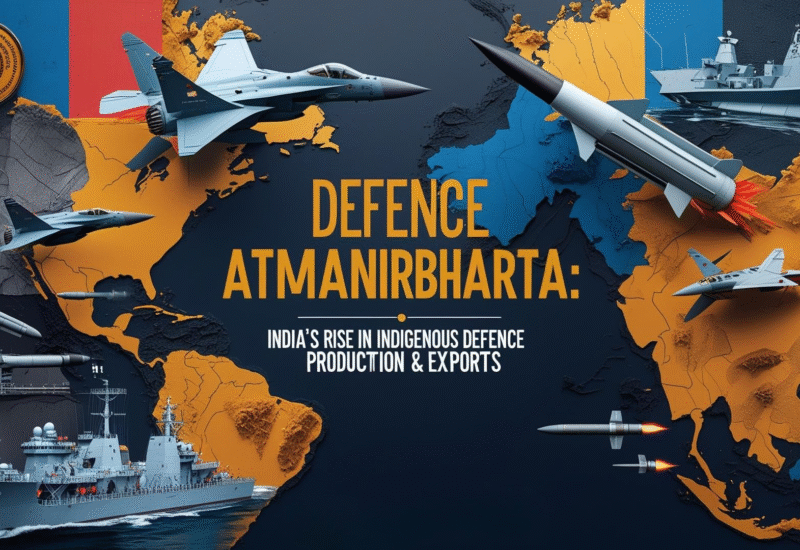
Defence Atmanirbharta: Record Production & Exports

Defence Atmanirbharta: Record Production & Exports   Context India’s defence sector is undergoing rapid indigenisation under Aatmanirbhar Bharat, aiming to reduce import dependence, enhance exports, strengthen R&D, and enable private sector + MSME participation.   Key Achievements Highest-ever defence production ₹1.54 lakh crore (FY 2024–25). Indigenous production ₹1,27,434 crore in FY 2023–24 (174% rise from 2014–15). Defence exports reached ₹23,622 crore (FY 2024–25), up from less than ₹1,000 crore in 2014. Private sector share increased to 23%; DPSUs contribute ~77%. 788 industrial licences issued to 462 companies; 16,000+ MSMEs onboarded.   Major Reforms Positive Indigenisation Lists, simplified licensing, and liberalised FDI (74% automatic). Defence Acquisition Procedure (DAP 2020) prioritises “Buy Indian‐IDDM”. Defence Procurement Manual (DPM 2025) promotes ease of doing business and transparency. iDEX, TDF, DIA-CoEs foster innovation, start-ups, and technology transfers.   Institutional Expansion Defence Industrial Corridors in UP and Tamil Nadu attracted investments worth ₹9,145+ crore. DRDO strengthening deep-tech ecosystem; ordnance factories reorganised into 7 DPSUs. Record 193 procurement contracts signed in FY 2024–25 worth ₹2,09,050 crore, majority to domestic vendors.   Defence Exports & Diplomacy Export basket includes bulletproof jackets, patrol boats, helicopters, radars, torpedoes, and subsystems. India now exports to 80+ countries including Armenia, U.S., and France. Export policy simplified via online authorisations, OGEL, and SOP reforms.   Budgetary Trends Defence budget rose from ₹2.53 lakh crore (2013–14) to ₹6.81 lakh crore (2025–26). Capital allocation for modernisation ₹1.72 lakh crore (2024–25), ensuring long-term capability development.   Targets Ahead Defence manufacturing target: ₹3 lakh crore by 2029. Defence export target: ₹50,000 crore by 2029.   Significance This shift strengthens national security, reduces strategic vulnerabilities, enhances global defence footprint, promotes technological sovereignty, and supports economic growth and employment generation. Practice :   Q1. Which category receives the highest priority under India’s defence procurement framework? (a) Buy (Global) (b) Buy (Indian-IDDM) (c) Buy & Make (Global) (d) Make (III)   Q2. What was India’s recorded defence production in FY 2024–25? (a) ₹1.27 lakh crore (b) ₹1.54 lakh crore (c) ₹23,622 crore (d) ₹2.09 lakh crore   Q3. What was India’s defence export figure in FY 2024–25? (a) Less than ₹1,000 crore (b) ₹15,209 crore (c) ₹23,622 crore (d) ₹54,000 crore   Q4. India’s major push for indigenous defence manufacturing is primarily linked to which initiative? (a) Skill India (b) Aatmanirbhar Bharat (c) Digital India (d) Sagarmala   Q5. Defence Industrial Corridors in India are located in: (a) Gujarat and Maharashtra (b) Uttar Pradesh and Tamil Nadu (c) Rajasthan and Karnataka (d) Delhi and Telangana   Q6. The primary aim of the Defence Acquisition Procedure (DAP) 2020 is: (a) Reducing defence exports (b) Enhancing speed and transparency in procurement (c) Privatizing all defence PSUs (d) Reducing the capital defence budget   Q7. The automatic route FDI limit in India’s defence sector is: (a) 26% (b) 49% (c) 74% (d) 100%   Q8. Which reform eased defence exports through digital processing and simplified licensing? (a) Digital India Portal (b) OGEL and end-to-end online export authorisation system (c) GST Exemption Scheme (d) Global Tender Relaxation   Q9. India now exports defence products to more than: (a) 20 countries (b) 40 countries (c) 60 countries (d) 80 countries   Q10. The purpose of the iDEX programme is to: (a) Promote global purchases (b) Encourage start-ups & MSME-led defence innovation (c) Subsidize foreign defence OEMs (d) Support only large PSUs   Q11. How many defence procurement contracts were signed in FY 2024–25? (a) 120 (b) 152 (c) 193 (d) 350   Q12. India’s defence budget for FY 2025–26 stands at: (a) ₹2.53 lakh crore (b) ₹6.81 lakh crore (c) ₹1.72 lakh crore (d) ₹9.15 lakh crore   Q13. Around what percentage of defence equipment is now manufactured domestically? (a) 20% (b) 30% (c) 50% (d) 65%   Q14. The major boost in India’s export sector is largely driven by: (a) Agriculture Technology (b) Private sector and MSMEs (c) Railway manufacturing units (d) Tourism sector   Q15. India’s defence export target for 2029 is: (a) ₹20,000 crore (b) ₹25,000 crore (c) ₹35,000 crore (d) ₹50,000 crore  

More Details

Free IAS Guidance
Start Your Journey Today 🇮🇳

Fill out the form below, and we will be in touch shortly.