Best UPSC and MPPSC IAS Coaching Classes in Gwalior

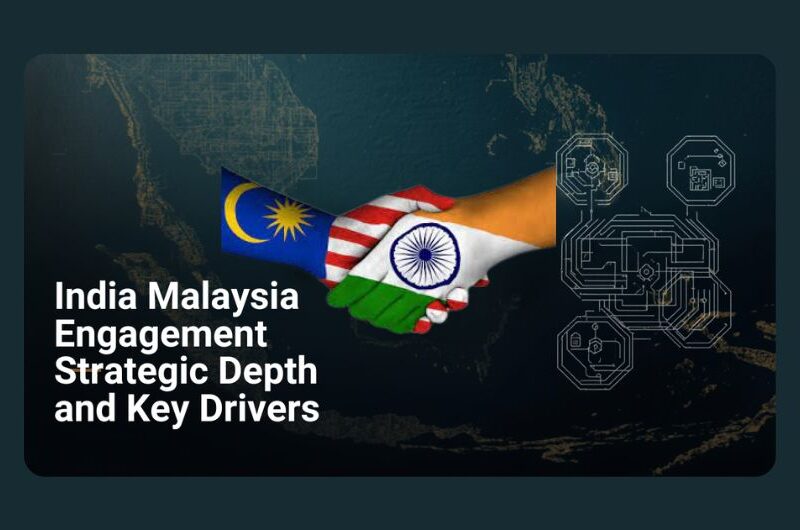
India Malaysia Engagement Strategic Depth and Key Drivers

India Malaysia Engagement Strategic Depth and Key Drivers 1. On 8 February 2026, Prime Minister Narendra Modi completed a two-day official Malaysia visit, closely reinforcing the Comprehensive Strategic Partnership formed in 2024 with Prime Minister Anwar Ibrahim. 2. India frames Malaysia ties through Act East Policy, Indo-Pacific Vision, and MAHASAGAR Vision (Mutual and Holistic Advancement for Security and Growth Across Regions), highlighting maritime neighbour synergy overall. 3. India–Malaysia relations were upgraded to Enhanced Strategic Partnership in 2015, while diplomatic relations formally began in 1957 after Malayan independence on 31 August 1957, showing long continuity early. 4. Modi received ceremonial welcome and guard of honour at Perdana Putra, Putrajaya; Anwar Ibrahim welcomed him at Kuala Lumpur airport, clearly signalling strong personal chemistry, trust, and diplomacy. 5. Leaders reviewed cooperation on trade, investment, defence, security, and digital technology across key sectors; an Audio-Visual Co-production Agreement was officially signed to promote joint film and media production. 6. Memorandums of Understanding (MoUs) on disaster preparedness and other cultural-commercial areas were discussed; Malaysia formally pledged support for India’s bid in a reformed United Nations Security Council explicitly. 7. Both sides see scope in counter-terrorism, intelligence sharing, and maritime security, with India reaffirming commitment to regional peace, security, stability, and coordinated Indo-Pacific engagement initiatives bilaterally, mutual convergence. 8. India supports ASEAN Centrality and seeks synergy between AOIP (ASEAN Outlook on the Indo-Pacific, 2019) and IPOI (Indo-Pacific Oceans Initiative, 2019) for rules-based cooperation, capacity-building, connectivity, and stability. 9. MAHASAGAR (Mutual and Holistic Advancement for Security and Growth Across Regions) is described as an Indian Navy-led capacity initiative for Indian Ocean littorals; Malaysia partnership further strengthens it. 10. Malaysia’s position on the Strait of Malacca makes it pivotal; about 40% of global trade transits this chokepoint linking Indian Ocean-Andaman Sea to Pacific-South China Sea routes daily. 11. China’s dependence is high: around 80% of its trade and oil imports pass Malacca; vulnerability was termed the “Malacca Dilemma” in 2003, shaping major strategic competition regional planning. 12. Both reaffirmed rules-based maritime order and adherence to UNCLOS (United Nations Convention on the Law of the Sea) 1982, emphasising freedom of navigation, overflight, and international law commitments. 13. Trade architecture includes CECA (Comprehensive Economic Cooperation Agreement) signed 2011; Malaysia supports AITIGA (ASEAN-India Trade in Goods Agreement) review due to India’s widening deficit and persistent non-tariff barriers. 14. Semiconductor cooperation is key: Malaysia ranks sixth globally in semiconductor exports; a framework pact aims to link India’s chip design strengths with Malaysia’s assembly, testing, packaging ecosystem capabilities. 15. India Semiconductor Mission 2.0 launched February 2026 targets 70–75% domestic demand by 2029, advanced 2-nanometre and 3-nanometre nodes, ₹1,000 crore budget, and $100 billion projected market by 2030.   Must Know Terms : 1. Putrajaya: Putrajaya is Malaysia’s planned federal administrative capital, located south of Kuala Lumpur. Key government complexes, including Perdana Putra, the Prime Minister’s Office, are based here. During PM Modi’s February 2026 visit, the ceremonial welcome and guard of honour took place at Perdana Putra in Putrajaya, and the main bilateral meeting with PM Anwar Ibrahim was held there. 2. MAHASAGAR: MAHASAGAR stands for Mutual and Holistic Advancement for Security and Growth Across Regions. It is presented as an Indian Navy-led security initiative focused on harmonising capacity among Indian Ocean Rim littoral states. In the Malaysia context, it is aligned with AOIP and IPOI, while Malaysia’s partnership adds synergy for maritime security cooperation and regional stability. 3. AOIP: AOIP means ASEAN Outlook on the Indo-Pacific, adopted by ASEAN in 2019. It is framed as a regional cooperation guide that stresses a rules-based order and strengthens ASEAN Centrality. India seeks closer alignment between AOIP and IPOI, linking shared priorities such as peace, stability, maritime cooperation, connectivity, and practical collaboration across Indo-Pacific stakeholders. 4. IPOI: IPOI is the Indo-Pacific Oceans Initiative, launched by PM Modi in 2019 at the East Asia Summit. It supports a rules-based architecture and focuses on maritime security, trade, disaster management, and capacity-building. In India–Malaysia engagement, IPOI serves as a bridge to work with ASEAN’s AOIP, reinforcing coordinated approaches to regional stability and maritime cooperation. 5. AITIGA: AITIGA is the ASEAN-India Trade in Goods Agreement, signed in 2009 and in force since 2010. India is pushing a review because its trade deficit with ASEAN widened, and issues exist on non-tariff barriers and rules-of-origin transparency. Malaysia supports the review, aiming to update AITIGA for modern trade practices, complementing India–Malaysia CECA signed in 2011. 6. Chokepoint: A chokepoint is a narrow strategic passage where trade concentrates. The Strait of Malacca is a decisive chokepoint, with about 40% of global trade transiting it, linking the Indian Ocean via the Andaman Sea to the Pacific via the South China Sea. Around 80% of China’s trade and oil imports pass here; this vulnerability was termed the Malacca Dilemma in 2003.   MCQ 1. The official visit of Prime Minister Narendra Modi to Malaysia in February 2026 primarily reinforced which bilateral framework established in 2024? A. Strategic Defence Alliance B. Comprehensive Strategic Partnership C. Economic Security Treaty D. Indo-Pacific Military Pact 2. India frames its relations with Malaysia through which combination of policy visions? A. Neighbourhood First Policy and SAARC Charter B. Act East Policy, Indo-Pacific Vision and MAHASAGAR Vision C. Look West Policy and Gulf Strategy D. Indo-Pacific Economic Framework and Quad Charter 3. Diplomatic relations between India and Malaysia formally began in which year? A. 1947 B. 1950 C. 1957 D. 1962 4. India–Malaysia relations were upgraded to Enhanced Strategic Partnership in: A. 2005 B. 2010 C. 2015 D. 2020 5. Perdana Putra, the venue of the ceremonial welcome during the visit, is located in: A. Kuala Lumpur B. Johor Bahru C. Putrajaya D. Penang 6. Which agreement was signed to encourage collaboration in film and media production? A. Cultural Exchange Protocol B. Audio-Visual Co-production Agreement C. Creative Media Partnership Treaty D. ASEAN Cultural Integration Agreement 7. Which international reform initiative received Malaysia’s support during the discussions? A. India’s bid for BRICS expansion B. India’s candidature for WTO leadership C. India’s bid for

More Details
High-Impact Highlights of the India–Russia Summit

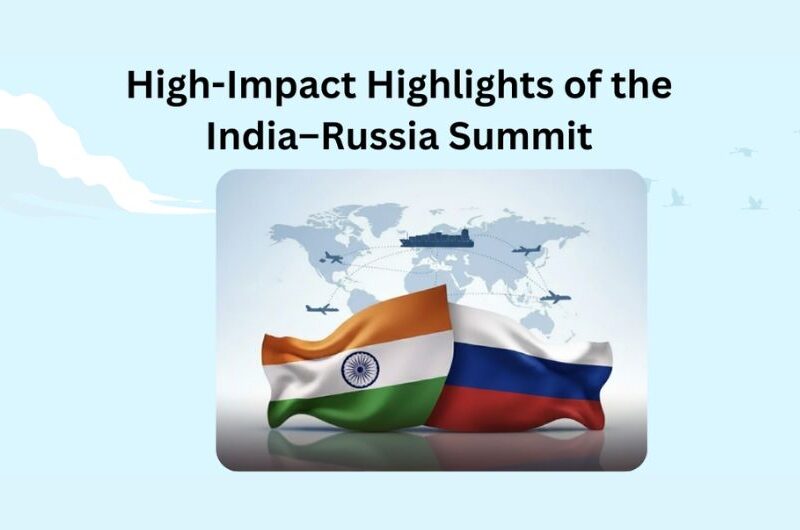
High-Impact Highlights of the India–Russia Summit   1. Summit held in New Delhi on 4–5 December 2025 reaffirmed India–Russia ties amid Ukraine talks and United States pressure on Russian crude purchases, emphasising strategic autonomy and partnerships. 2. Two-way trade in 2024–25 reached 68.69 billion United States dollars (USD): Russian exports 63.3 billion USD, Indian exports 4.8 billion USD, highlighting a persistent deficit needing diversification significantly. 3. Leaders adopted Programme 2030: Programme for Development of Strategic Areas of India–Russia Economic Cooperation till 2030, to boost investment, high technology, and raise Indian merchandise exports into Russia. 4. Free Trade Agreement (FTA) talks with the Eurasian Economic Union (EAEU) were reiterated, but only “intensified negotiations” were promised; no finalisation timeline was announced in the joint statement. 5. Agreement on Migration and Mobility signed to supply skilled Indian workers as Russia faces labour shortages; Indian work permits rose from 5,480 in 2021 to 36,208 in 2024. 6. Parallel pact to curb irregular migration aims for verified contracts, worker protection, and structured channels, reducing exploitation risks while meeting Russia’s manpower needs during war-linked demographic stress today. 7. Maritime corridors were reaffirmed: International North–South Transport Corridor (INSTC), Northern Sea Route (NSR), and Chennai–Vladivostok Maritime Corridor, intended to cut shipping time, lower costs, and improve resilience significantly. 8. Both sides agreed to train Indian seafarers for polar waters operations, supporting Arctic logistics capability and enabling India to diversify supply routes beyond traditional chokepoint-dependent maritime pathways safely. 9. Customs protocol signed for information exchange and streamlined controls; both committed to expanding national-currency settlement mechanisms. President Putin said about 96% of bilateral trade uses this payment system. 10. Defence cooperation stayed central, with push for more joint production. Energy agenda included assurance of uninterrupted crude supply and expansion of civil nuclear cooperation for cleaner diversified power. 11. Kudankulam project: accelerate work on four additional nuclear reactors and explore another similar site, strengthening India’s low-carbon electricity roadmap and long-term energy security under bilateral cooperation for decades. 12. Fertiliser security highlighted: imports from Russia surged 82% year-on-year to 10.2 billion USD during April–October 2025, supporting Indian agriculture that employs over 40% of workers nationally and productivity. 13. Memorandum of Understanding (MoU) signed with JSC UralChem and Indian partners Rashtriya Chemicals and Fertilisers (RCF), National Fertilisers Limited (NFL), and Indian Potash, for urea manufacturing in Russia. 14. Media cooperation agreements expanded content and broadcasting exchange; President Putin inaugurated RT India (Russia Today India) channel, while encouraging Indian media offices in Russia to balance presence better. 15. Key challenges flagged: trade imbalance, market access, Arctic and Far East projects, delayed corridors, and Western pressure. Cooperation in BRICS and SCO was urged to strengthen multipolar outcomes.     Must Know Terms : 1.Rouble: Rouble (RUB) is Russia’s national currency, issued by the Bank of Russia. In the summit context, India–Russia trade increasingly uses national-currency settlement; Putin said about 96% of bilateral trade is settled via such mechanisms. Settlement often pairs rupee–rouble accounts through designated banks, reducing reliance on US dollars and easing sanction-related payment frictions, while creating conversion and repatriation constraints today.   2.Seafarers: Seafarers are trained maritime crew certified under the IMO STCW system (International Maritime Organization Standards of Training, Certification and Watchkeeping). India supplies many officers and ratings globally. The summit outcome included training Indian seafarers for polar-water operations, relevant for Northern Sea Route shipping. Polar routes need ice-navigation skills, cold-weather safety, and specialized vessel procedures, increasing employability and corridor readiness today.   3.Corridor: Corridor here means a defined multimodal logistics route. Three India–Russia corridors were reaffirmed: INSTC (International North–South Transport Corridor), NSR (Northern Sea Route), and Chennai–Vladivostok Maritime Corridor. These aim to shorten distance and time versus traditional routes. Progress remains slow despite years of discussion. Seafarer training and customs information exchange are intended to make corridor operations more practical and bankable today.   4.Customs: Customs agencies control cross-border movement of goods, apply tariffs, enforce prohibitions, and manage risk-based inspections. The summit referenced a protocol to enhance customs cooperation and information exchange, intended to streamline trade flows and optimise control procedures. For India–Russia trade growth, faster clearance, standardised documentation, and data sharing can reduce dwell time and logistics costs. Coordination also supports national-currency settlement compliance.   5.UralChem: UralChem (JSC UralChem) is a major Russian fertiliser producer. Reuters reported Indian fertiliser firms signing a deal with UralChem to set up a urea manufacturing joint venture in Russia. The summit-linked MoU involved RCF (Rashtriya Chemicals and Fertilisers), NFL (National Fertilisers Limited), and Indian Potash. Fertiliser imports from Russia rose 82% year-on-year to USD 10.2 billion in Apr–Oct 2025.   6.Mobility: Mobility refers to cross-border movement of workers. India and Russia signed an Agreement on Migration and Mobility and a pact to prevent irregular migration. Russia faces labour shortages linked to war and demographic decline. Work permits for Indians in Russia rose from 5,480 (2021) to 36,208 (2024). The framework targets legal entry, contracts, worker protection, and recruitment channels.     MCQ : 1. The India–Russia summit referred to here was held in New Delhi on: A) 4–5 December 2024 B) 4–5 December 2025 C) 14–15 January 2026 D) 22–23 February 2026 2. Two-way trade in FY 2024–25 is given as: A) USD 58.69 billion B) USD 63.30 billion C) USD 68.69 billion D) USD 73.69 billion 3. In FY 2024–25, Russian exports to India are stated at: A) USD 4.8 billion B) USD 36.2 billion C) USD 63.3 billion D) USD 96.0 billion 4. In FY 2024–25, Indian exports to Russia are stated at: A) USD 2.8 billion B) USD 4.8 billion C) USD 10.2 billion D) USD 68.69 billion 5. “Programme 2030” refers to: A) A 2030 defence exercises calendar B) A programme for development of strategic areas of economic cooperation till 2030 C) A roadmap to finalise EAEU FTA within 12 months D) A plan to open 2030 new trade corridors 6. FTA talks reiterated in the summit were with: A) European Union B) ASEAN C) Eurasian Economic Union (EAEU) D) African Union 7. Indian work permits in Russia are

More Details

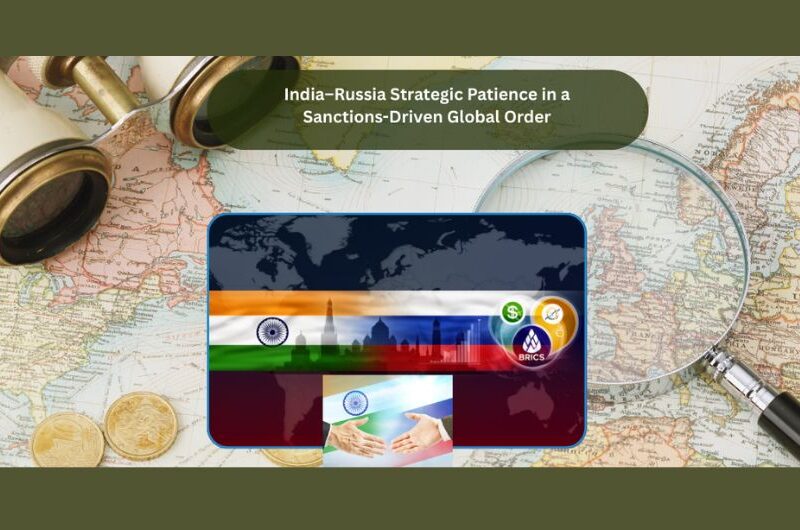
India–Russia Strategic Patience in a Sanctions-Driven Global Order

India–Russia Strategic Patience in a Sanctions-Driven Global Order   1. India and Russia are positioned as long-standing, self-reliant partners, expected to rely primarily on domestic capacity plus stable bilateral ties. 2. BRICS and the SCO are treated as practical platforms through which India–Russia cooperation can be scaled beyond the bilateral track. 3. External pressure is described as historically unable to decisively redirect the India–Russia political trajectory, even during major global shifts. 4. The 2022 rupture between Russia and the West is treated as a turning point; despite secondary-sanctions risk, bilateral trade is described as expanding sharply. 5. Summit-level messaging is framed as “economics-first”: concrete targets and deliverables are emphasized over broad political language. 6. The United States is described as moving from predictable risk to strategic uncertainty, increasing volatility for partners and rivals alike. 7. The U.S. is portrayed as shifting from free-trade promotion to tariff-centric trade conflict, affecting multiple countries simultaneously. 8. Russia and India are described as having built independent financial systems, reducing exposure to external financial coercion. 9. Both are described as digitising governance and economic life using domestic software and platforms to reduce critical dependence. 10. Military modernisation is treated as a shared trend, paired with diversification of suppliers where full self-reliance is not feasible. 11. The Ukraine track is described as more negotiable because core Russian interests are assumed to be non-negotiable, making talks the only workable path. 12. The sanctions environment is described as structurally persistent; the scale and breadth of restrictions make rapid rollback unlikely. 13. Even if conflict de-escalates, the post-2022 trade drivers are described as “sticky,” meaning they won’t reverse quickly. 14. Policy reversals in Washington are highlighted as a credibility risk; long-term agreements are treated as vulnerable to electoral change. 15. The closing argument is “strategic patience”: India and Russia are expected to manage pressure through endurance, institutional continuity, and multi-platform cooperation.   Must Know Terms : 1) Strategic Patience – Foreign policy approach based on long-term objectives rather than immediate tactical gains. – Often used by states facing sanctions, military pressure, or diplomatic isolation. – In India–Russia context, refers to maintaining steady engagement despite global shifts since 2022. – Linked to sustained bilateral trade growth even under secondary sanction risks. – Emphasises endurance in negotiations (e.g., Ukraine talks reference) rather than abrupt concessions.   2) Eurasian Security – Refers to security architecture covering Europe, Russia, Central Asia, and parts of East Asia. – Includes issues such as NATO expansion, Ukraine conflict, Central Asian stability, and energy corridors. – India and Russia cooperate through platforms like SCO to address terrorism, extremism, and regional instability. – Eurasia remains central due to land connectivity, energy pipelines, and strategic geography.   3) Sanctions Resilience – Ability of a country to absorb and adapt to economic sanctions. – Russia faced extensive Western sanctions post-2022; India maintained trade, especially energy imports. – Diversification of payment systems, currency settlements, and non-Western trade partners strengthens resilience. – Development of domestic financial systems and alternative supply chains reduces vulnerability.   4) SCO (Shanghai Cooperation Organisation) – Founded in 2001. – Members include China, Russia, India, Pakistan, Iran, and Central Asian states. – Focus areas: counter-terrorism, regional stability, economic cooperation. – Provides a Eurasian security dialogue platform outside Western-led institutions. – India became a full member in 2017.   5) BRICS – Group of Brazil, Russia, India, China, South Africa; expanded in 2024 to include additional members. – Focus: economic cooperation, development finance, multipolar global order. – Established New Development Bank (NDB) in 2014. – Promotes local currency trade and reduced reliance on Western financial systems. – Seen as platform for Global South coordination.   6) NATO (North Atlantic Treaty Organization) – Founded in 1949. – Collective defence alliance; Article 5 commits members to mutual defence. – Expanded eastward after Cold War, which Russia views as a strategic concern. – Central to European security architecture. – Mentioned in context of US policy shifts and debates over expansion and burden sharing.   MCQ: 1. India–Russia relations in the passage are primarily characterised as: A) Transactional and short-term B) Ideologically driven and alliance-based C) Long-standing and self-reliant D) Dependent on Western mediation 2. BRICS and SCO are portrayed mainly as: A) Military alliances against NATO B) Platforms to scale cooperation beyond bilateral ties C) Trade blocs replacing the WTO D) Crisis-management forums limited to Eurasia 3. External pressure on India–Russia ties is described as: A) Successfully reshaping their political trajectory B) Historically decisive in redirecting policy C) Unable to decisively alter long-term alignment D) Leading to complete diplomatic isolation 4. The 2022 Russia–West rupture is treated as: A) A temporary diplomatic misunderstanding B) A turning point with expanding bilateral trade despite sanctions risk C) A collapse of Eurasian trade D) A reversal of Global South cooperation 5. Summit-level messaging between India and Russia is framed as: A) Security-first B) Ideology-first C) Economics-first with concrete targets D) Symbolism-first without deliverables 6. The United States is described as shifting toward: A) Stable multilateral predictability B) Strategic uncertainty increasing volatility C) Neutral global disengagement D) Currency diplomacy dominance 7. The U.S. trade posture is portrayed as moving toward: A) Free-trade expansion B) Regional trade blocs C) Tariff-centric trade conflict D) Complete protectionist autarky 8. Financial cooperation between India and Russia is strengthened through: A) Exclusive reliance on SWIFT B) Adoption of Western clearing systems C) Independent financial systems reducing coercion exposure D) NATO-backed financial guarantees 9. Digitisation efforts are described as: A) Dependent on foreign software ecosystems B) Focused on reducing critical external dependence C) Limited to military networks D) Coordinated exclusively through NATO frameworks 10. Military modernisation in the passage is linked with: A) Full autarky in defence production B) Supplier diversification where self-reliance is limited C) Exclusive Western procurement D) Complete disengagement from arms imports 11. The Ukraine track is described as negotiable mainly because: A) All sides have unlimited flexibility B) Core Russian interests are assumed negotiable C) Talks are viewed as the only workable path D) NATO guarantees immediate

More Details

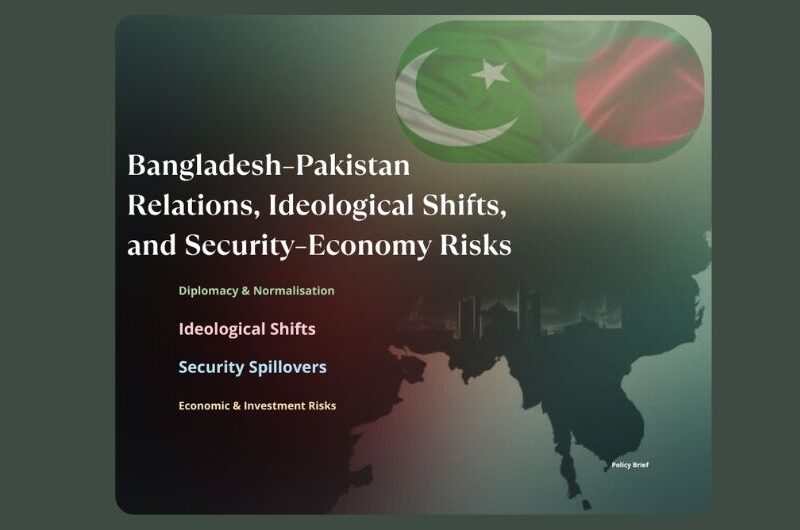
Bangladesh–Pakistan Relations, Ideological Shifts, and Security–Economy Risks

Bangladesh–Pakistan Relations, Ideological Shifts, and Security–Economy Risks   1. In 1974, Bangladesh and Pakistan established diplomatic relations under Sheikh Mujibur Rahman, despite discomfort among liberation supporters and war survivors, prioritising state interests, recognition, and stability. 2. From 1974 through 2025, relations persisted despite political upheavals; the Awami League governed roughly two decades, yet ties were never severed, indicating institutional continuity in Dhaka. 3. After Mujib’s assassination, Pakistan gained strategic benefit as orientations shifted; pro-Pakistan segments inside Bangladesh became more confident, and engagement rose when political Islam and anti-India narratives strengthened. 4. Official diplomacy maintained embassies, visas, and formal channels, but broad social trust remained limited, as 1971 memories stayed politically sensitive and symbolically charged across generations and institutions. 5. Pakistan avoided sustained outreach to Bangladesh’s progressive mainstream; cultural soft power like music, literature, and theatre was rarely leveraged, leaving engagement dominated by politics and symbolism. 6. Cricket became a high-visibility influence channel, especially during India–Pakistan fixtures, amplifying emotional mobilisation and sometimes sharpening anti-India sentiment within media discourse beyond conventional diplomatic messaging. 7. Legal travel to Pakistan can trigger future visa scrutiny elsewhere, discouraging students and professionals; reduced mainstream travel allows politically motivated networks to dominate cross-border contacts and narratives. 8. Concerns persist about clandestine financing via informal transfers, intermediaries, and smuggling corridors; early destabilisation tactics reportedly used ultra-left violence when overt religious militancy lacked domestic space. 9. From the 1980s onward, fundamentalist organisations increased visibility and external linkages; after 2024 upheavals, closer engagement coincided with stronger Islamist political influence in interim arrangements. 10. Bangladesh’s traditional Muslim practice blended Sufi devotion and riverine culture; Jamaat ideology draws on Maududi’s political Islam, prioritising state-centric order over plural social traditions. 11. Empowerment of hardline actors can pressure mainstream Muslims, minorities, and cultural practitioners; reports of attacks on temples and shrines signal contestation over heritage, freedom, and communal security. 12. Multiple militant organisations are reported operating in Bangladesh; leadership nodes in Pakistan enable training linkages and ideological diffusion across South Asian militant ecosystems over time. 13. Instability interacts negatively with investment confidence: growth slowed from about six percent to under four; FDI retreats, buyers reduce orders, and firms pivot toward trading over manufacturing. 14. Security spending can crowd out welfare, health, and education; border insecurity can trigger arms-spiral dynamics, while Teknaf disruptions and Rohingya camp violence heighten recruitment vulnerability. 15. Myanmar frontiers, coastal smuggling, Sundarbans policing challenges, and Hill Tracts fragility can compound risk; durable stability needs balanced diplomacy, pluralism, border management, and economic confidence.   Must Know Terms : 1.Normalisation and Institutional Continuity Normalisation and Institutional Continuity: “Normalisation” is the shift from ad-hoc, personality-driven rule to routine, rules-based governance where institutions keep functioning across leadership changes. A widely used cross-country proxy is the World Bank’s Worldwide Governance Indicators (WGI), published annually since 1996 and covering 200+ economies through 2024. WGI aggregates 35 data sources into six comparable dimensions (Voice & Accountability, Political Stability, Government Effectiveness, Regulatory Quality, Rule of Law, Control of Corruption), allowing continuity to be tracked year-on-year. 2.Soft Power and Selective Appeal Soft Power and Selective Appeal: Soft power is the ability to secure preferred outcomes through attraction rather than coercion or payment. Quantification is now routine: Brand Finance’s Global Soft Power Index 2025 measures all 193 UN member states via public perception scoring. In 2025, the United States ranked #1 with an overall score of 79.5/100; China ranked #2 with 72.8/100; the UK ranked #3. “Selective appeal” means a state’s attractiveness is not uniform—scores can mask sharp differences by audience, region, or issue-pillar. 3.Informal Finance and Covert Networks Informal Finance and Covert Networks: Informal value transfer systems (IVTS) like hawala move value without conventional bank settlement, often using brokers and netting across locations. The IMF and World Bank have documented hawala as a major informal funds-transfer channel, particularly in the Middle East and South Asia, and a policy focus post-9/11 due to misuse risks. FATF typologies classify “hawala and similar service providers” and document how weak licensing/registration, thin records, and limited suspicious-transaction reporting make them vulnerable to money laundering and terrorist financing when unregulated or complicit. 4.Maududism and Political Islam Maududism and Political Islam: Maududism refers to the political thought associated with Mawlana Abul A‘la Mawdudi (1903–1979), who founded Jamaʿat-i Islami in 1941. Britannica notes his core political project was reforming society toward an Islamic political system and influencing Pakistan’s constitutional direction after 1947. His writings popularised modern Islamist vocabulary around God’s sovereignty as the source of law, an Islamic state as an organising principle, and party-based cadre mobilisation for societal Islamisation through education, organisation, and politics. 5.Investment Confidence and Manufacturing Horizon Investment Confidence and Manufacturing Horizon: A hard metric for forward-looking investor intent is the Kearney FDI Confidence Index (FDICI), which ranks markets likely to attract the most FDI over the next three years. The 2025 FDICI is based on a proprietary survey of 536 senior executives (surveyed January 2025), all from firms with US$500 million+ annual revenues, headquartered in 30 countries across sectors. “Manufacturing horizon” in practice reflects this planning window: capex decisions lock in supply-chain geography, permitting, and workforce ramp-up typically over multi-year (often 2–5 year) cycles. 6.Border-Security Spillovers Border-Security Spillovers: Cross-border security shocks routinely spill into refugee flows, smuggling corridors, and fiscal/administrative stress in neighbouring states. UNHCR reports that by end-2024, 123.2 million people were forcibly displaced worldwide; reported refugees total 42.7 million. These displacement magnitudes become border-security variables: screening capacity, camp logistics, policing of trafficking networks, and management of grey-zone flows (cash, fuel, arms, narcotics) along frontier districts, especially when conflicts persist without political settlement. MCQ   1. Bangladesh and Pakistan established diplomatic relations in: (a) 1965 (b) 1971 (c) 1974 (d) 1985 2. The text states relations persisted from 1974 through: (a) 2010 (b) 2015 (c) 2020 (d) 2025 3. Cricket is described as influencing sentiment mainly during: (a) Bangladesh–Sri Lanka fixtures (b) India–Pakistan fixtures (c) Australia–England fixtures (d) IPL auctions 4. Legal travel to Pakistan may discourage mainstream travel because it can: (a) Lower fuel prices (b) Trigger future visa scrutiny elsewhere

More Details

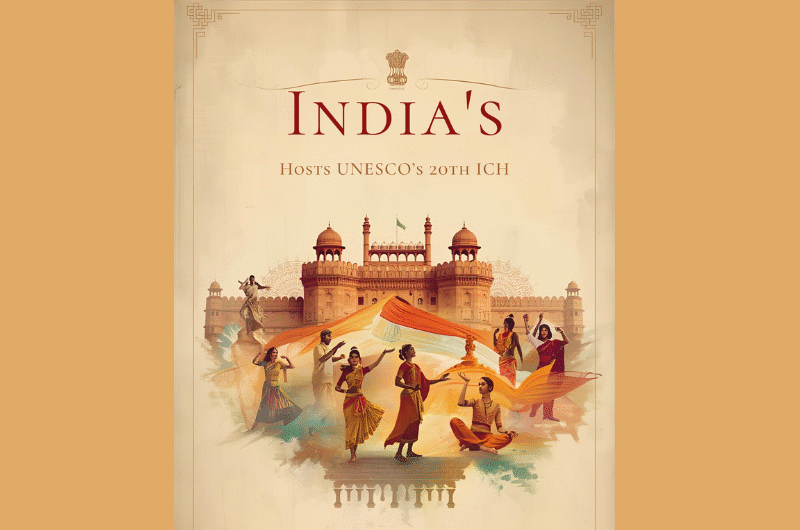
India Hosts UNESCO’s 20th ICH Session

India Hosts UNESCO’s 20th ICH Session     India will host the 20th session of the UNESCO Intergovernmental Committee for Safeguarding of the Intangible Cultural Heritage from 8 to 13 December 2025 at the Red Fort in New Delhi. This is the first time the session will be held in India, and the event aligns with the twentieth anniversary of India’s ratification of the 2003 Convention. The venue, a UNESCO World Heritage Site, symbolically brings together tangible and intangible heritage.   The 2003 Convention, adopted during UNESCO’s 32nd General Conference in Paris, was established to address global concerns about the vulnerability of living cultural traditions under pressures such as globalisation, rapid social change and limited resources. The Convention recognises that communities, including indigenous groups and traditional practitioners, play the central role in preserving and transmitting intangible heritage. It seeks to safeguard practices, rituals, performing arts, festive events, craftsmanship, oral traditions and knowledge systems that shape cultural identity.   The Intergovernmental Committee functions as the primary body responsible for ensuring the effective implementation of the Convention. Its responsibilities include promoting the objectives of the Convention, reviewing best practices, recommending safeguarding measures, overseeing the Intangible Cultural Heritage Fund, drafting operational directives, assessing periodic reports submitted by States Parties and examining requests for inscription on various heritage lists. It also evaluates requests for international assistance and prepares plans for the Fund’s utilisation. India has already served three terms on the Committee.   By hosting the 20th session, India aims to present its heritage safeguarding framework, which emphasises institutional support, sustained documentation, national inventory efforts and direct involvement of communities. The session provides a platform to strengthen international cultural cooperation through joint nominations, shared safeguarding initiatives, capacity-building programmes and technical collaboration. It also offers an opportunity to enhance global visibility for India’s traditional practices, local crafts, regional festivals and community-based knowledge systems. The event encourages domestic initiatives such as documentation, youth engagement, preparation of nomination dossiers and revitalisation of cultural expressions.   India’s intangible heritage represents a wide spectrum of traditions embedded in social customs, ritual practices, performing arts, festive celebrations, oral literature and craftsmanship. Fifteen Indian elements have been inscribed on UNESCO’s Representative List, including Kutiyattam, Chhau, Ramlila, Vedic chanting, Buddhist chanting in Ladakh, Sankirtana, Kalbelia dance, Durga Puja, Garba, Kumbh Mela, Yoga, Novruz (shared), Ramman and the metalcraft of the Thatheras of Jandiala Guru. For the current cycle, India has nominated Chhath Mahaparva and Diwali.   To strengthen preservation efforts, the Ministry of Culture has implemented the Scheme for Safeguarding the Intangible Heritage and Diverse Cultural Traditions of India. The scheme supports documentation, inventory creation, preparation of UNESCO nomination dossiers, training programmes, capacity building, workshops, performances, dissemination initiatives and integration of cultural knowledge into education. It extends assistance to practitioners, researchers, universities, cultural organisations and state institutions. The Sangeet Natak Akademi contributes significantly through awareness programmes, training workshops and promotion of performing arts traditions.   India’s intangible heritage contributes to social cohesion, cultural continuity, livelihood generation and intergenerational knowledge transmission. It sustains the crafts economy, supports performing communities, strengthens cultural identity and enhances tourism potential. It also plays a major role in cultural exchange and strengthens the nation’s cultural presence abroad. Hosting the 20th session underscores India’s long-standing commitment to heritage preservation and offers an opportunity to influence global discourse on safeguarding living traditions.   The upcoming session is expected to deepen international collaboration, highlight India’s diverse cultural expressions and reinforce efforts to ensure that traditional knowledge, practices and art forms continue to thrive for future generations.     MCQ:   The venue selected for hosting the 20th session of the UNESCO Intergovernmental Committee for Safeguarding of Intangible Cultural Heritage is: Humayun’s Tomb, Delhi Red Fort, New Delhi City Palace, Jaipur Golconda Fort, Hyderabad   The 2003 Convention for Safeguarding of the Intangible Cultural Heritage was adopted during UNESCO’s General Conference held in: Geneva Paris Rome Vienna   The 20th session of the ICH Committee coincides with: India’s independence centenary India’s first ICH inscription anniversary Twentieth anniversary of India’s ratification of the 2003 Convention Fiftieth anniversary of UNESCO’s creation   Under the 2003 Convention, safeguarding intangible heritage places primary importance on: National governments alone Private organisations Communities and practitioners Commercial sponsors   Which of the following is NOT a function of the Intergovernmental Committee? Monitoring implementation of the Convention Approving World Heritage Sites Drafting operational directives Evaluating nomination requests for ICH Lists   India has served on the UNESCO Intergovernmental Committee for Safeguarding ICH for: One term Two terms Three terms Four terms   The Scheme for Safeguarding the Intangible Heritage and Diverse Cultural Traditions of India is implemented by: Ministry of External Affairs Ministry of Culture Ministry of Education NITI Aayog   The Sangeet Natak Akademi plays a key role primarily in: Archaeological excavation Promoting capacity building and awareness for ICH Trade facilitation measures Managing national archives   Which of the following is among India’s nominations for UNESCO’s ICH List for the current cycle? Holi and Onam Chhath Mahaparva and Diwali Bihu and Pongal Rath Yatra and Guruparv   Which Indian element is included on UNESCO’s Representative List of Intangible Cultural Heritage? Kathakali murals of Kerala Garba of Gujarat Terracotta temples of Bishnupur Ajanta cave paintings   The 2003 Convention addresses threats arising from: Climate treaties Globalisation and rapid social change International trade barriers Radioactive pollution   The Intangible Cultural Heritage Fund is primarily used for: Military support Global economic reforms Safeguarding measures and international assistance Infrastructure development   The Red Fort was chosen as the session venue because it symbolises: Technological progress Convergence of tangible and intangible heritage India’s maritime strength Expansion of trade routes   The Ministry of Culture’s ICH scheme supports: Patent registration for industries Documentation, inventory creation and training for ICH practitioners Agricultural mechanisation Space technology missions   Elements such as Kutiyattam, Chhau dance, and Vedic chanting represent: Modern industrial practices Living cultural traditions inscribed under UNESCO’s ICH framework Geological formations of India Intangible assets in financial markets

More Details

Free IAS Guidance
Start Your Journey Today 🇮🇳

Fill out the form below, and we will be in touch shortly.